Amorphous Solid (original) (raw)
Last Updated : 23 Jul, 2025
**Amorphous Solid is a type of solid matter characterized by the absence of a well-defined crystalline structure. The word amorphous means "having no definite form." Unlike crystalline solids, which exhibit a highly ordered and repeating three-dimensional lattice arrangement of atoms or molecules, amorphous solids lack long-range order.
In this article, we are going to discuss, amorphous solids in detail, We will also discuss the definitions, types, formations, and applications of amorphous solids.
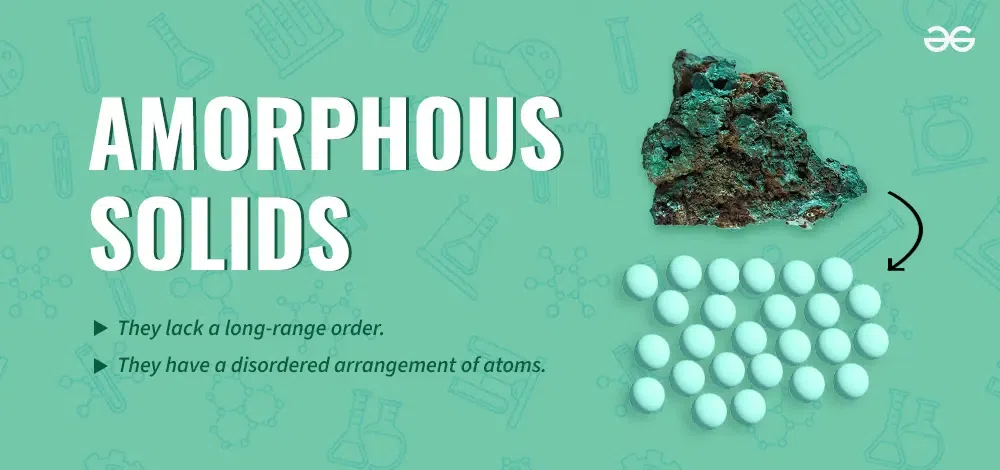
Table of Content
- What is an Amorphous Solid?
- Properties of Amorphous Solids
- Formation of Amorphous Solids
- Examples of Amorphous Solid
- Applications of Amorphous Solids
- Amorphous Solid Vs Crystalline Solids
What is an Amorphous Solid?
Amorphous solids are shapeless solids. They are made up of irregularly arranged particles. In amorphous solid, there exist short-range order off arrangement of constituent particles (atoms, molecules, or ions). In short range arrangement, regular and periodically repeating pattern observed only over short distances.
Unlike crystalline solids, which have a highly organized and regular arrangement of particles, amorphous solids exhibit a more random and disordered structure. In amorphous solids, the constituent particles (atoms, molecules, or ions) are arranged in a more chaotic fashion, lacking long-range order.
Definition of Amorphous Solids
Amorphous solids are a type of solid material that lacks a well-defined, ordered, and repeating atomic or molecular structure.
Properties of Amorphous Solids
Amorphous Solid exhibits following properties:
- Lack of long range order
- Isotropic in nature
- Supercooled Liquids
- No sharp melting and boiling point
- Undergoes irregular cleavage
Let's learn these properties in detail
Lack of long range order
In amorphous solids, the lack of long-range order of arrangement of particles. This means periodic arrangements of atoms or molecules do not extend over large distances. This short-range order gives rise to some degree of rigidity and stability in amorphous materials.
Amorphous Solids are Isotropic
Isotropic means the physical properties such as refractive index etc. when measured along different direction inside the solid, the value is same. The isotropic nature of amorphous solid is credited to its short arrange order arrangement of atoms. Unlike crystalline solids, which have a well-defined repeating pattern, amorphous solids have a disordered arrangement of atoms or molecules. Examples of amorphous solids include glass and some polymers.
No sharp melting Point
Amorphous Solids have no sharp and fixed melting point. The absence of a sharp melting point is due to the disordered nature of the amorphous structure. Different regions of the material may undergo the transition to a more fluid state at slightly different temperatures. Hence, amorphous solids broader range of melting point.
Amorphous Solids are Supercooled Liquid
Amorphous Solids are although solids but its molecules have tendency to flow under gravity over a longer period of time. Hence, they are called supercooled liquids. To convert a material into an amorphous solid (glass), heat it to a molten state and rapidly cool it through quenching. This prevents the formation of a crystalline structure. The amorphous solid forms during this rapid cooling process, exhibiting properties such as transparency and a lack of cleavage planes.
Mechanical Properties
The mechanical properties of amorphous solids differ from those of crystalline solids due to their disordered atomic or molecular structure. Amorphous solids can have high strength and hardness. The absence of crystal defects and dislocations contributes to their mechanical integrity. This can make them suitable for certain applications where strength is essential. Many amorphous solids are brittle, meaning they tend to fracture without significant plastic deformation.
Thermal Properties
Amorphous solids, like other materials, undergo thermal expansion when heated. The thermal properties of amorphous solids, like any other material, are influenced by their structure, composition, and bonding characteristics. Amorphous materials exhibit different thermal expansion behaviour compared to crystalline materials.
Optical Properties
Amorphous solids typically have a refractive index different from that of crystalline materials. The optical properties of amorphous solids, like glass and certain polymers, are influenced by their non-crystalline structure. The refractive index of an amorphous solid is a measure of how much light is refracted (bent) as it enters the material. This property is essential for optical applications, including lenses, prisms, and optical fibers.
Types of Amorphous Solids
There are two types of amorphous solids based on their origin:
- Organic Amorphous Solids
- Inorganic Amorphous Solids
The details are discussed below:
Organic Amorphous Solids
Organic amorphous solids refer to a class of amorphous (non-crystalline) solids composed of organic (carbon-containing) molecules. These materials lack the long-range order and regular structure found in crystalline solids. They have a more disordered and random arrangement of their constituent molecules. Organic amorphous solids can exhibit a range of physical and chemical properties, making them versatile and useful in various applications
Inorganic Amorphous Solids
Inorganic amorphous solids are non-crystalline materials composed of inorganic (non-carbon-containing) compounds. Unlike crystalline solids, which have a highly ordered and repeating atomic or molecular structure, inorganic amorphous solids lack long-range order, exhibiting a more random and disordered arrangement of their constituent particles. These materials can have diverse properties and find applications in various fields.
Formation of Amorphous Solids
The formation of amorphous solids involves processes that prevent the material from adopting a well-defined crystalline structure, resulting in a disordered and random arrangement of particles. Several methods can be employed to create amorphous solids, and these methods vary depending on the type of material and the desired properties. Here are some common methods for the formation of amorphous solids:
- **Rapid Cooling:
- One of the most common methods is rapid cooling of a molten material. If a liquid is cooled quickly enough, the particles do not have sufficient time to arrange themselves into a regular crystalline lattice. This process is often used in the production of amorphous metals (metallic glasses) and certain types of glass.
- **Quenching:
- Quenching involves cooling a material rapidly from a high temperature to a lower temperature. This can be achieved by using cooling media such as water or oil. The sudden cooling prevents the particles from organizing into a crystalline structure, resulting in an amorphous solid.
- **Amorphization by Mechanical Methods:
- Mechanical methods, such as ball milling or high-energy milling, can introduce disorder into the structure of a material, leading to the formation of an amorphous phase. The mechanical energy disrupts the regular arrangement of particles, promoting an amorphous structure.
- **Sol-Gel Process:
- The sol-gel process involves the transformation of a solution (sol) into a gel and then solid material. By carefully controlling the conditions, such as temperature and concentration, it is possible to produce amorphous materials, including amorphous metal oxides and glasses.
- **Physical Vapour Deposition (PVD):
- Techniques like sputtering or evaporation under specific conditions can produce thin films of amorphous materials. The controlled deposition of atoms or molecules onto a substrate at low temperatures prevents the formation of a crystalline structure.
Examples of Amorphous Solid
Several common examples of amorphous solids include:
- **Glass: Glass is a classic example of amorphous solid. It is formed by rapidly cooling a molten material, typically a mixture of silica, soda ash, and limestone. It lacks a crystalline structure and exhibits transparency and a lack of cleavage planes.
- **Amorphous Metals (Bulk Metallic Glasses): Certain alloys can be quenched to form amorphous metals. These materials combine the strength of metals with the non-crystalline structure, resulting in unique mechanical properties.
- **Amorphous Polymers: Some polymers, when cooled rapidly from a molten state, can form amorphous structures. Examples include some types of plastics like polystyrene.
- **Amorphous Carbon: Certain forms of carbon, like soot or carbon black, lack a well-defined crystalline structure and can be considered amorphous.
- **Amorphous Silicon: Used in technologies like thin-film solar cells, amorphous silicon lacks the long-range order seen in crystalline silicon.
Applications of Amorphous Solids
Amorphous solids find a wide range of applications across various industries due to their unique properties and versatility. Some notable applications include:
- **Glass Products:
- The most common and well-known application of amorphous solids is in the production of glass. Windows, containers, glassware, and optical lenses are all made from different types of glass. The amorphous structure of glass allows it to be transparent or translucent, making it suitable for these applications.
- **Packaging Materials:
- Amorphous polymers, such as certain types of plastics, are extensively used in packaging materials. Their flexibility, durability, and ability to be molded into various shapes make them ideal for packaging food, beverages, and consumer goods.
- **Optical Fibers:
- Amorphous materials, particularly silica-based glasses, are used in the production of optical fibers for communication. The controlled refractive index and transparency of amorphous glass fibers make them essential for transmitting data over long distances.
- **Amorphous Metals (Metallic Glasses):
- Metallic glasses, also known as amorphous metals, have applications in various fields. They are used in electronics, as components in certain medical devices, and in the production of precision parts due to their unique combination of high strength, hardness, and elasticity.
Amorphous Solid Vs Crystalline Solids
Amorphous Solid and crystalline solids vary from each other in regard to order of arrange of particle. However there are other differences as well. The difference between amorphous and crystalline solid is tabulated below:
| **Crystalline Solid | **Amorphous Solid |
|---|---|
| A crystalline solid has well-arranged constituent particles. | Constituent particles of amorphous solids are not well arranged. |
| Crystalline solids are true solids. | Amorphous solids are pseudo-solids. |
| Crystalline solids are anisotropic. | Amorphous solids are isotropic. |
| Crystalline solids have a sharp melting point and begin to melt at a specific temperature. | Amorphous solids soften gradually over a temperature range and can be shaped into various shapes when heated. |
| The shapes are well defined and also particle arrangements of crystalline solids are well-defined. | The shape of amorphous solids is irregular and also particle arrangement is not well defined. |
| Crystalline solids when cut with the edge of a sharp tool, they split into two pieces and the newly formed surfaces are smooth and plain. | When amorphous solids are cut with a sharp edge tool, irregular surfaces are formed. |
Amorphous Solids Conclusion
In conclusion, amorphous solids represent a diverse class of materials characterized by a lack of long-range order in their atomic or molecular structure. Unlike crystalline solids, which possess a well-defined and repeating lattice arrangement, amorphous solids exhibit a more disordered and random structure. This distinctive feature gives rise to a range of unique properties that influence their mechanical, thermal, and optical behaviours.
**Also, Read