Aromatic Compounds (original) (raw)
Last Updated : 19 May, 2026
Aromatic compounds are a special class of hydrocarbons that contain one or more benzene rings. They are also known as arenes. These compounds are characterised by the presence of a cyclic, planar structure with delocalised π-electrons, which provides them with unusual stability. Due to this stability, aromatic compounds generally undergo substitution reactions rather than addition reactions.
Structure of Benzene
Benzene (C6H6) is a planar cyclic molecule consisting of six carbon atoms arranged in a hexagonal ring.
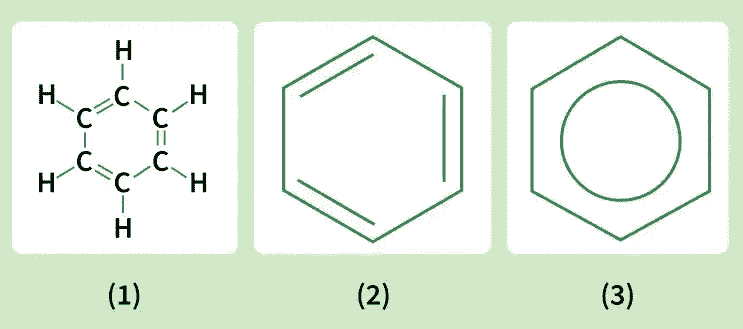
- Each carbon atom is sp2 hybridised and forms three σ bonds (two with adjacent carbon atoms and one with hydrogen).
- The six carbon atoms form a regular hexagon with bond angles of 120°.
- Each carbon has one unhybridized p orbital, which overlaps sideways to form a delocalised π-electron cloud above and below the plane of the ring.
- Due to this delocalisation, all C–C bonds in benzene are equal in length (≈139 pm), intermediate between single and double bonds.
- Benzene is best represented as a resonance hybrid of two Kekulé structures, which explains its extra stability.
**Aromaticity
Aromaticity is the property due to which certain cyclic compounds show unusual stability because of delocalisation of π-electrons over the ring.
- The compound must be cyclic, forming a closed ring structure.
- It should be planar so that proper overlap of p orbitals can take place.
- It must be fully conjugated, i.e., continuous overlap of unhybridised p orbitals throughout the ring.
- It must follow Hückel's Rule, having (4n + 2) π-electrons (where n = 0, 1, 2, …).
- Due to delocalisation of π-electrons, aromatic compounds have high stability.
- They generally undergo substitution reactions instead of addition reactions to preserve aromaticity.
IUPAC Nomenclature of Aromatic Compounds
Aromatic compounds are named using benzene as the parent compound, and substituents are named as prefixes according to their positions on the ring. Certain rules are followed:
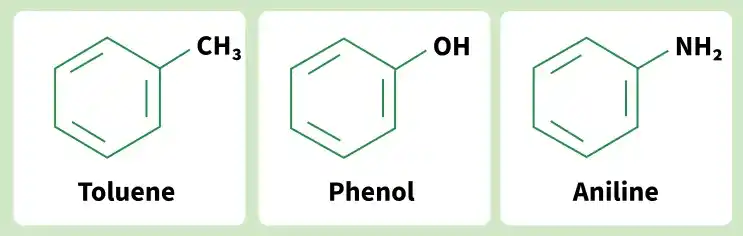
- **Monosubstituted aromatic compounds: When one substituent is present, the compound is named as substituent + benzene.
- Disubstituted aromatic compounds: Numbering is done to give lowest possible locants. When two substituents are present, their positions are indicated by: (a) 1,2- (ortho, o-) (b) 1,3- (meta, m-) (c) 1,4- (para, p-)
- **More than two substituents: Number the ring to give lowest set of locants, write substituents in alphabetical order, use numbers instead of o-, m-, p- .
- When side chain is longer: If the attached chain is more complex, the benzene ring is treated as a substituent (phenyl group).
**Physical Properties of Aromatic Compounds
Aromatic compounds show characteristic physical properties due to their non-polar nature and delocalised π-electrons
- **Physical state: Lower aromatic compounds like benzene are liquids, while higher members become solids. This is because intermolecular forces increase with size.
- **Solubility: Aromatic compounds are insoluble in water since they are non-polar, whereas water is polar. However, they dissolve easily in organic solvents such as ether, chloroform, and benzene due to similarity in polarity.
- **Boiling and melting points: These increase with increase in molecular mass due to stronger van der Waals forces. Also, compounds with more symmetrical structure generally have higher melting points because they pack better in solid form.
- **Density: Most aromatic hydrocarbons are lighter than water, but their density increases as molecular mass increases.
- **Odour and appearance: They are generally colourless and have a characteristic pleasant smell (hence the term “aromatic”).
Chemical Properties of Aromatic Compounds
Aromatic compounds (like benzene) are highly stable due to delocalised π-electrons. Because of this stability, they prefer electrophilic substitution reactions rather than addition reactions, since addition would destroy aromaticity.
**1. Nitration
In this reaction, benzene reacts with concentrated nitric acid in the presence of concentrated sulphuric acid to form nitrobenzene. Sulphuric acid acts as a reagent and helps in generating the nitronium ion (NO2+), which is the electrophile. This electrophile attacks the benzene ring and replaces a hydrogen atom.
C_6H_6 + HNO_3 \xrightarrow{conc.\ H_2SO_4} C_6H_5NO_2 + H_2O
2. Halogenation
Benzene reacts with chlorine or bromine in the presence of a Lewis acid catalyst such as FeCl3 or FeBr3. The catalyst helps in the formation of the electrophile (Cl⁺), which substitutes a hydrogen atom in the benzene ring.
C_6H_6 + Cl_2 \xrightarrow{FeCl_3} C_6H_5Cl + HCl
3. Sulphonation
Benzene reacts with fuming sulphuric acid (oleum) to form benzenesulphonic acid. The electrophile in this reaction is SO3, which attacks the benzene ring and replaces hydrogen.
C_6H_6 + SO_3 \xrightarrow{H_2SO_4} C_6H_5SO_3H
4. Friedel–Crafts Alkylation
In this reaction, an alkyl group is introduced into the benzene ring using an alkyl halide in the presence of AlCl3.The catalyst generates a carbocation (R⁺), which acts as the electrophile.
C_6H_6 + RCl \xrightarrow{AlCl_3} C_6H_5R + HCl
5. Friedel–Crafts Acylation
In this reaction, an acyl group (–COR) is introduced using acyl chloride in the presence of AlCl3. The electrophile is the acylium ion (RCO⁺). This reaction is useful for preparing aromatic ketones.
C_6H_6 + RCOCl \xrightarrow{AlCl_3} C_6H_5COR + HCl