Balancing Redox Reactions (original) (raw)
Last Updated : 23 Jul, 2025
**Redox Reactions are the reaction in which oxidation and reduction occur in the same reaction. Balancing redox reactions is the process in which we balance redox reaction equations using various methods. There are generally two methods that are used to balance redox reactions that include,
- Oxidation Number Method
- Ion Electron Method
Balancing redox reactions is very important because redox reactions are observed all around us and having the knowledge of balancing redox reactions helps us to achieve various things in our daily life. Before starting with balancing the redox reaction we have to first know what Redox Reactions are, Oxidation and Reduction reactions, and Balancing Redox reactions using the Oxidation Number method and Ion-Electron method, their examples, and others in detail.
Redox Reaction
The term "Redox Reaction" refers to a reaction in which both oxidation and reduction occur at the same time. So to learn more about Redox Reaction first learn about Oxidation and Reduction reaction.
**What is Oxidation?
- Addition of oxygen to a substance is called Oxidation.
- Removal of hydrogen from a substance is also called Oxidation.
**For Example, **2Cu + O 2 → 2CuO
In this reaction, oxygen is added to copper. Therefore, copper is **Oxidized.
**What is Reduction?
- Addition of hydrogen to a substance is called reduction.
- Removal of oxygen from a substance is also called reduction.
**For Example: CuO + H 2 → Cu + H 2 O
In this reaction, Oxygen is removed from copper oxide. Therefore, copper oxide (CuO) is **Reduced.
The gain of electrons is known as reduction, and the loss of electrons is known as oxidation. The redox reaction refers to the combination of reduction and oxidation reactions. In a redox reaction, there are two methods for balancing redox reactions. The Oxidation Number Method and the Half-Reaction Method.
Balancing of Redox Reactions
Chemical equations for redox processes are balanced using two ways. One technique is based on the oxidation number of the reducing and oxidizing agents changing, while the other method is based on splitting the redox reaction into two half-reactions, one involving oxidation and the other involving reduction. Both of these ways are in use, and it is up to the individual who uses them to decide which one to utilize.
Two methods are used to balance the redox reaction are,
- Oxidation Number Method
- Half Reaction Method(Ion Electron Method)
Now let's learn about them in detail.
**Oxidation Number Method
The composition and formulas for the reactants and products must be known when creating equations for oxidation-reduction processes. The oxidation number method is best demonstrated in the steps that follow:
While balancing redox reacction we need to be aware about the medium of the reaction. There are two mediums in which redox reaction are present, Acidic Medium and Basic Medium.
**Steps to Balance Redox Reaction in Acidic Medium by Oxidation Number Method
**Step 1: Assign the oxidation number to all elements in the reaction to identify atoms that change oxidation number during the reaction.
**How to Find Oxidation Number?
The oxidation number for some common elements are given in the table below:
| **Elements | **Oxidation State | **Exceptions |
|---|---|---|
| Group 1 Metals | Always +1 | |
| Group 2 Metals | Always +2 | |
| Fluorine | Always -1 | |
| Oxygen | Mostly -2 | Peroxides and F2O |
| Hydrogen | Mostly +1 | Metal hydrides (-1) |
| Chlorine | Mostly -1 | Compounds with O or F |
- Oxidation number of an atom or molecule is 0 (Zero). E.g., Cu, N2
- Sum of oxidation number the n compound is 0. eg, CO: Oxidation number (O.N.) of Cu = +2 and O.N. of O is -2, i.e. +2 + (-2) = 0.
- More Electronegative atom = -ve O.S.
- Less Electronegative atom = +ve O.S.
**Examples: **Find oxidation numbers of,
- **Cr 2 O 7 2-
2(x) + 7(-2) = -2, (Here, x is O.N. of Cu and -2 is O.N. of O)
2x - 14 = -2
2x = -2 + 14
x = 6 (Oxidation number of Cr)
- **Na 3 PO 3
3(+1) + (x) + 3(-2) = 0
3 + x - 6 = 0
x = +3 (Oxidation number of P)
**Step 2: Identify the elements/atoms that undergo oxidation and reduction.
**Step 3: After balancing atoms that have undergone oxidation and reduction, balance charge by cross multiplication.
**Step 4: Balance all other atoms except oxygen and hydrogen.
**Step 5: Add H2O to balance the oxygen.
**Step 6: By adding H+ molecules to the reactants or products, you can make the number of hydrogen atoms in the expression on both sides equal.
Let us use the example below to explain the steps involved in the method.
**Example: Balance the Redox Reaction.
**P + HNO 3 → HPO 3 + NO + H 2 O
**Solution:
**Step 1: Assign the oxidation number to all elements in the reaction to identify atoms that change oxidation number during the reaction.

**Step 2: Identify the elements/atoms that undergo oxidation and reduction.
**Oxidation: P → HPO3
**Reduction: HNO3 → NO
**Step 3: After balancing atoms that have undergone oxidation and reduction, balance charge by cross multiplication.
**P + HNO 3 → HPO 3 + NO + H 2 O
There is an increase in the O.N. of P from 0 to +5 which is an increase of 5 in O.N. and there is a decrease in the O.N. of N from +5 to +2 which is a decrease of 3 in O.N.
**Cross multiplication: 3P + 5HNO 3 → 3HPO 3 + 5NO + H 2 O
**Step 4: Balance all other atoms except oxygen and hydrogen.
**3P + 5HNO 3 → 3HPO 3 + 5NO + H 2 O
**Step 5: Add H2O to balance the oxygen.
**3P + 5HNO 3 → 3HPO 3 + 5NO + H 2 O
**Step 6: By adding H+ molecules to the reactants or products, you can make the number of hydrogen atoms in the expression on both sides equal.
**3P + 5HNO 3 → 3HPO 3 + 5NO + H 2 O
Hence, the equation is balanced.
Steps to Balance the Redox Reaction in Basic Medium by Oxidation Number Method
**Step 1: Assign the oxidation number to all elements in the reaction to identify atoms that change oxidation number during the reaction.
**Step 2: Identify the elements/atoms that undergo oxidation and reduction.
**Step 3: Balance all other atoms except oxygen and hydrogen.
**Step 4: After balancing atoms that have undergone oxidation and reduction, balance charge by cross multiplication.
**Step 5: Add H2O to balance the oxygen.
**Step 6: By adding H+ molecules to the reactants or products, you can make the number of hydrogen atoms in the expression on both sides equal.
**Step 7: Add as many OH- ions on both sides as a number of H+ ions on one side.
Let us use the example below to explain the steps involved in the method.
**Example: Balance the Redox Reaction in Basic Medium by Oxidation Number Method.
**Cl 2 + IO 3 - + OH - → IO 4 - + Cl - + H 2 O
**Solution:
**Step 1: Assign the oxidation number to all elements in the reaction to identify atoms that change oxidation number during the reaction.

**Step 2: Identify the elements/atoms that undergo oxidation and reduction.
**Oxidation: IO3- → IO4-
**Reduction: Cl2 → Cl-
**Step 3: Balance all other atoms except oxygen and hydrogen.
Cl2 + IO3- + OH → IO4- + 2Cl- + H2O
**Step 4: After balancing atoms that have undergone oxidation and reduction, balance charge by cross multiplication.
Cl2 + IO3- +OH- → IO4- + 2Cl- + H2O
There is an increase in the O.N. of I from +5 to +7whicht is an increase of 2 in O.N. and there is a decrease in the O.N. of Cl from 0 to -2 that is a decrease of 2 in O.N.
Cancel difference of (2) from each other
Cl2 + IO3- + OH- → IO4- + 2Cl- + H2O
**Step 5: Add H2O to balance the oxygen
Cl2 + IO3- + H2O → IO4- + 2Cl-
**Step 6: By adding H+ molecules to the reactants or products, you can make the number of hydrogen atoms in the expression on both sides equal.
Cl2 + IO3- + H2O → IO4- + 2Cl- + 2H+
**Step 7: Add as many OH- ions on both sides as the number of H+ ions on one side.
Cl2 + IO3- + H2O + 2OH- → IO4- + 2Cl- + 2H+ + 2OH-
Cl2 + IO3- + H2O + 2OH- → IO4- + 2Cl- + 2H2O
Cl2 + IO3- + 2OH- → IO4- + 2Cl- + (2H2O - H2O)
Cl2 + IO3- + 2OH- → IO4- + 2Cl- + H2O
Hence, the equation is balanced.
**Half Reaction Method (Ion Electron Method)
Half Reaction Method or Ion Electron Method uses two individual half reaction one of oxidation and other reduction. The two half equations are balanced individually and then combined to create a balanced redox reaction. There are two mediums in which these reactions are carried out,
- Acidic Medium
- Basic Medium
**Steps to Balance Redox Reaction in Acidic Medium by Half Reaction Method:
**Step 1: In ionic form, generate an imbalanced equation for the reaction.
**Step 2: Identify the elements/atoms that undergo oxidation and reduction.
**Step 3: Break the reaction into two halves.
- Oxidation Half
- Reduction Half
**Step 4: Balance the Half reaction
- Balance all other atoms except oxygen and hydrogen.
- Add H2O to balance the oxygen.
- Balance Hydrogen (Add H+ ion) with protons.
- Balance the charge with the electron.
**Step 5: To balance the charges, add electrons to one side of the half-reaction. If necessary, multiply one or both half-reactions by an appropriate value to equal the number of electrons in the two half-reactions.
**Step 6: To get the overall reaction, we combine the two half-reactions and cancel the common term on both sides. The net ionic equation is thus obtained.
**Step 7: Check that both sides of the equation have the same kind and number of atoms, as well as the exact charges. This final check confirms that the equation is perfectly balanced in terms of particles and charges.
**Example: Balance the Redox Reaction in Acidic Medium by Half Reaction Method.
**Cr 2 O 7 2- (aq) + HNO 2 (aq) → Cr 3+ (aq) + NO 3 - (aq)
**Solution:
**Step 1: In ionic form, generate an imbalanced equation for the reaction.
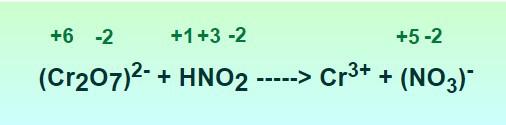
**Step 2: Identify the elements/atoms that undergo oxidation and reduction.
**Oxidation: HNO2(aq) → NO3-(aq)
**Reduction: Cr2O72-(aq) → Cr3+(aq)
**Step 3: Break the reaction into two halves.
Reduction Half,
Cr2O72-(aq) → Cr3+(aq)
Oxidation Half,
HNO2(aq) → NO3-(aq)
**Step 4: Balance the Half reaction.
- Balance all other atoms except oxygen and hydrogen.
(In 1st reaction, there are 2 moles of Cr on the n left side so we have to take molecule of Cr on the n right side.)
Cr2O72-(aq) → 2Cr3+(aq)
(In 2nd reaction),
HNO2(aq) → NO3-(aq)
- Add H2O to balance the oxygen.
Cr2O72-(aq) → 2Cr3+(aq) + 7H2O(l)
HNO2(aq) + H2O(l) → NO3-(aq)
- Balance Hydrogen (Add H+ ion) with protons.
Cr2O72-(aq) + 14H+(aq) → 2Cr3+(aq) + 7H2O(l)
HNO2(aq) + H2O(l) → NO3-(aq) + 3H+(aq)
- Balance the charge with electron.
**In 1 st reaction,
Cr2O72-(aq) + 14H+(aq) → 2Cr3+(aq) + 7H2O(l)
**LHS: (2-) + (14+) = (12+) charges
**RHS: 2(3+) = (6+) charges
Therefore,
Cr2O72-(aq) + 14H+(aq) + 6e- → 2Cr3+(aq) + 7H2O(l)
**In 2 nd reaction,
HNO2(aq) + H2O(l) → NO3-(aq) + 3H+(aq)
**LHS: No charges
**RHS: (1-) + (3+) = (2+) charges
Therefore,
HNO2(aq) + H2O(l) → NO3-(aq) + 3H+(aq) + 2e-
**Step 5: To balance the charges, add electrons to one side of the half-reaction. If necessary, multiply one or behalf-reactions by an appropriate value to equal the number of electrons in the half-reactions.
Here, 6 electrons in 1st reaction and 2 electrons in 2nd reaction. so we multiply
1st reaction,
Cr2O72-(aq) + 14H+(aq) + 6e- → 2Cr3+(aq) + 7H2O(l)
2nd reaction,
HNO2(aq) + H2O(l) → NO3-(aq) + 3H+(aq) + 2e-
3( HNO2(aq) + H2O(l) → NO3-(aq) + 3H+(aq) + 2e-)
3HNO2(aq) + 3H2O(l) → 3NO3-(aq) + 9H+(aq) + 6e-
**Step 6: To get the overall reaction, we combine the two half-reactions and cancel the common term on both sides. The net ionic equation is thus obtained.
Cr2O72-(aq) + 5H+(aq) + 3HNO2(aq) → 2Cr3+(aq) + 4H2O(l) + 3NO3-(aq)
**Step 7: Check that both sides of the equation have the same kind and number of atoms, as well as the exact charges. This final check confirms that the equation is perfectly balanced in terms of particles and charges.
Hence, the equation is balanced.
**Steps to Balance Redox Reaction in Basic Medium by Half Reaction Method
**Step 1: In ionic form, generate an imbalanced equation for the reaction.
**Step 2: Identify the elements/atoms that undergo oxidation and reduction.
**Step 3: Break the reaction into two halves.
- Oxidation Half
- Reduction Half
**Step 4: Balance the Half reaction.
- Balance all other atoms except oxygen and hydrogen.
- Add H2O to balance the oxygen.
- Balance Hydrogen (Add H+ ion) with protons.
- Balance the charge with the electron.
**Step 5: To balance the charges, add electrons to one side of the half-reaction. If necessary, multiply one or both half-reactions by an appropriate value to equal the number of electrons in the two half-reactions.
**Step 6: To get the overall reaction, we combine the two half-reactions and cancel the common term on both sides. The net ionic equation is thus obtained.
**Step 7: Add as many OH- ions on both sides as the number of H+ ions on one side.
**Step 8: Check that both sides of the equation have the same kind and number of atoms, as well as the exact charges. This final check confirms that the equation is perfectly balanced in terms of particles and charges.
**Example: Balance the Redox Reaction in Basic Medium by Half Reaction Method.
**MnO 4 - + I - → MnO 2 + I 2
**Solution:
**Step 1: In ionic form, generate an imbalanced equation for the reaction.

**Step 2: Identify the elements/atoms that undergo oxidation and reduction.
**Oxidation: I- → I2
**Reduction: MnO4- → MnO2
**Step 3: Break the reaction into two halves.
Oxidation Half: I- → I2
Reduction Half: MnO4- → MnO2
**Step 4: Balance the Half reaction.
- Balance all other atoms except oxygen and hydrogen.
2I- → I2
(Here, 2 moles of I on the n right side so we have to take a molecule of I on the n left side.)
MnO4- → MnO2
- Add H2O to balance the oxygen.
2I- → I2
MnO4- → MnO2 + 2H2O
- Balance Hydrogen (Add H+ ion) with protons.
2I- → I2
MnO4- + 4H+ → MnO2 + 2H2O
- Balance the charge with electron.
2I- → I2 + 2e-
MnO4- + 4H+ + 3e- → MnO2 + 2H2O
**Step 5: To balance the charges, add electrons to one side of the half-reaction. If necessary, multiply one or both half-reactions by an appropriate value to equal the number of electrons in the two half-reactions.
Here, 2 electrons in 1st reaction and 3 electrons in 2nd reaction. so we balance the electron.
3(2I- → I2 + 2e-)
6I- → 3I2 + 6e-
2( MnO4- + 4H+ + 3e- → MnO2 + 2H2O)
2MnO4- + 8H+ + 6e- → 2MnO2 + 4H2O
**Step 6: To get the overall reaction, we combine the half-reactions and cancel the common term on both sides. The net ionic equation is thus obtained.
6I- + 2MnO4- + 8H+ + 8OH- → 3I2 + 2MnO2 + 4H2O + 8OH-
**Step 7: Add as many OH- ions on both sides the s number of H+ ions on one side.
6I- + 2MnO4- + 8H+ + 8OH- → 3I2 + 2MnO2 + 4H2O + 8OH-
6I- + 2MnO4- + 8H2O → 3I2 + 2MnO2 + 4H2O + 8OH-
6I- + 2MnO4- + 4H2O → 3I2 + 2MnO2 + 8OH-
**Step 8: Check that both sides of the equation have the same kind and number of atoms, as well as the exact charges. This final check confirms that the equation is perfectly balanced in terms of particles and charges.
Hence, the equation is balanced.
Balancing Redox Reaction Problems
**Problem 1: Balance the Redox Reaction added below using the oxidation number method.
**CuO + NH 3 → Cu + N 2 + H 2 O
**Solution:
**Step 1: Assign the oxidation number to all elements in the reaction to identify atom thatch change oxidation number during the reaction.

**Step 2: Identify the elements/atoms that undergo oxidation and reduction.
Oxidation: NH3 → N2
Reduction: CuO → Cu
**Step 3: After balancing atoms that have undergone oxidation and reduction, balance charge by cross multiplication.
CuO + NH3 → Cu + N2 + H2O
There is an increase in the O.N. of N from -3 to which is an increase of 3 in O.N. and there is a decrease in the O.N. of Cu from +2 to whichat is a decrease of 2 in O.N.
Cross multiplication,
3CuO + 2NH3 → 3Cu + 2N2 + H2O
**Step 4: Balance all other atoms except oxygen and hydrogen.
3CuO + 4NH3 → 3Cu + 2N2 + H2O
**Step 5: Add H2O to balance the oxygen
3CuO + 4NH3 → 3Cu + 2N2 + H2O +2H2O
**Step 6: By adding H+ molecules to the reactants or products, you can make the number of hydrogen atoms in the expression on both sides equal.
3CuO + 4NH3 → 3Cu + 2N2 + H2O +2H2O + 6H+
3CuO + 2NH3 → 3Cu + N2 + 3H2O
Hence, the equation is balanced.
**Problem 2: Balance the Redox Reaction in acidic medium by Ion Electron method,
**Fe 2+ + Cr 2 O 7 2- → Cr 3+ + Fe 3+
**Solution:
**Step 1: In ionic form, generate an imbalanced equation for the reaction.
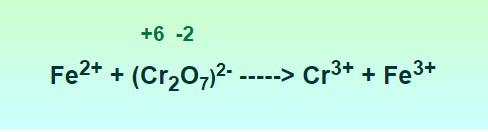
**Step 2: Identify the elements/atomthatch undergo oxidation and reduction.
Oxidation: Fe2+ → Fe3+
Reduction: Cr2O72- → Cr3+
**Step 3: Break the reaction into two halves.
Oxidation Half,
Fe2+ → Fe3+
Reduction Half,
Cr2O72- → Cr3+
**Step 4: Balance the Half reaction.
- Balance all other atoms except oxygen and hydrogen.
Fe2+ → Fe3+
Cr2O72- → 2Cr3+
- Add H2O to balance the oxygen.
Fe2+ → Fe3+
Cr2O72- → 2Cr3+ + 7H2O
- Balance Hydrogen (Add H+ ion) with protons.
Fe2+ → Fe3+
Cr2O72- + 14H+ → 2Cr3+ + 7H2O
- Balance the charge witan h electron.
In 1st reaction,
Fe2+ → Fe3+
LHS: (2+) charges
RHS: (3+)charges
Therefore,
Fe2+ → Fe3+ + e-
In 2nd reaction,
Cr2O72- + 14H+ → 2Cr3+ + 7H2O
LHS: (2-) + (14+) = (12+)charges
RHS: (6+) = (6+) charges
Therefore,
Cr2O72- + 14H+ + 6e- → 2Cr3+ + 7H2O
**Step 5: To balance the charges, add electrons to one side of the thhalf-reactionon. If necessary, multiply one or behalf-reactions by an appropriate value to equal the number of electrons in the twhalf-reactionsns.
(Here, 1 electron in 1st reaction and 6 electrons in 2nd reaction. so we balance the electrons.)
1st reaction,
6(Fe2+ → Fe3+ + e-)
6Fe2+ → 6Fe3+ + 6e-
2nd reaction,
Cr2O72- + 14H+ + 6e- → 2Cr3+ + 7H2O
**Step 6: To get the overall reaction, we combine the twhalf-reactionsns and cancel the common term on both sides. The net ionic equation is thus obtained.
6Fe2+ + Cr2O72- + 14H+ → 6Fe3+ + 2Cr3+ + 7H2O
**Step 7: Check that both sides of the equation have the same kind and number of atoms, as well as the exact charges. This final check confirms that the equation is perfectly balanced in terms of particles and charges.
Hence, the equation is balanced.
**Problem 3: Balance the Redox Reaction in the Basic medium by Half reaction method,
**Ag(s) + Zn 2+ (aq) → Ag 2 O(aq) + Zn(s)
**Solution:
**Step 1: In ionic form, generate an imbalanced equation for the reaction.

**Step 2: Identify the elements/atomthatch undergo oxidation and reduction.
Oxidation: Ag(s) → Ag2O(aq)
Reduction: Zn2+(aq) → Zn(s)
**Step 3: Break the reactiointoin two halves.
Oxidation Half,
Ag(s) → Ag2O(aq)
Reduction Half,
Zn2+(aq) → Zn(s)
**Step 4: Balance the Half reaction.
- Balance all other atoms except oxygen and hydrogen.
2Ag(s) → Ag2O(aq)
Zn2+(aq) → Zn(s)
- Add H2O to balance the oxygen.
H2O(l) + 2Ag(s) → Ag2O(aq)
Zn2+(aq) → Zn(s)
- Balance Hydrogen (Add H+ ion) with protons.
H2O(l) + 2Ag(s) → Ag2O(aq) + 2H+(aq)
Zn2+(aq) → Zn(s)
- Balance the charge witan h electron.
H2O(l) + 2Ag(s) → Ag2O(aq) + 2H+(aq) + 2e-
Zn2+(aq) + 2e- → Zn(s)
**Step 5: To balance the charges, add electrons to one side of the thhalf-reactionon. If necessary, multiply one or bothalf-reactionsns by an appropriate value to equal the number of electrons in the two half reactions.
H2O(l) + 2Ag(s) → Ag2O(aq) + 2H+(aq) + 2e-
Zn2+(aq) + 2e- → Zn(s)
Step 6] To get the overall reaction, we combine the twhalf-reactionsns and cancel the common term on both sides. The net ionic equation is thus obtained.
H2O(l) + 2Ag(s) + Zn2+ → Ag2O(aq) + 2H+(aq) + Zn(s)
**Step 7: Add as many OH- ions on both sides athe s number of H+ ions on one side.
2Ag(s) + Zn2+(aq) + 2OH-(aq) → Zn(s) + Ag2O(aq) + H2O(l)
Step 8] Check that both sides of the equation have the same kind and number of atoms, as well as the exact charges. This final check confirms that the equation is perfectly balanced in terms of particles and charges.
Hence, the equation is balanced.
**Problem 4: Balance the Redox Reaction in acidic medium by Oxidation number method,
**Cu + NO 3 - → NO 2 **+ Cu 2+
**Solution:
**Step 1: Assign the oxidation number to all elements in the reaction to identify atomthatch change oxidation number during the reaction.

**Step 2: Identify the elements/atomthatch undergo oxidation and reduction.
Oxidation: Cu → Cu2+
Reduction: NO3- → NO2
**Step 3: After balancinatomsom that have undergone oxidation and reduction, balance charge by cross multiplication.
Cu + NO3- → NO2 + Cu2+
There is an increase in the O.N. of Cu from 0 to +2 which is an increase of 2 in O.N. and there is a decrease in the O.N. of N from +5 to +4 which is a decrease of 1 in O.N.
Cross multiplication,
Cu + 2NO3- → 2NO2 + Cu2+
**Step 4: Balance all other atoms except oxygen and hydrogen.
Cu + 2NO3- → 2NO2 + Cu2+
**Step 5: Add H2O to balance the oxygen.
Cu + 2NO3- → 2NO2 + Cu2+ + 2H2O
**Step 6: By adding H+ molecules to the reactants or products, you can make the number of hydrogen atoms in the expression on both sides equal.
Cu + 2NO3- + 4H+ → 2NO2 + Cu2+ + 2H2O
Hence, the equation is balanced.
**Problem 5: Balance the Redox Reaction in the Basic medium by Oxidation number method,
**[Cr(OH) 4 ] + H 2 O 2 **→ CrO 4 2- + H 2 O
**Solution:
**Step 1: Assign the oxidation number to all elements in the reaction to identify atomthatch change oxidation number during the reaction.

**Step 2: Identify the elements/atomthatch undergo oxidation and reduction.
- **Oxidation: [Cr(OH)4] → CrO42-
- **Reduction: H2O2 → H2O
**Step 3: Balance all other atoms except oxygen and hydrogen.
[Cr(OH)4] + H2O2 → CrO42- + H2O
**Step 4: After balancinatomsom that have undergone oxidation and reduction, balance charge by cross multiplication.
There is an increase in the O.N. of chromium from +3 to +whichat is an increase of 3 in O.N. and there is a decrease in the O.N. of one oxygen atom in hydrogen peroxide from −1 to −whichat is a decrease of 1 in O.N.
Cross multiplication,
2[Cr(OH)4]- + 3H2OCr2 → CrO42-+ H2O
**Step 5: Add H2O to balance the oxygen.
2[Cr(OH)4]- + 3H2O2 → 2CrO42- + 6H2O
**Step 6: Add as many OH- ions on both sides as the s number of H+ ions on one side.
2[Cr(OH)4]- + 3H2O2 + 2OH- → 2CrO42- + 8H2O
Hence the equation is balanced.
**Read More,