Biodegradable and Non Biodegradable (original) (raw)
Last Updated : 23 Jul, 2025
**Biodegradable and Non-biodegradable are types of waste materials (or substances) that are categorized on the basis of their degradation. Biodegradable materials can be decomposed or broken down by microorganisms and other living organisms while **Non-Biodegradable materials cannot be decomposed or broken down by microorganisms and other living organisms rather leading to pollution.
Let's learn about them in detail.
Biodegradable Meaning
A biodegradable substance or material is one that may quickly break down by bacteria or any other natural organisms without contributing to pollution.
Kitchen waste, food waste, and other naturally occurring waste are a few examples of biodegradable waste. Biodegradable wastes are waste materials that are and can be easily degraded by natural factors like microbes (e.g., bacteria, fungi, and a few others), and abiotic components like temperature, UV, oxygen, etc.
Together with other abiotic components, microorganisms decompose complicated materials into simple organic matter that eventually suspends and dissipates into the earth. The entire procedure, which might go quickly or slowly, is natural. Therefore, there are very few hazards and environmental problems associated with biodegradable garbage.
Biodegradable Materials Examples
Some important examples of Biodegradable Materials are,
- Paper
- Food waste
- Human waste
- Manure
- Sewage sludge
- Slaughterhouse waste
- Dead animals and plants
- Hospital Waste, etc.
Biodegradable Waste
The type of waste that can be broken down by other living things mainly comes from plant or animal sources and is called **Biodegradable Waste.

Green garbage, food waste, paper waste, and biodegradable plastics are all common examples of biodegradable waste that can be found in municipal solid waste. Human waste, manure, sewage, and slaughterhouse waste are examples of additional biodegradable wastes.
Non-Biodegradable Meaning
A non-biodegradable material is any type of substance that is a cause of pollution and cannot be degraded by living things.
Non-biodegradable wastes cannot be handled as easily as biodegradable trash. Wastes that are not biodegradable cannot be broken down or eliminated by natural processes. They endure on earth for a very long time without degrading.
As a result, the threat they pose is likewise more serious. Plastics, which are frequently used materials in practically every sector, are a remarkable example. Improved quality plastics are being used to offer these polymers a long-lasting effect. They became more durable even after use and more temperature resistant as a result..
Non-Biodegradable Waste Examples
Some important examples of Non-Biodegradable Materials are,
- Glass
- Plastic
- Metals
- Pesticides
- Fibers
- E-waste
- Hazardous substances
- Artificial rubber
- Artificial polymers, etc.
Non Biodegradable Waste
A substance that cannot break down or dissolve naturally and causes pollution is referred to as non-biodegradable waste.
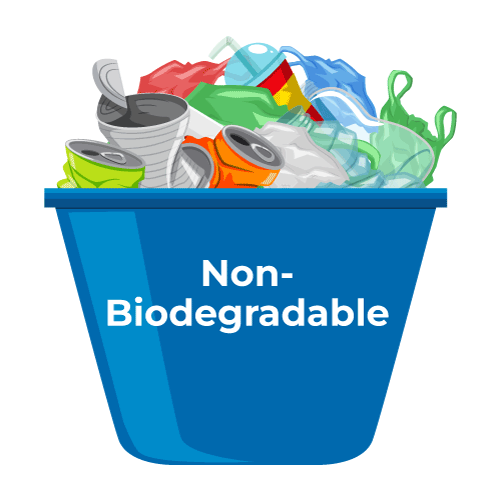
Degradation is not possible with these products because they are manufactured and do not occur naturally. Therefore, they damage our environment when they exist in the ecosystem for a long time without decomposing. Examples of non-biodegradable garbage include polystyrene, metal, aluminium cans, tires, paint, poisonous chemicals, and plastics.
Difference between Biodegradable and Non Biodegradable
The major differences between Biodegradable and Non-Biodegradable materials are,
| Biodegradable vs. Non-Biodegradable | |
|---|---|
| Biodegradable | Non-Biodegradable |
| Biodegradable materials can be decomposed naturally by microorganisms and other living organisms. | Non-Biodegradable materials can not be decomposed naturally by any living organisms. |
| The decomposition of such materials takes place in presence of air, sunlight, water, soil, microorganisms, and all. | However, Non-Biodegradable wastes can not decay in the ecosystem naturally and create pollution. |
| Biodegradable wastes come from organic things like kitchen waste, paper, organic waste, etc. | While non-biodegradable wastes are manufactured chemically, therefore found to become from human activities |
| Faster Rate of Decomposition. | Slower Rate of Decomposition. |
| Such waste is useful for the production of fertilizers, manure, compost, biogas, etc. | This waste is needed to be separated first and get recycled, which is expensive and time-consuming. |
| e.g. Kitchen waste, Human waste, Manure, Sewage sludge, Dead animals and plants, etc. | e.g. Glass, Plastic, Metals, Hazardous substances, Pesticides, Fibers, etc. |
Effect of Waste Material on Environment
Here are a few adverse effects that waste materials have on our environment:
- Waste materials significantly harm our environment, contaminating the spaces where we live and rendering them unsuitable for habitation.
- These materials not only harm human environments but also affect the habitats of other animals, making survival challenging for them.
- Annually, billions of tonnes of waste end up in landfills or the ocean, causing suffering to organisms in those environments and disrupting ecological balance.
- Emissions from vehicles and factories pollute the air, leading to various health issues in humans and animals, including eye irritation, lung diseases, and breathing difficulties.
- The detrimental impact of waste on our environment is evident, highlighting the importance of our responsibility to maintain cleanliness in our surroundings.
Reduce Reuse and Recycle
3R or Reduce, Reuse and Recycle is the way to remove waste materials from the human society or environment. We can not directly just ban all the materials which are harmful to us and our surroundings as they are required for various purposes but to make sure they do not end up in seas, or landfills, we must do some things.
So to achieve all these purposes environmentalists came up with an idea about 3R (Reduce, Reuse, and Recycle). Let's learn about it.
**Reduce
We must reduce the use of harmful chemicals and plastics and must switch to safer alternatives as early as possible. For example, reducing the use of plastic bags and promoting the use of jute bags.
**Resue
We must reuse harmful plastics substances so that they may not end up in the seas or landfills. For example, we can use paint buckets (after cleaning) for storing water and other essentials.
**Recycle
We should recycle the waste materials to be used again and again. For example, aluminium can be used again, we can recycle old newspapers and others.
**Read More :