Cathode and Anode (original) (raw)
Last Updated : 23 Jul, 2025
**Cathode and **Anode are commonly used terms in the context of electrochemistry, specifically in electrochemical cells like batteries and electrolytic cells. An anode is a negative or reducing electrode that releases electrons and oxidizes during an electrochemical reaction whereas a Cathode is a positive or oxidizing electrode.
In this article, we will learn about, Cathode, Anode, their differences, and others in detail.
What are Cathode and Anode?
Cathode and Anode are the basic terms of electrochemistry that are used to denote the two positive and negative parts of any electrochemical cell or battery. Now let's learn about Cathode and Anode in detail.
Cathode Definition
**In an electrochemical cell (such as a battery or electrolytic cell), the cathode is the electrode where reduction (gain of electrons) occurs.
Cathode is a crucial component in various electrochemical processes, playing a key role in facilitating reduction reactions. In the context of batteries, the cathode is the electrode where electrons are accepted from the external circuit during a spontaneous electrochemical reaction. The significance of the cathode extends beyond its role in electrochemistry. It serves as a critical element in technologies such as cathode-ray tubes (CRTs) and certain types of diodes.
Anode Definition
**In an electrochemical cell, the anode is the electrode where oxidation (loss of electrons) occurs.
Anode is another important of an electrochemical systems, representing the electrode where oxidation reactions occur. In the context of batteries, the anode is the site where electrons are released to the external circuit during a spontaneous electrochemical reaction. This release of electrons is typically accompanied by the oxidation of ions or molecules, resulting in the development of a negative charge. In electronic devices like diodes, the anode is the electrode where current enters, and it plays a crucial role in regulating the direction of electric flow.
Charges on Cathode and Anode
In electrochemical cells,
- Cathode is associated with a Positive Charge and undergoes Reduction
- Anode is associated with a Negative Charge and undergoes Oxidation.
Cathode and Anode Meaning
Cathode and Anode are terms used to identify the two electrodes in an electrical device, such as a battery or an electrolytic cell.
Cathode and Anode in an Electrochemical Cell is shown in the image added below,
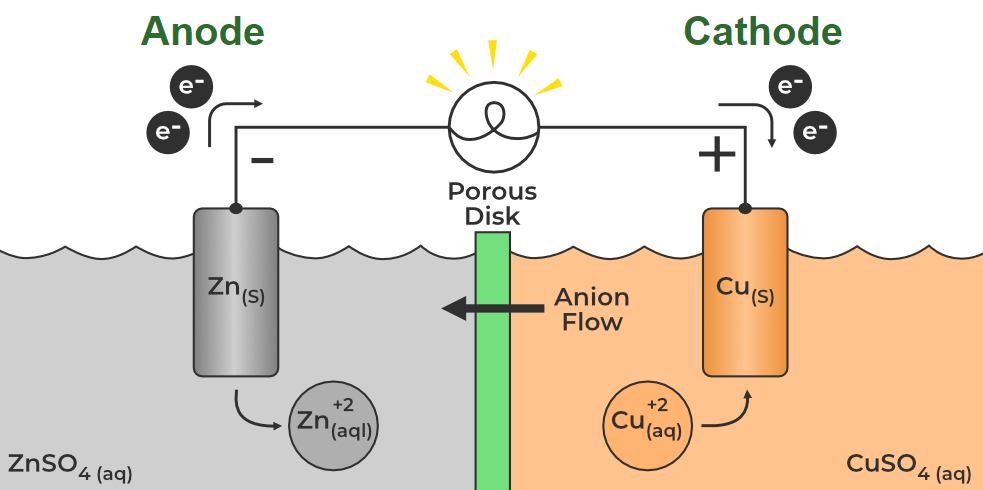
Anode and Cathode in Electrolytic Cell
In electrolysis, the terms "anode" and "cathode" are used to describe the two electrodes immersed in an electrolyte, which is a solution that conducts electricity.
Cathode in Electrolysis
- Cathode is the Negative electrode in the electrolysis where reduction (gain of electrons) occurs.
- Electrons are supplied to the cathode from an external circuit, and positive ions from the electrolyte gain electrons to become neutral.
- In the process, metal ions may plate out onto the cathode or other reduction reactions may take place.
Anode in Electrolysis
- Anode is the Positive electrode in the electrolysis where oxidation (loss of electrons) occurs.
- Electrons are released at the anode and flow through the external circuit back to the cathode.
- At the anode, substances may lose electrons, forming positive ions or undergoing oxidation reactions.
Cathode and Anode of a Diode
In the context of a semiconductor diode, such as a typical silicon or germanium diode used in electronic circuits, the terms "cathode" and "anode" refer to the two terminals of the diode. Here's how these terms are applied to a diode:
Cathode of a Diode
- Cathode in the diode is negatively charged.
- Electrons flow into the cathode during forward biasing (when the diode is conducting).
- In schematic symbols, the cathode is usually indicated by a line or arrow pointing away from the diode symbol.
Anode of a Diode
- Anode in the diode is positively charged.
- Electrons flow out of the anode during forward biasing.
- In schematic symbols, the anode is usually indicated by a line or arrow pointing toward the diode symbol.
Anode Vs Cathode
The differences between cathode and Anode are added in the table below,
| Difference Between Anode and Cathode | ||
|---|---|---|
| Characteristic | Cathode | Anode |
| Definition | Electrode where reduction (gain of electrons) occurs | Electrode where oxidation (loss of electrons) occurs. |
| Electron Flow | Electrons flow into the cathode from the external circuit. | Electrons are released from the anode into the external circuit. |
| Charge Accumulation | Accumulates a positive charge. | Accumulates a negative charge. |
| Function in Cells | Consumes electrons during a spontaneous electrochemical reaction. | Produces electrons during a spontaneous electrochemical reaction. |
| Direction of Current Flow (Conventional) | From cathode to anode. | From anode to cathode. |
| Example | In a battery, the cathode is where reduction occurs during discharge. | In a battery, the anode is where oxidation occurs during discharge. |
Conclusion on Cathode and Anode
Cathode and anode are essential in understanding the behavior of diodes in electronic circuits.
- Cathode, being the negatively charged terminal, facilitates the flow of electrons into the diode during forward biasing.
- Anode, with its positive charge, allows electrons to flow out of the diode during the same biasing condition.
This fundamental understanding of the cathode and anode plays a pivotal role in the proper integration of diodes within circuits, ensuring their intended functionality during both forward and reverse biasing. Whether rectifying current or serving in signal processing, diodes' distinct terminal characteristics make them indispensable components in the realm of electronics.
**Read More,
Cathode and Anode Questions
**Q1. Identify the cathode and anode in a galvanic cell with the reaction
**Zn(s) + CuSO 4 (aq) → ZnSO 4 (aq) + Cu(s)
The cathode is Cu(s), and the anode is Zn(s).
**Q2. In a battery, if electrons flow from the copper electrode to the zinc electrode, which electrode is the cathode?
The zinc electrode is the cathode.
**Q3. Describe the electron flow and conventional current direction in a simple circuit with a battery and a light bulb.
Electrons flow from the anode (negative terminal) to the cathode (positive terminal). Conventional current flows in the opposite direction.
**Q4. In a vacuum tube, if electrons are emitted when the cathode is heated, what type of electrode is the cathode?
The cathode is an electron-emitting electrode.