Covalent Bond (original) (raw)
Last Updated : 18 Apr, 2026
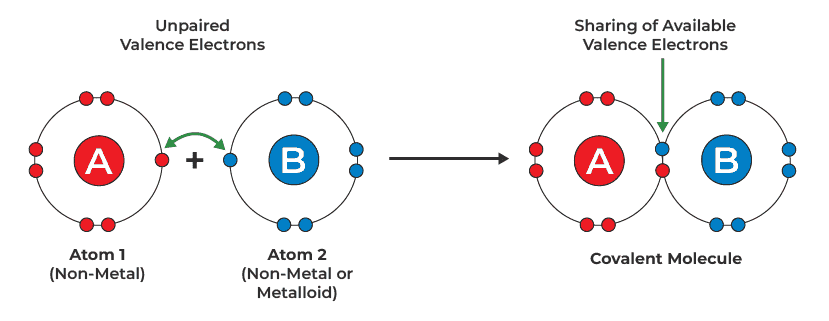
A covalent bond is a chemical bond formed by the mutual sharing of electron pairs between two atoms. This type of bonding usually occurs between non-metals in order to achieve a stable electronic configuration (octet). The nature of covalent bonding influences the physical and chemical properties of substances, such as their melting point, solubility, and electrical conductivity.
**Example:
When two hydrogen atoms combine, each shares one electron to form a hydrogen molecule:
H· + ·H → H–H (H2 )
Covalent Bonding in Carbon Atom
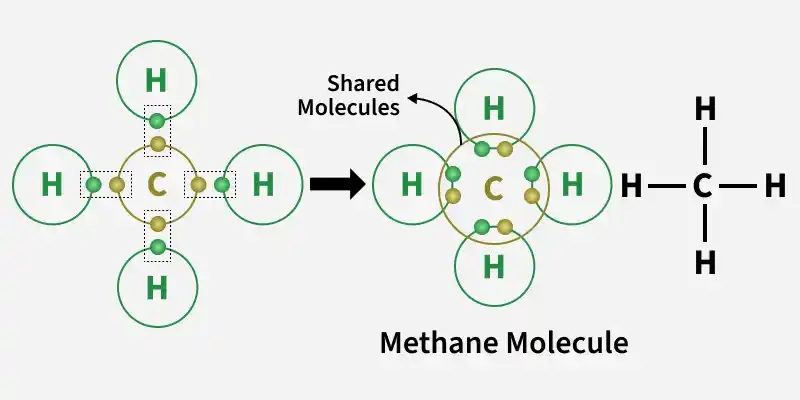
Carbon has an atomic number of 6 and its electronic configuration is 2,4, which means it has 4 valence electrons. To achieve a stable octet, carbon requires four electrons to complete its octet. Carbon cannot gain or lose 4 electrons easily because it would require a large amount of energy. Therefore, carbon attains stability by sharing electrons with other atoms, forming covalent bonds.
Each carbon atom can form four covalent bonds, which is known as its tetravalency. This property allows carbon to form a large number of compounds.
**Example:
In methane (CH4), carbon shares its four electrons with four hydrogen atoms, forming four single covalent bonds.
Properties of Covalent Bond
Covalent compounds exhibit certain characteristic properties due to the nature of covalent bonding.
- **Low Melting and Boiling Points: Covalent compounds generally have low melting and boiling points because the forces between molecules are weak.
- **Poor Conductors of Electricity: They do not conduct electricity as they do not have free ions or charged particles.
- **Insoluble in Water: Most covalent compounds are insoluble in water, but some polar covalent compounds are soluble.
- **Exist as Molecules: Covalent compounds exist as discrete molecules rather than ions.
- **Generally Soft and Volatile: They are usually soft and have low density, making them volatile in nature
Types of Covalent Bonds
Covalent bonds are classified based on the number of electron pairs shared between atoms.
1. **Single Covalent Bond
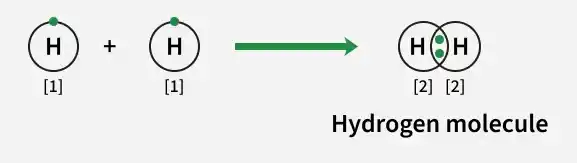
A single covalent bond is formed when one pair of electrons (2 electrons) is shared between two atoms. These molecules are stable because each atom completes its duplet/octet.
- Each atom contributes one electron to form the shared pair.
- It is the weakest type of covalent bond because only one pair of electrons is involved.
**Example:
- Hydrogen molecule (H2): H–H
- Chlorine molecule (Cl2): Cl–Cl
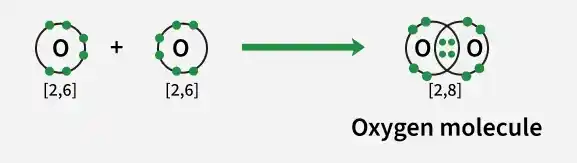
2. **Double Covalent Bond
A double covalent bond is formed when two pairs of electrons (4 electrons) are shared between two atoms. Double bonds make the molecule more stable than single bonds.
- Each atom contributes two electrons.
- It is stronger than a single bond because more electrons are shared.
**Example:
- Oxygen molecule (O2 ): O=O
- Carbon dioxide (CO2 ): O=C=O
3. **Triple Covalent Bond
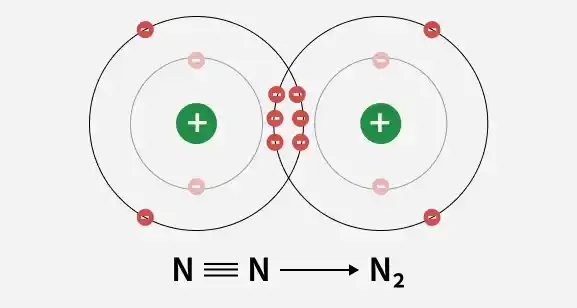
A triple covalent bond is formed when three pairs of electrons (6 electrons) are shared between two atoms. Triple bonds are very strong and hold atoms tightly together.
- Each atom contributes three electrons.
- It is the strongest covalent bond due to maximum sharing of electrons.
**Example:
Nitrogen molecule (N2 ): N≡N
Polarization of Covalent Bonds
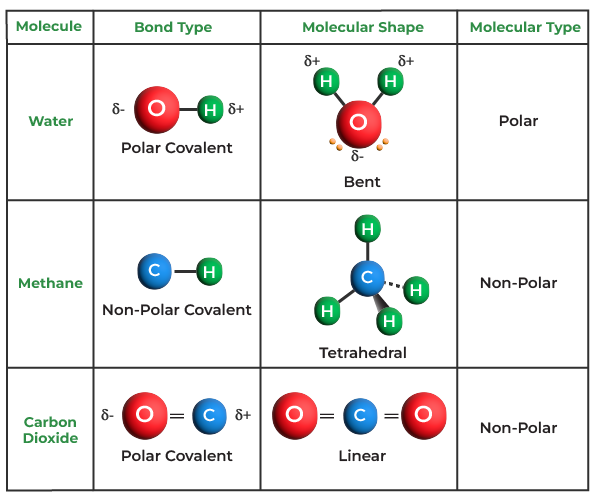
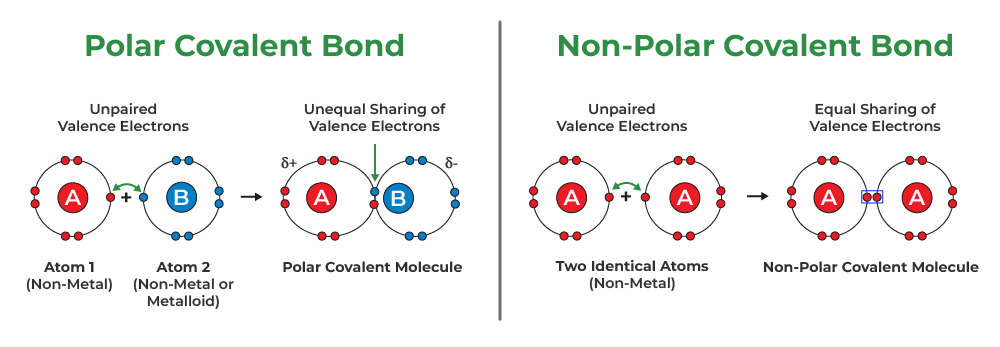
A covalent bond is formed by the sharing of electrons between two atoms. However, in some cases, the shared pair of electrons is not equally shared between the two atoms. This leads to the polarisation of the covalent bond. Polarization occurs when there is a difference in electronegativity between the bonded atoms. The atom with higher electronegativity attracts the shared electrons more strongly towards itself.
As a result:
- The more electronegative atom develops a partial negative charge (δ–)
- The less electronegative atom develops a partial positive charge (δ+)
This unequal distribution of charge makes the covalent bond polar.
Polar Covalent Bond
A polar covalent bond is formed when the shared pair of electrons is unequally distributed between two atoms.
- This happens due to a difference in electronegativity between the atoms.
- The more electronegative atom attracts electrons more strongly.
- As a result, partial charges develop: One atom gets δ– (partial negative charge) and The other gets δ+ (partial positive charge).
**Example:
HCl (Hydrogen chloride)
- Cl is more electronegative → attracts electrons
- So, Cl = δ– and H = δ+
Nonpolar Covalent Bond
A non-polar covalent bond is formed when the shared electrons are equally distributed between the atoms.
- This occurs when both atoms have same or nearly equal electronegativity.
- No partial charges are developed.
**Example:
H2 , O2 , N2
Covalent Bond Examples
Here some important examples of covalent bonds are discussed in brief: