Intermolecular Forces (original) (raw)
Last Updated : 2 Jun, 2026
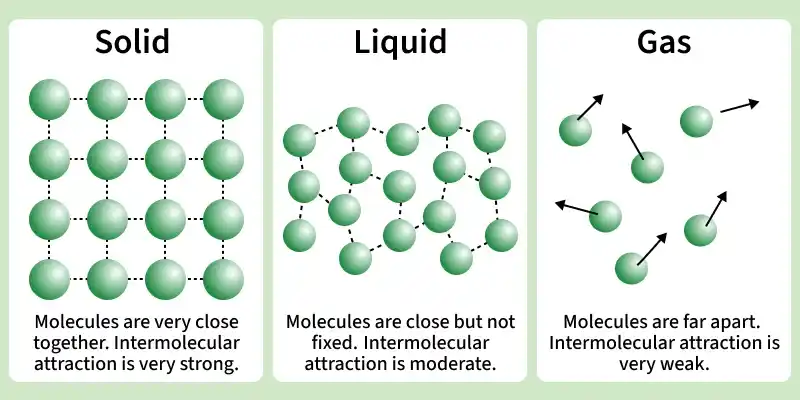
Matter exists in the form of solids, liquids, and gases. The molecules in these states are held together by weak forces of attraction known as intermolecular forces. These forces are responsible for various physical properties such as boiling point, melting point, viscosity, and surface tension. Depending on the nature of molecules, different types of intermolecular forces such as van der Waals forces and hydrogen bonding are observed.
Types of Intermolecular Forces
Intermolecular forces are mainly classified into two types:
**1. Van der Waals Forces
Van der Waals forces are weak forces of attraction that exist between molecules. These forces are generally weaker than hydrogen bonding and are responsible for the attraction between neutral molecules. They are of three types:
**a) Dipole–Dipole Forces
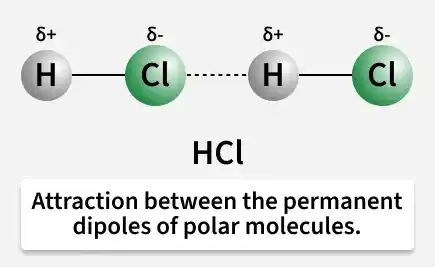
Dipole–dipole forces are the attractive forces present between polar molecules having permanent positive and negative ends.
- In polar molecules, electrons are not equally shared, due to which one end becomes slightly positive (δ⁺) and the other becomes slightly negative (δ⁻).
- The positive end of one molecule attracts the negative end of another molecule.
- These forces are stronger than dispersion forces but weaker than hydrogen bonding.
**Example:
- HCl – HCl
- SO2 – SO2
**b) Dipole–Induced Dipole Forces
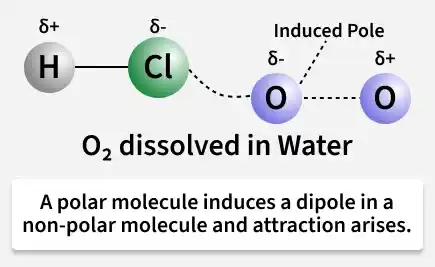
These forces occur between a polar molecule and a non-polar molecule. These forces are weaker than dipole–dipole interactions.
- The polar molecule distorts the electron cloud of the non-polar molecule and induces a temporary dipole in it.
- This creates a weak force of attraction between them.
**Example:
- Oxygen dissolved in water
- HCl with argon
**c) London Dispersion Forces
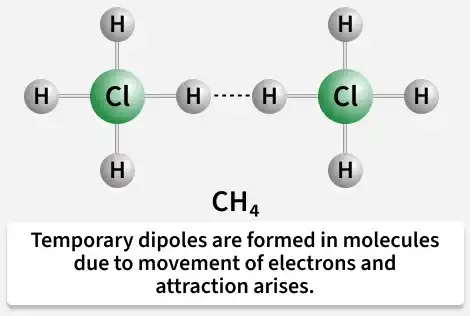
London dispersion forces are weak attractive forces caused by temporary dipoles formed due to random movement of electrons.
- At any instant, electrons may become unevenly distributed in a molecule, creating a temporary dipole.
- This temporary dipole induces dipoles in neighboring molecules, resulting in attraction.
- These forces are present in all molecules, especially non-polar molecules.
**Example:
- CH4 – CH4
- I2 – I2
**2. Hydrogen Bonding
Hydrogen bonding is a special type of intermolecular force in which a hydrogen atom bonded to highly electronegative atoms like nitrogen (N), oxygen (O), or fluorine (F) is attracted to another electronegative atom. Hydrogen bonding is stronger than ordinary dipole–dipole forces.
Hydrogen Bonding is further classified as:
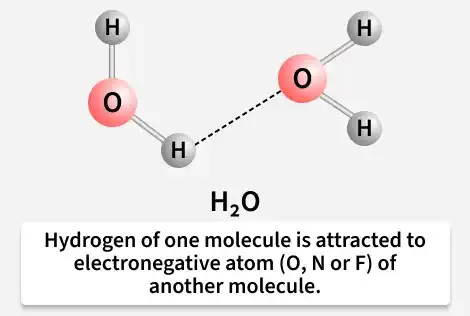
**a) Intermolecular Hydrogen Bonding: Hydrogen bonding that occurs between different molecules is called intermolecular hydrogen bonding. This type of bonding causes molecules to associate with each other, increasing boiling point and surface tension.
**Example: Water (H2O), Hydrogen fluoride (HF)
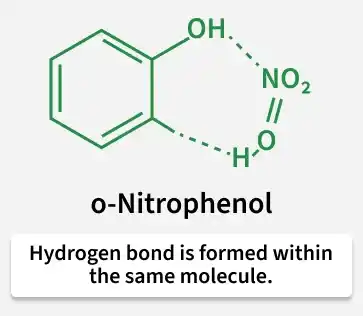
**b) Intramolecular Hydrogen Bonding: Hydrogen bonding occurring within the same molecule is called intramolecular hydrogen bonding. In this case, hydrogen forms a bond with another atom present in the same molecule, resulting in ring-like structures.
**Example: o-Nitrophenol
Effects of Intermolecular Forces
Intermolecular forces greatly influence the physical properties of substances. Stronger intermolecular forces result in stronger attraction between molecules and affect various physical properties.
**1. Effect on Boiling Point: Substances having stronger intermolecular forces require more heat energy and therefore have higher boiling points.
**2. Effect on Melting Point: Melting point depends upon the strength of attraction between molecules. Stronger intermolecular forces hold molecules more firmly, requiring more heat energy to melt the substance.
**3. Effect on Viscosity: Viscosity is the resistance offered by a liquid to flow. Liquids with strong intermolecular forces have greater resistance to flow and hence higher viscosity.
**4. Effect on Surface Tension: Surface tension is the tendency of the surface of a liquid to contract into the minimum possible surface area. Strong intermolecular forces pull molecules inward, increasing surface tension.
**5. Effect on Physical State of Matter: The strength of intermolecular forces determines whether a substance exists as a solid, liquid, or gas. Solids have strongest intermolecular forces, liquids have moderate intermolecular forces, gases have weakest intermolecular forces.