Le Chateliers Principle (original) (raw)
Last Updated : 8 May, 2026
In chemical reactions, many processes are reversible and exist in a state of equilibrium. At equilibrium, the forward and backward reactions occur at equal rates, and the concentrations of reactants and products remain constant. However, when the conditions of the system, such as concentration, temperature, or pressure, are changed, the equilibrium gets disturbed. This behaviour is explained by Le Chatelier’s Principle.
**Factors Affecting Equilibrium (Le Chatelier’s Principle)
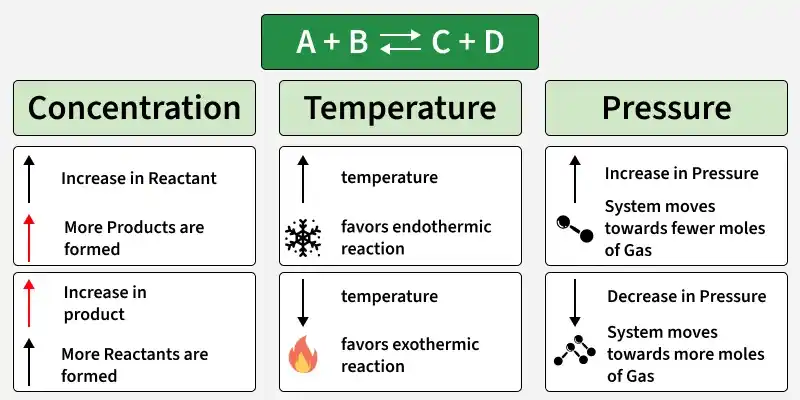
According to Henri Le Chatelier, a system at equilibrium shifts in a direction that opposes the change applied to it.
1. Effect of Concentration
Equilibrium is disturbed when concentration changes. System shifts to reduce the change. Equilibrium constant (K) remains unchanged. The effect is more noticeable in reversible reactions.
- **Increase in reactant: Forward reaction increases, more products are formed.
- **Increase in product: Backward reaction increases, more reactants are formed.
- **Decrease in reactant: System shifts backward to form reactants.
- **Decrease in product: System shifts forward to form products.
**Example:
H2 + I2 ⇌ 2HI
- Increase in H2 or I2 → equilibrium shifts forward
- Increase in HI → equilibrium shifts backward
2. Effect of Temperature
Temperature affects both position of equilibrium and K. Increase in temperature favours endothermic reaction.
**a) Endothermic reaction (ΔH > 0)
- Heat is absorbed (acts as reactant).
- Increase in temperature, forward reaction favoured.
- Decrease in temperature, backward reaction favoured.
**b) Exothermic reaction (ΔH < 0)
- Heat is released (acts as product).
- Increase in temperature, backward reaction favoured.
- Decrease in temperature, forward reaction favoured.
**Examples:
2SO22 + O2 ⇌ 2SO3 + heat
- Increase in temperature shifts equilibrium in the endothermic direction
- Decrease in temperature shifts equilibrium in the exothermic direction
3. Effect of Pressure and Volume
Applicable only when gases are involved. Pressure and volume are inversely related. If number of gaseous moles is same there is no effect. Solids and liquids do not affect pressure change.
- **Increase in pressure (decrease in volume): System shifts to reduce pressure, moves towards fewer moles of gas.
- **Decrease in pressure (increase in volume): System shifts to increase pressure, moves towards more moles of gas.
**Example:
N2O4 ⇌ 2NO2
- Left side: 1 mole
- Right side: 2 moles
Increase in pressure, shifts left (fewer moles)
Decrease in pressure, shifts right (more moles)
4. Effect of Inert Gas
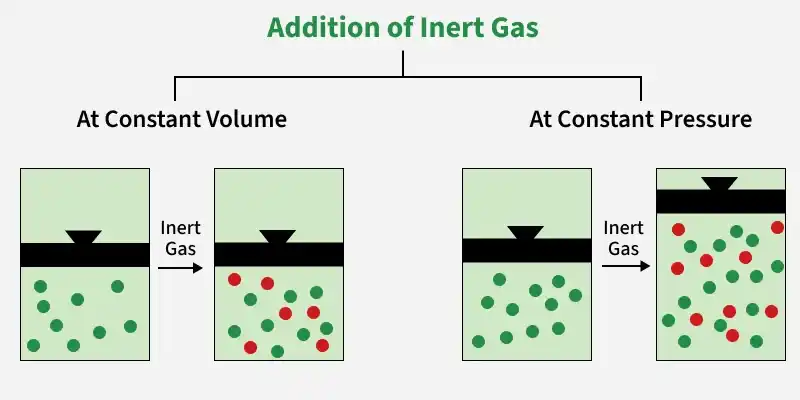
Inert gases do not participate in reaction.
- At constant volume: No change in concentration of reacting gases .
- At constant pressure: Equilibrium shifts towards more moles of gas.
**Example:
N2 + 3H2 ⇌ 2NH3
- At constant volume, no effect
- At constant pressure, volume increases
5. Effect of Catalyst
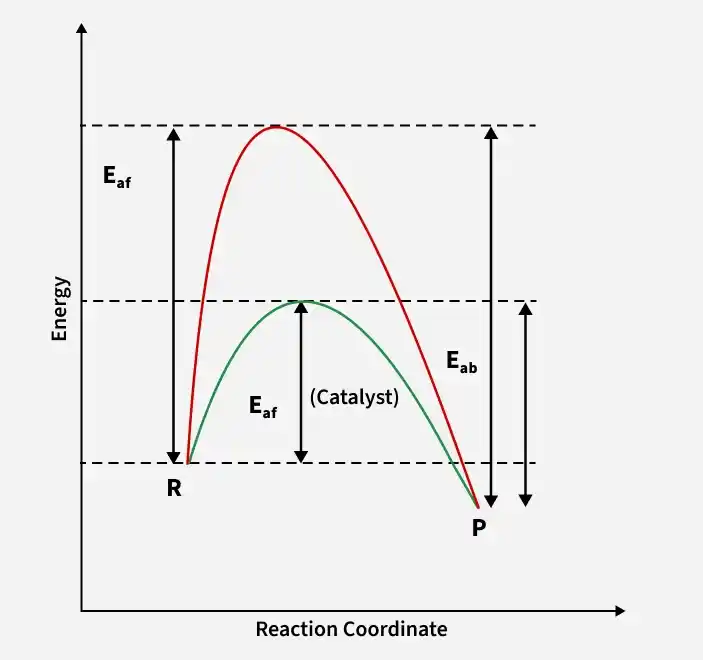
Catalyst provides an alternative pathway. It increases rate of both forward and backward reactions.
- It Helps system reach equilibrium faster.
- Does not change equilibrium position.
- Does not change equilibrium constant (K).
**Example:
2SO2 + O2 ⇌ 2SO3
- Catalyst increases rate of both forward and backward reactions
- Equilibrium is reached faster
- No change in equilibrium position