Melting Point (original) (raw)
Last Updated : 23 Jul, 2025
Melting point is the temperature at which any solid changes its form from solid to liquid. The melting point of any solid is the temperature at which it changes its temperature from solid to liquid at constant pressure, (generally at constant pressure). At the melting point, the liquid and solid phases of any material exist simultaneously.
In this article, we will learn about melting points and various factors that affect melting points, examples, and others in detail.
Table of Content
- What is Melting Point?
- Melting Point Determination Methods
- Factors Affecting Melting Point
- Common Examples of Melting Points
- Applications of Melting Point
- Conversion of Solid to Liquid
- Sample Questions on Melting Point
**What is Melting Point?
The temperature at which a solid substance melts and transforms into a liquid at atmospheric pressure is termed the melting point of a substance.
Different solids display varying melting points. For example, the melting point of wax is 63 °C. The greater the melting point of the substances, the more will be the intraparticle forces of attraction binding the particles. For instance, in the solid form of water, ice melts at a temperature of 0 °C to form liquid water. Therefore, the melting point of ice is 0 °C at atmospheric pressure.
At the melting point, the solid and liquid states of matter coexist together. The melting point of a substance is its characteristic property influenced by the applied pressure.
Explanation of Melting Point
Melting or fusion is the process by which a solid substance changes into a liquid on heating. On heating a substance, the particles vibrate with greater intensity and move more vigorously. Heat energy is produced. The particles gain sufficient kinetic energy to overcome the strong forces of attraction. They gain energy to break through to form small groups of particles. Solids, therefore, melt to form a liquid state.
Melting of a substance occurs at defined ambient pressure conditions. The energy supplied to melt a system is known as **Enthalpy of fusion or **Entropy of fusion. However, some of the substances pose an exception to this process, and heat has to be removed from these systems in order to melt them. e.g. Helium.

Melting Point Determination Methods
In chemistry labs, there are various methods for the determination of melting points.
- Simple Melting Point Apparatus
- Automated Melting Point Apparatus
- Capillary Tube Method
Factors Affecting Melting Point
Molecular Structure and Intermolecular Forces
As the Melting point is the point at which atoms release themselves from the intermolecular forces using the energy of the surroundings, thus molecular structure and intermolecular forces affect the melting point. Substances with stronger intermolecular forces, such as hydrogen bonding or dipole-dipole interactions, tend to have higher melting points. For example, water (H2O) has strong hydrogen bonding, leading to a relatively high melting point.
Molecular Weight and Size
Larger the molecule, the more area it has for intermolecular interactions, hence a much stronger force of attraction between molecules and melting point as well. Therefore, larger molecules have greater melting points than smaller molecules. Other than size, shape also affects the melting point as linear-shaped molecules can be packed much more efficiently than branched or spherical-shaped molecules.
Impurities and Purity of Substances
The presence of impurities in a substance can lower its melting point. Impurities disrupt the regular packing arrangement of molecules or ions, making it easier for the substance to transition from the solid to the liquid phase. This phenomenon is known as "melting point depression."
Common Examples of Melting Points
There are various common daily-use compounds, for which we will discuss the melting point.
Metals
The melting point of some most common metals are:
| Chemical | Melting Point (K) | Melting Point (°C) |
|---|---|---|
| Sodium (Na) | 370.87 | 97.87 |
| Magnesium (Mg) | 923 | 650 |
| Aluminium (Al) | 933.47 | 660.47 |
| Potassium (K) | 336.53 | 63.53 |
| Titanium (Ti) | 1941 | 1668 |
| Iron (Fe) | 1811 | 1538 |
| Nickel (Ni) | 1728 | 1455 |
| Copper (Cu) | 1357.77 | 1084.77 |
| Zinc (Zn) | 692.88 | 419.88 |
| Gallium (Ga) | 302.9146 | 29.9146 |
| Silver (Ag) | 1234.93 | 961.93 |
| Cadmium (Cd) | 594.22 | 321.22 |
| Indium (In) | 429.75 | 156.75 |
| Tungsten (W) | 3695 | 3422 |
| Platinum (Pt) | 2041.4 | 1768.4 |
| Gold (Au) | 1337.33 | 1064.33 |
| Mercury (Hg) | 234.43 | -38.57 |
| Lead (Pb) | 600.61 | 327.61 |
| Bismuth (Bi) | 544.7 | 271.7 |
Non-Metals
The melting point of some most common non-metals are:
| Element | Melting Point (K) | Melting Point (°C) |
|---|---|---|
| Hydrogen (H) | 14 | -259 |
| Nitrogen (N) | 63.15 | -209.85 |
| Oxygen (O) | 54.36 | -218.64 |
| Sulfur (S) | 388.36 | 115.36 |
| Chlorine (Cl) | 171.6 | -101.4 |
| Iodine (I) | 386.85 | 113.85 |
Organic Compounds
The melting point of some most common organic compounds are:
| Chemical | Melting Point (K) | Melting Point(°C) |
|---|---|---|
| Methane(CH4) | 109 | -164 |
| Ethane(C2H6) | 184 | -89 |
| Methanol (CH3OH) | 338 | 65 |
| Propane (C3H8) | 231 | -42 |
| Ethanol (C2H5OH) | 351 | 78 |
| Butane (C4H10) | 272 | -1 |
| Phenol (C6H6O) | 315 | 42 |
| Oxalic Acid (C2H2O4) | 374 | 101 |
| Benzoic Acid (C7H6O2) | 395 | 122 |
| Naphthalene (C10H10) | 353 | 80 |
| Fructose (C6H12O6) | 376 | 103 |
| Glucose (C6H12O6) | 419 | 146 |
| Sucrose (C12H22O11) | 459 | 186 |
Inorganic Compounds
The melting point of some most common inorganic compounds are:
| Compound | Melting Point (°C) | Melting Point (K) |
|---|---|---|
| Water (H2O) | 0 | 273 |
| Sodium Chloride (NaCl) | 801 | 1074 |
| Calcium Carbonate (CaCO3) | 825 | 1098 |
| Aluminum Oxide (Al2O3) | 2072 | 2345 |
| Silicon Dioxide (SiO2) | 1713 | 1986 |
| Copper (Cu) | 1083 | 1356 |
| Iron (Fe) | 1538 | 1811 |
| Lead (Pb) | 327.5 | 600.5 |
| Zinc (Zn) | 419.5 | 692.5 |
| Silver (Ag) | 961.8 | 1234.8 |
| Gold (Au) | 1064 | 1337 |
| Mercury (Hg) | -38.83 | 234.17 |
| Carbon Dioxide (CO2) | -78.5 | 194.5 |
| Ammonium Nitrate (NH4NO3) | 169.6 | 442.6 |
**Check: **Melting Point and Boiling Point
**Applications of Melting Point
The application can be observed during the process of snow skating. The weight of the skater gets concentrated on a thin line, there is considerable pressure applied on the ice slab. This results in the melting of ice beneath the shoe of the skater. This melting ice lubricates the undersides of his skating shoes. This makes it possible to skate on the ice.
Conversion of Solid to Liquid
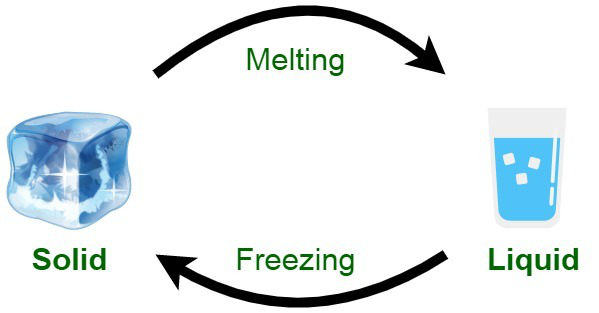
The process of a solid turning into a liquid state is called melting. It is also known as **fusion. The reverse process of a liquid becoming a solid is in turn called **solidification.
The temperature at which melting occurs for any pure substance is termed the **melting point of that substance. Melting point is considered to be a physical characteristic of any substance. To melt a substance from solid to liquid, there is always a requirement of energy and as it requires energy, it is an **endothermic reaction. Every pure substance requires a certain amount of energy which is required to change from a solid to a liquid state.
Energy is exclusively required to carry out the transition of the substance, from solid to liquid substance. The phase of a substance is changed, and the temperature remains unchanged. Therefore, melting is known to be an **isothermal process, since the substance remains at the same unmodified temperature.
**Check: **Thermal Properties of Matter
**Heating Curve for the Conversion of Solid to Liquid
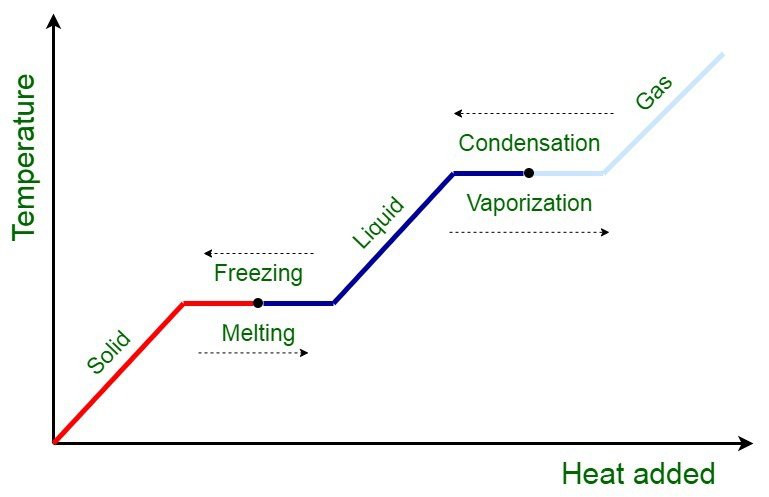
The heating curve denotes the temperature on the y-axis and the heat that has been supplied on the x-axis respectively. Let us assume a constant rate of heating, owing to which the x-axis can be shown as the amount of time that is shown as the substance is being heated. The curve majorly shows two main points:
- The portion of the graphs, where the temperature rises as and when heat is supplied to the system, and
- The portion of the graphs plateaus where the temperature remains at a constant level. Change in phase occurs at this plateau.
**Read More,
Sample Questions on Melting Point
**Question 1: What causes phase change?
**Answer:
When the temperature or pressure change of a system occurs, the phase changes. Upon increasing the temperature or pressure of the system, the intramolecular forces of attraction increase. Upon decreasing the temperature, the molecules or atoms turn into a rigid structure.
**Question 2: Does temperature change during the process of heating ice?
**Answer:
As we constantly supply heat energy to transform ice into water, the temperature of the system doesn't change. The heat energy is absorbed by the ice changing slowing into the liquid state. Both the states of matter coexist together during this process.
**Question 3: How does melting occur in the case of amorphous solids?
**Answer:
The non-crystalline solids, such as glass or pitch undergo melting by slowly decreasing viscosity with the simultaneous increase in the temperature. However, there is no sharp transformation from solid to liquid state.
**Question 4: Define the heat of fusion.
**Answer:
The amount of energy required by a pure substance to change from the solid to a liquid state is termed as the enthalpy of fusion (or heat of fusion) of the substance. It is denoted by ΔHfus.
**Question 5: Differentiate between boiling and melting.
**Answer:
Boiling is the process of melting of liquid to gas state whereas melting is the transformation of solid to liquid state.
**Question 6: How does energy change occur during melting?
**Answer:
Heat must be supplied to the enclosed system in order to simulate the melting of the substance. When energy is supplied the atoms composing the substance break away and are pulled apart farther.