Molecular Orbital Theory (original) (raw)
Last Updated : 18 Apr, 2026
Molecular Orbital Theory (MOT) is an advanced theory of chemical bonding that explains how atoms combine to form molecules by considering the behaviour of electrons in a molecule. According to this theory, when atoms approach each other, their atomic orbitals combine to form new orbitals called molecular orbitals. Unlike Valence Bond Theory, which explains bonding by overlap of atomic orbitals, Molecular Orbital Theory treats electrons as moving under the influence of all nuclei in the molecule.
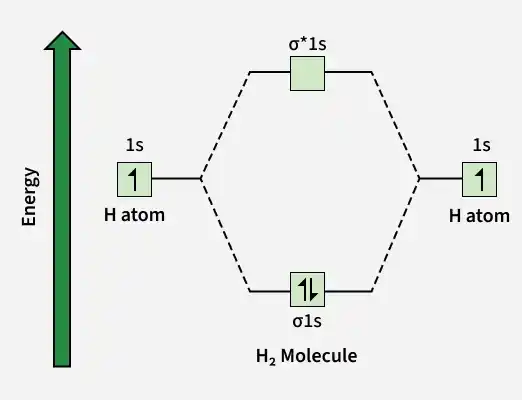
Features of MOT
- Molecular Orbital Theory states that molecular orbitals are formed by the linear combination of atomic orbitals of the combining atoms.
- These molecular orbitals belong to the entire molecule and are not confined to a single atom.
- The number of molecular orbitals formed is equal to the number of atomic orbitals that combine.
- When atomic orbitals combine, two types of molecular orbitals are formed: bonding molecular orbitals, which have lower energy and increase the stability of the molecule, and antibonding molecular orbitals, which have higher energy and decrease the stability.
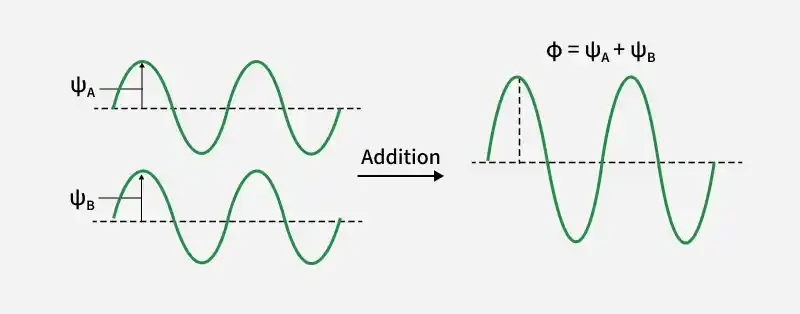
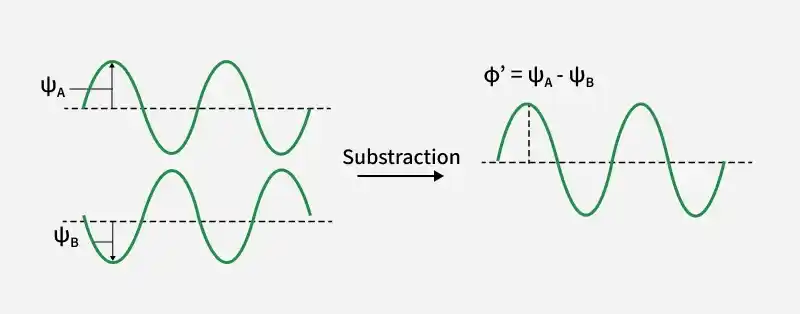
- Bonding orbitals are formed by constructive interference of wave functions, while antibonding orbitals are formed by destructive interference.
Linear Combination of Atomic Orbitals
Linear Combination of Atomic Orbitals (LCAO) is the basic mathematical approach used in Molecular Orbital Theory to explain how molecular orbitals are formed. According to this method, atomic orbitals of combining atoms add or subtract to form molecular orbitals.
When two atoms come close to each other, their atomic orbitals overlap. During this overlap, their wave functions combine either by addition or subtraction. This combination is called linear combination.
**There are two ways in which atomic orbitals combine:
**1. Constructive Combination (Addition of Wave Functions)
When the wave functions of atomic orbitals combine in the same phase (same sign), they add together. This increases the electron density between the two nuclei. As a result, a bonding molecular orbital is formed. Bonding molecular orbitals have lower energy than the original atomic orbitals and make the molecule more stable.
**2. Destructive Combination (Subtraction of Wave Functions)
When the wave functions combine in opposite phase (opposite signs), they cancel each other in the region between the nuclei. This decreases the electron density between the nuclei and forms an antibonding molecular orbital. Antibonding molecular orbitals have higher energy and reduce the stability of the molecule.
Mathematically, molecular orbitals are represented as:
**Bonding Molecular Orbital:
ψ=ψA+ψB
**Antibonding Molecular Orbital:
ψ=ψA−ψB
Where,
ψA and ψB
represent the atomic orbitals of atom A and atom B respectively.
**Conditions for Linear Combination of Atomic Orbitals
For atomic orbitals to combine and form molecular orbitals, certain conditions must be satisfied. If these conditions are not fulfilled, effective overlap will not occur and molecular orbitals will not form properly.
**1. Comparable Energy
The atomic orbitals that combine must have nearly the same energy. Orbitals with very different energies cannot combine effectively. For example, a 1s orbital cannot combine effectively with a 3p orbital because their energies are very different.
**2. Proper Orientation
The atomic orbitals must have correct orientation in space so that maximum overlap can occur. For example, p-orbitals must align properly along the internuclear axis to form sigma bonds.
**3. Significant Overlap
There must be sufficient overlap between atomic orbitals. Greater the overlap, stronger will be the bonding molecular orbital formed. If overlap is very small, bond formation will be weak or may not occur.
Molecular Orbitals
Molecular orbitals are the new orbitals formed when atomic orbitals of two atoms combine during bond formation. Unlike atomic orbitals, which belong to a single atom, molecular orbitals belong to the entire molecule. The electrons present in these orbitals are influenced by all the nuclei of the bonded atoms.
Molecular orbitals are formed by the linear combination of atomic orbitals (LCAO). The number of molecular orbitals formed is always equal to the number of atomic orbitals that combine.
**Types of Molecular Orbitals
According to molecular orbital theory, some types of molecular orbitals are formed by the linear combination of atomic orbitals. These orbitals are described in more detail below.
**1. Anti Bonding Molecular Orbitals:
Antibonding molecular orbitals are formed by destructive combination (subtraction) of atomic orbitals. Node formed between nuclei (no electron density). Electron density decreases in internuclear region.
**Example: Helium molecule (He2)
**2. Bonding Molecular Orbitals:
Bonding molecular orbitals are formed by the constructive combination (addition) of atomic orbitals. Electron density increases between nuclei (internuclear region). Energy is lower than atomic orbitals.
**Example: Hydrogen molecule (H2)
Characteristics of Bonding M**olecular Orbitals
- The probability of finding the electron in the bonding molecular orbital's internuclear region is greater than that of combining atomic orbitals.
- The electrons in the bonding molecular orbital cause the two atoms to be attracted to one another.
- Because of attraction, the bonding molecular orbital has lower energy and thus greater stability than the combining atomic orbitals.
- They are formed as a result of the additive effect of atomic orbitals.
**Characteristics of Anti-bonding Molecular Orbitals
- In the anti-bonding molecular orbitals, the probability of finding an electron in the internuclear region decreases.
- The electrons in the anti-bonding molecular orbital cause the two atoms to repel each other.
- Because of the repulsive forces, the anti-bonding molecular orbitals have more energy and less stability.
- They are formed by the atomic orbitals' subtractive effect.
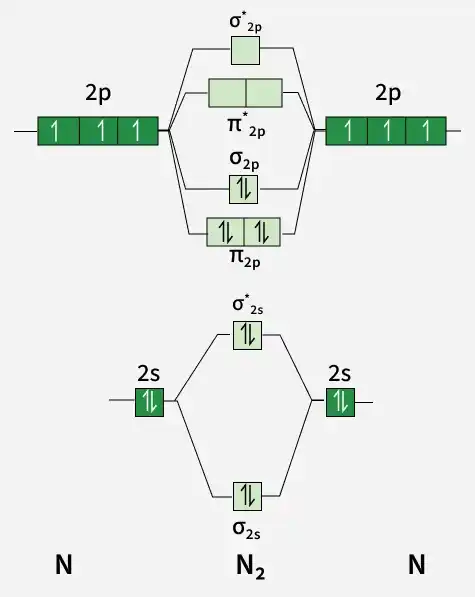
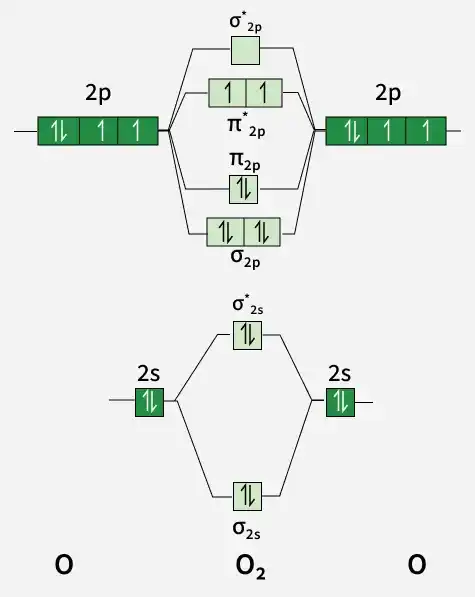
Energy Level Diagram
It shows the arrangement of molecular orbitals according to energy and how electrons fill them.
1. For molecules up to nitrogen (Z ≤ 7) like B₂, C₂, N₂:
- π2p orbitals are lower in energy than σ2p.
- Due to interaction (mixing) of s and p orbitals, energy levels shift .
- Electrons fill orbitals according to Aufbau principle, Pauli principle, Hund’s rule.
2. For oxygen and beyond (Z ≥ 8) like O₂, F₂:
- σ2p is lower in energy than π2p.
- Less s–p mixing compared to lighter molecules.
- σ2p fills before π2p.
- In O2 two electrons remain _unpaired in π orbitals which explains paramagnetism.
Bond Order
Bond order tells number of bonds between two atoms and stability of molecule
Bond Order=Nb−Na2\text{Bond Order} = \frac{N_b - N_a}{2}Bond Order=2Nb−Na
Where:
- Nb = electrons in bonding orbitals
- Na = electrons in antibonding orbitals
Related Articles:
Solved Examples
**Question 1: Calculate bond order of O₂
**Solution:
- Bonding electrons = 10
- Antibonding electrons = 6
Bond Order = (10−6 )/ 2 = 2
Bond order = 2 (double bond, stable)
**Question 2: Calculate bond order of N₂
**Solution:
- Bonding electrons = 10
- Antibonding electrons = 4
Bond Order = (10 − 4) / 2 = 3
Bond order = 3 (triple bond, very stable)