Molecular Speed Formula (original) (raw)
Last Updated : 23 Jul, 2025
Molecular speed is defined as the speed of the group of molecules in an ideal gas. Molecular speed is an important concept in the kinetic theory of gases. According to the kinetic theory of gases, the molecules of a gas are in constant motion and move in a straight line until they collide with another molecule. All the molecules of an ideal gas undergo elastic collision. It explains why small molecules diffuse more rapidly than large molecules. The molecular speed of a gas is directly proportional to its speed and inversely proportional to its molar mass. The molecular speed of a gas increases with an increase in the temperature of the gas. For example, Helium has the lowest molecular mass and thus has the highest molecular speed.
Types of Molecular Speed
The concept of molecular speed states that a cluster of atoms moves at a typical rate. The particles in an ideal gas don't come into contact with one another. Let us see different types of molecular speed and how to calculate them. Molecular speed can be of 3 types which are as follows:
**Average Molecular Speed
It is the average speed of a group of molecules in a gas. It is denoted using \bar{v} . It can be calculated using the formula:
\bar{v} = \sqrt{\frac{8RT}{\pi M}}
where,
- T is the temperature of the gas in Kelvin
- M is the molar mass
- R is the Ideal gas constant, 8.314 kg*m2/s2*mol*K
**Root Mean Square Speed
It is the measure of the speed of the particles in particular gas. It is denoted by vrms and can be calculated using the formula:
v_{rms} = \sqrt{\frac{3RT}{M}}
where,
- T is the temperature of the gas in Kelvin
- M is the molar mass
- R is the Ideal gas constant, 8.314 kg*m2/s2*mol*K
**Most Probable Speed
It is the speed which is acquired by most of the molecules in a gas. It is denoted by vp and can be calculated using the following formula:
v_{p} = \sqrt{\frac{2RT}{M}}
where,
- T is the temperature of the gas in Kelvin
- M is the molar mass
- R is the Ideal gas constant, 8.314 kg*m2/s2*mol*K
**Relation between Molecular Speeds
The volume of a gas molecule is little in relation to the whole volume of the container when it comes to the molecular speeds of a particle. The gas particles travel freely and with complete mobility. The force of attraction between the gaseous molecules is therefore absent.
- The relationship between average molecular speed, root mean square speed, and most probable speed is:
v_{rms}> \bar{v} > v_p
- The ratio between average molecular speed, root mean square speed, and most probable speed is:
u_{rms}: \bar{v}: u_{mp}:: 1:1.128:1.224
Maxwell Distribution of Molecular Speeds
Maxwell and Boltzmann derived an equation to find the distribution of various types of molecular speeds in a gas. The number of molecules per unit speed is indicated on the y-axis of the Maxwell-Boltzmann distribution graph. The quantity of molecules in the gas is represented by the total area under the whole curve. The peak of the graph will move to the right if we heat the gas to a greater temperature (since the average molecular speed will increase). The graph grows higher and more narrow as the gas gets colder, similar to how the graph shortens and widens as the gas heats up.
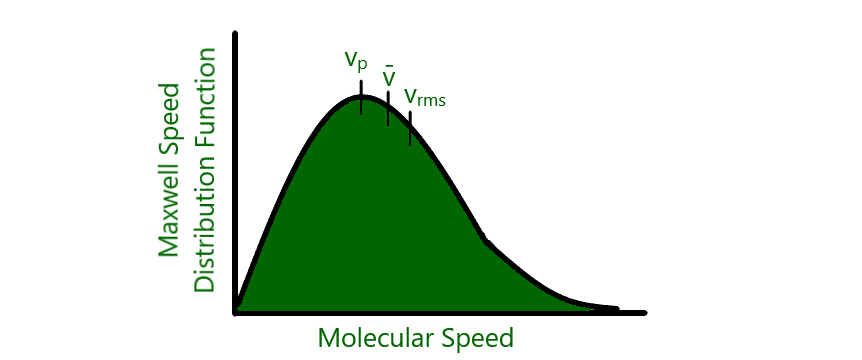
Maxwell Distribution of Molecular Speeds
Inferences from the Graph
- The most probable speed is represented by the peak of the curve. The average molecular speed is the speed that is just a little higher than the most probable speed. The root mean square speed coincides with the average kinetic energy of the gas molecules.
- The curve will spread and flatten out when we observe the gas at increasing temperatures.
- The shape of the curve is dependent upon the molar mass and temperature of the gas.
- The curve gets taller and flatter when we consider gases of increasing molar mass.
- With the increase in temperature, the most probable speed increases, and the peak of the curve shifts to the right. The particles of gas also tend to move faster.
Solved Examples on Molecular Speed
**Example 1: The temperature of gas with a molar mass of 2 g/mol is 900K. Calculate the root mean square speed of the particles of gas.
**Solution:
Given, M = 2g/mol, T = 900K
R = 8.314
v_{rms} = \sqrt{\frac{3RT}{M}}
= \sqrt{\frac{3*8.314*900}{2}}
= √11223.9
\therefore v_{rms} = 105.9 m/s
**Example 2: Calculate the most probable speed of Helium gas at 800K.
**Solution:
Given, T = 800K
For Helium, M = 4g/mol and R = 8.314
v_{p} = \sqrt{\frac{2RT}{M}}
= \sqrt{\frac{2*8.314*800}{4}}
= \sqrt{3325.6}
\therefore v_{p} = 57.66 m/s
**Example 3: Determine the speed of particles of m = 1 gr/mol and temperature 1500 k.
**Solution:
Given, M = 1g/mol, T = 1500K and R = 8.314
v_{rms} = \sqrt{\frac{3RT}{M}}
= \sqrt{\frac{3*8.314*1500}{1}}
= \sqrt{37413}
\therefore v_{rms} = 193.42 m/s
**Example 4: Compare the following quantities, the RMS velocity of oxygen at 80 °C and the RMS velocity of Hydrogen at 45 °C.
**Solution:
To compare the quantities, we shall calculate the rms for oxygen and hydrogen for the given conditions.
**Oxygen:
Given T = 80\degree C = 353K, Molar mass of oxygen (M) = 16g/mol
v_{rms} = \sqrt{\frac{3RT}{M}}
= \sqrt{\frac{3*8.314*353}{16}}
\therefore v_{rms_o} = 23.45 m/s
**Hydrogen:
Given, T = 45°, C = 318K, Molar mass of Hydrogen (M) = 2g/mol
v_{rms} = \sqrt{\frac{3RT}{M}}
= \sqrt{\frac{3*8.314*318}{2}}
\therefore v_{rms_h} = 62.97 m/s
Thus, rms velocity of hydrogen is more than Oxygen at the given conditions.
**Example 5: Find the average molecular speed of gas with a molar mass 19 g at 500K.
**Solution:
Given, T = 500K, M = 19g/mol
\bar{v} = \sqrt{\frac{8RT}{\pi M}}
= \sqrt{\frac{8*8.314*500}{3.14*19}}
\therefore \bar{v} = 23.60 m/s
**Question 1: What is meant by the kinetic theory of gases?
**Solution:
Based on the notion that a gas is made up of atoms or molecules that are moving quickly, kinetic theory describes how gases behave.
**Question 2: Why do smaller gas atoms travel more quickly?
**Solution:
Because of the molecular mobility of molecules, smaller gas particles travel more quickly. At all temperatures higher than absolute zero, they have kinetic energy. The average kinetic energy of gas molecules and temperature are directly inversely correlated. At the same temperature and pressure, lighter gases will also move at speeds that are higher than heavier gases.
**Question 3: What is meant by the degree of freedom?
**Solution:
The amount of independent ways that the system's path and configuration might vary is referred to as the degree of freedom.
**Question 4: Describe mean energy.
**Solution:
The mean energy or internal energy of one mole of gas is called the mean energy. It is represented by the letter U.