Periodic Classification of Elements (original) (raw)
Last Updated : 8 May, 2026
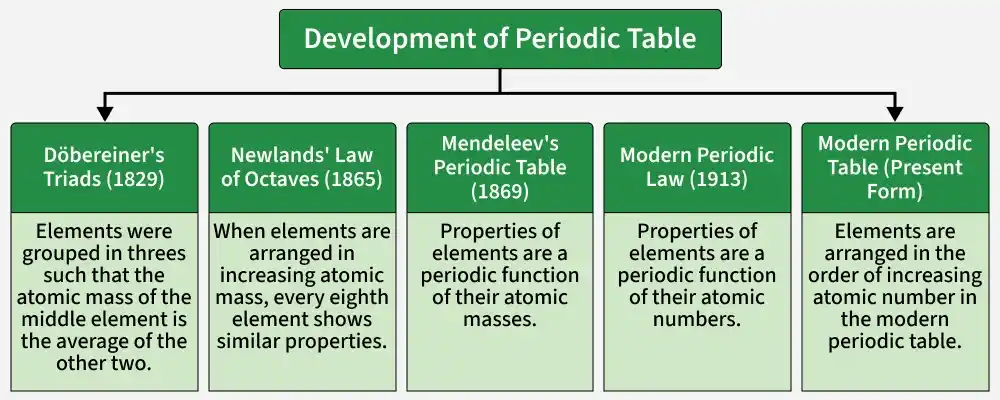
Periodic Classification of Elementsrefers to the arrangement of elements on the basis of the periodic repetition of their properties. It means the elements that exhibit similar properties on a regular interval are placed in the same group. Earlier, only 31 chemical elements were discovered in 1800. By 1869, about 63 elements were known. This necessitated the periodic classification of elements, as it was difficult to remember the properties of each element.
History of the Classification of Elements
Over time, as more and more elements were discovered, scientists noticed that elements with similar properties could be grouped together. To study and understand elements easily, many chemists proposed different ways of arranging them. This led to the development of the periodic table.
1. Döbereiner’s Triads
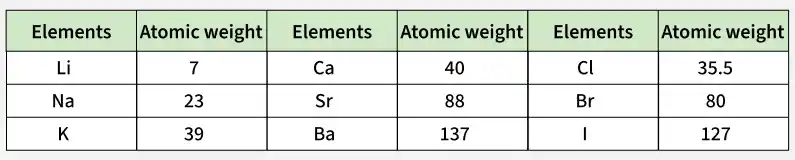
In 1829, Johann Wolfgang Döbereiner noticed that some elements could be grouped in sets of three based on their similar chemical properties. He called these sets triads. He placed 3 elements in a group and stated that the mass of the middle element is equal to the arithmetic mean of the other two elements. The group formed by him is shown below:
Mathematically:
\text{Atomic Mass of Middle Element} \approx \frac{\text{Atomic Mass of First Element + Atomic Mass of Third Element}}{2}
**Example:
**Alkali Metals:
- Lithium (Li) → Atomic Mass = 7
- Sodium (Na) → Atomic Mass = 23
- Potassium (K) → Atomic Mass = 39
Here, 23 = (7+39) / 2
Drawbacks of Döbereiner’s Triads
Although Döbereiner’s Triads were an important first step in classifying elements, this system had several limitations that prevented it from being applied to all known elements. Those are:
- Only a few elements could be arranged into triads, and many elements did not fit into any group.
- The system worked mainly for lighter elements and failed for heavier or newly discovered elements.
- It could not classify all known elements.
- In some cases, the atomic mass of the middle element was not exactly the average of the other two.
2. Newlands’ Law of Octaves
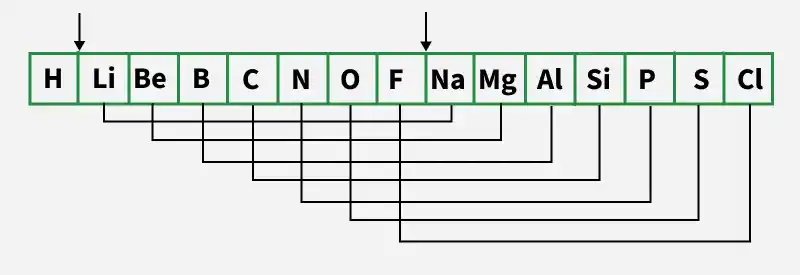
In 1864, John Newlands arranged the known elements in order of increasing atomic mass. He noticed an interesting pattern: every eighth element had properties similar to the first, just like the eighth note in a musical scale. He called this pattern the Law of Octaves.
The elements arranged in Newlands law of Octaves are discussed below,
Drawbacks of Newlands' Law of Octaves
Even though Newlands’ Law of Octaves showed a repeating pattern in element properties, it was not completely reliable and could not explain all elements, especially the heavier ones, which highlighted the need for a better system.
- It worked only for lighter elements.
- It did not leave gaps for undiscovered elements.
- Sometimes elements with different properties were placed together.
- It was not accepted for heavier elements because the pattern failed.
3. Mendeleev's Periodic Table
He stated that "The properties of elements whether physical or chemical are periodic functions of their atomic masses". He arranged the 63 known elements in order of increasing atomic mass. He also grouped elements with similar chemical properties together. This arrangement became the first widely accepted Periodic Table of Elements. He called the vertical column 'Groups' and horizontal rows 'Periods'.
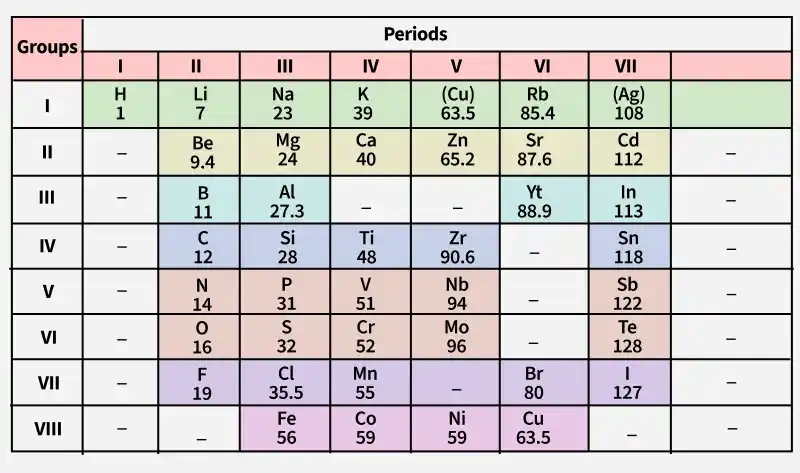
- Elements were arranged in rows (periods) according to increasing atomic mass.
- Elements with similar properties were placed in the same vertical columns (groups).
- Mendeleev left gaps for elements that were not yet discovered.
- He predicted the properties of undiscovered elements, such as gallium (Ga) and germanium (Ge).
Drawbacks of Mendeleev's Periodic Table
Although Mendeleev’s Periodic Table was a major breakthrough, it had some limitations that were later addressed by the modern periodic table. These were:
- Some elements were placed out of order according to atomic mass to keep similar properties in the same group.
- The position of hydrogen was unclear.
- Isotopes of elements could not be explained at that time.
4. Modern Periodic Table
Modern Periodic Table is a long-form periodic classification of elements based on the electronic configuration of elements. It has vertical columns called 'Groups' and horizontal rows called 'Periods'. There are 18 Groups and 7 Periods in Modern Periodic Table. The Modern Periodic Table was given by Henry Moseley in 1913.
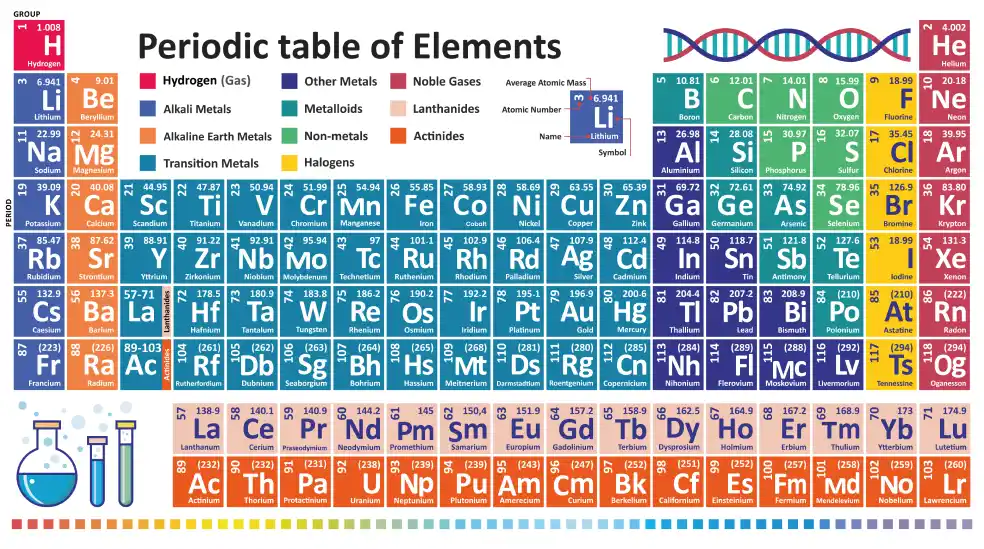
- Elements are arranged in increasing atomic number.
- Elements with similar chemical properties are placed in the same group.
- The table consists of 18 groups and 7 periods.
- It includes s-, p-, d-, and f-blocks based on electronic configuration.
Drawbacks of Modern Periodic Table
Although the modern table is highly accurate, it still has a few minor limitations.
- Some properties of transition and inner transition elements are more complex and do not always follow a simple pattern.
- Additionally, the table cannot fully explain the properties of super heavy or newly synthesized elements.
5. Modern Periodic Law
Modern Periodic Law became the basis of the Modern Periodic Table. It was given by Henry Moseley in 1913. It states that
Elements' physical and chemical properties are periodic functions of their atomic numbers and not atomic mass.