Polymers of Commercial Importance (original) (raw)
Last Updated : 23 Jul, 2025
Polymer word is made up of two terms, "poly" which means many, and "mer" which means entities or groups. So polymers mean giant molecules which consist of a large number of small molecules. The molecular mass of these giant molecules is quite high as these are formed by repeating small entities which are called monomers. The structure of monomers is the same as polymers but these are smaller molecules having covalent bonding among them. Polymers are formed from monomers and the process is called Polymerisation.
Some Important Properties of Polymers are:
- Polymers have a chain-like structure in which monomers are cross-linked to one another.
- Polymers are made from monomers so polymers have high molecular weights.
- Polymers are resistant to heat and can stand high temperatures.
- Polymers are highly flexible due to the dipole-dipole type of bonding across molecules.
- Crystalline polymers can change their state to become semi-crystalline under suitable conditions.
Polymers aregenerally of three main types depending on their sources that are:
- Natural Polymers: Natural polymers are those polymers that exist in nature and are formed naturally in animals and plants These polymers are important for humans and help in their survival.
- Examples of natural polymers are Cellulose, Proteins, Starch, natural rubber, etc.
- Semi-Synthetic Polymers: These type of polymers are between synthetic and natural polymers as these are the derivatives of polymers that occurs naturally but to form these polymers they need to be processed.
- For example, Cellulose acetate is also known as Rayon and Cellulose Nitrate both are derivatives of Cellulose so these are semi-synthetic polymers.
- Synthetic Polymers: A large number of polymers are produced commercially by applying different processes so these polymers are known as synthetic polymers.
- For example, Buna - S, and Nylon 6,6 are some of the synthetic polymers.
Polymers of Commercial Importance
Polypropene
Polypropene is a synthetic polymer that is formed by the repetitive joining of propene. Propene is the monomer of Polypropene. The structure of polypropene is given as (-C2H5CH-)n Polypropene is commercially important as it is used in the preparation of different useful materials like fibers, ropes, pipes, etc.

Polypropene
Properties of Polypropene
- Semi-Rigid: Polypropene is semi-rigid so they are used in making flexible and strong pipes, semi-rigid property allows it cross-links chain-like structures to make ropes.
- Chemical Resistant: It is resistant to the effects of chemicals, so due to this property polypropene does not degrade easily and provide long life to it.
- Crystalline melting point is increased by the position of the methyl group in carbon atoms at alternate positions in the chain.
- Translucent: Polypropene is translucent in nature means it allows sunlight to pass through it.
Polystyrene
Polystyrene is a synthetic polymer that is formed from aromatic hydrocarbons, styrene is its monomer. Polystyrene is insoluble in water and has a high boiling point of 430°C. Polystyrene can be synthesized in solid form or foamed form.
It is used as a wrapping material to provide coverage to important materials, cabinets of television are made of polystyrene, and it is also used in making radios.

Polystyrene
Properties of Polystyrene
- Easy Processing: Polystyrene is easy to process as it is prepared by heating ethylene glycol and terephthalic acid at a suitable temperature.
- Low cost: As polystyrene is easy to process so it can be produced at a large scale easily hence its cost is low as compared to other commercially important polymers.
- Solubility: Polystyrene is not soluble in alcohol but it can be easily dissolved in aromatic solvents and also in chlorinated solvents.
Polyvinyl Chloride (PVC)
PVC is formed by combining a large number of molecules of vinyl chloride. Vinyl chloride is the monomer of polyvinyl chloride. Nearly 4 crore tons of PVC is manufactured each year.
It ranks third in the production of synthetic polymers. It is used in making raincoats and especially in water pipes.

Polyvinyl Chloride (PVC)
Properties of Polyvinyl Chloride (PVC)
- Density: The density of PVC is high as compared to other plastics.
- Strength: PVC has a high tensile strength in its rigid form.
- Hardness: PVC is tough, hard, and durable in nature and hence is used in many applications like making water pipes.
- Formation: PVC can be prepared by Suspension polymerization, Emulsion polymerization, and Bulk polymerization processes.
Glyptal
Glyptal is a synthetic polymer that is formed by monomers of Ethylene glycol and Phthalic acid. Glyptal is used in the manufacturing of paints, fabrics, lacquers etc.

Properties of Glyptal
- Formation: Phthalic anhydride and glycerol monomer is used in the formation of Glyptal.
- It is a thermosetting polymer and is tough in nature and has a high degree of polymerization.
- Glyptal is insoluble in alcohol and is used in making paints.
Bakelite
Bakelite is a synthetic plastic. It is also known as Polyoxybenzylmethylenglycolanhydride. Phenol and Formaldehyde are used as monomers to produce bakelite which is formed by the condensation reaction of these monomers.
Its appearance is brownish and it is solid in nature. It is used for making electrical switches as it is resistant to heat, and it is also used in making utensil handles and combs.

Bakelite
Properties of Bakelite
- Preparation: Bakelite is prepared by the condensation reaction of phenol and formaldehyde under suitable temperature conditions.
- Bakelite could be molded easily means it takes less time in production.
- It has high heat-resistant properties and hence it is used in making string heat-resistant materials like handles of utensils.
- It is resistant to chemicals and the polymer is lightweight.
Natural Rubber
Natural Rubber is a natural polymer that is composed of polyisoprene molecules linked together to form an elastomeric structure. These are held together by weak intermolecular forces known as van der Waals forces. Natural rubber is used for various purposes like making tires, rubber bands, lid grippers, etc.

Natural Rubber
Properties of Natural Rubber
- It is not resistant to heat so it melts easily at a temperature of about 80 degrees.
- It has excellent elastic properties.
- It is also abrasion-resistant and tear-resistant.
- Strength can be improved by the vulcanization of rubber.
Polypropylene
It is a hydrocarbon polymer that has a linear structure. It is a multifaceted polymer as it has properties of plastic as well as fiber and hence is used for multi-purposes. Propylene is the monomer of polypropylene and can be given the formula CnH2n. It started producing commercially in 1957.

Polypropylene
Properties of Polypropylene
- Temperature Resistance: Polypropylene does not melt easily when exposed to heat, it can withstand a temperature of 160 degrees Celsius.
- Polypropylene is available in three grades which are Homopolymers, Block copolymers, and Random copolymers.
- Polypropylene is resistant to acids, alkalies, grease/oil, and alcohol.
- Bowls, battery cases, toys bottle caps, etc are prepared from polypropylene.
Polyethylene Terephthalate
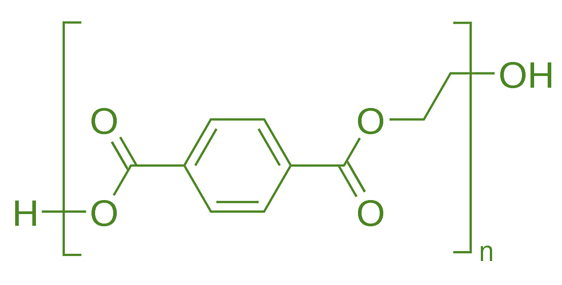
Polyethylene Terephthalate also termed PET is a thermoplastic polymer. Ethylene glycol and terephthalic acid are used in the preparation of Polyethylene Terephthalate.
DuPont was the first chemist to prepare PET in 1940. It is used in making different useful things like containers for packing food and drinks.
Properties of Polyethylene Terephthalate
- It is fully recyclable and hence does not pollute the environment.
- It is used in making fabrics as it has fabric properties.
- It has high strength along with light in weight properties which makes it one of the most favorable polymers.
- PET is shatterproof and cannot break into pieces like glasses and is hence easy to transport.
Polytetrafluoroethylene (PTFE)
Polytetrafluoroethylene also termed PTFE is a fluoropolymer. It is slippery in nature and is highly resistant to heat. It also does not have any visible effect of chemicals on it.
It was first discovered by Roy Plunkett in 1938. The monomer of polytetrafluoroethylene is tetrafluoroethylene which is colorless in nature.

Polytetrafluoroethylene
Properties of Polytetrafluoroethylene
- It is a flame-resistant polymer and hence it is widely used in making cookware.
- It is also used to provide a coating to metallic equipment to protect them from corrosion.
- It is strong and tough and due to these physical properties, it is used in industries for making pipe liners and bearings.
- The friction coefficient of Polytetrafluoroethylene is low so it is used as a solid lubricant.
Neoprene
Neoprene is a synthetic rubber that is formed from chloroprene. It is prepared by free radical polymerization. It is somewhat polluting as its preparation releases some harmful gases.
The monomer of neoprene is chloroprene. It is a good rubber and is more strong as compared to natural rubber. It is used for preparing gaskets, conveyor belts, etc.

Neoprene
Properties of Neoprene
- It is highly resistant to mineral and vegetable oil.
- It is chemically stable and can also withstand high temperatures as compared to natural rubber.
- It is an insulator means it does not allow the flow of current through it.
- It is one of the good sealants as it prevents water from entering the surface.