Polysaccharides Definition, Types, Features, Examples (original) (raw)
Last Updated : 8 Mar, 2022
A biomolecule, sometimes known as a biological molecule, is a term that refers to molecules found in living things that are required for one or more biological processes, such as cell division, morphogenesis, or development. Large macromolecules (or polyanions) like proteins, carbohydrates, lipids, and nucleic acids, as well as tiny molecules like primary metabolites, secondary metabolites, and natural products, are all examples of biomolecules. Biological materials is a more broad term for this type of material. Biomolecules are essential components of living creatures. While endogenous biomolecules are created within the organism, organisms typically require external biomolecules, such as specific nutrients, to exist.
Polysaccharides
Polysaccharides are linear or branched chains generated by connecting monosaccharide units with glycosidic connections. Polysaccharides, then, are monosaccharide polymers. Glycosidic linkages are used to connect the monosaccharide units.
Features of Polysaccharides
- Glycans are a type of non-sugar.
- Polysaccharides are biological compounds with a significant molecular weight.
- Many of them are water-insoluble.
- Polysaccharides do not have a sweet flavour.
- Desiccation turns them into an amorphous powder.
- Polysaccharides are polymers of simple sugars connected together by glycosidic linkages, which are covalent connections.
- Polysaccharide terminal ends can be either reducing (the terminal carbon atom is not involved in the glycosidic link) or non-reducing (the terminal carbon atom is involved in the glycosidic bond) (terminal atom involved in glycosidic bond)
- Polysaccharides have the general formula (C6H10O5)n, where n is the number of monosaccharide units and can range from 100 to 2500.
Types of Polysaccharides
Polysaccharides are polymers made up of monomeric units that might be of the same or distinct types. Polysaccharides are categorised as follows based on the sort of monosaccharide units that make them up:
- Homopolysaccharides/Homoglycans: When the monomeric unit is only one type, such as starch, cellulose, glycogen, chitin, and so on.
- Heteropolysaccharides/Heteroglycans: When the monomeric units have distinct types of monomers. Hyaluronic acid, gamma globulins, heparin, and other polysaccharides may contain lipid or protein components as well.
Polysaccharides can be categorised into the following categories based on their functional roles:
- Storage polysaccharides: Which are used as food storage or reserve energy, such as starch and glycogen.
- Structural polysaccharides: They primarily contribute to the creation of structural components of cells including cell walls, such as cellulose, hemicellulose, and lignin.
Examples of Polysaccharides
- Starch
- This is the most prevalent food storage polysaccharide discovered in plants.
- Glucose, the photosynthetic end product, is transformed to starch and stored in various plant sections.
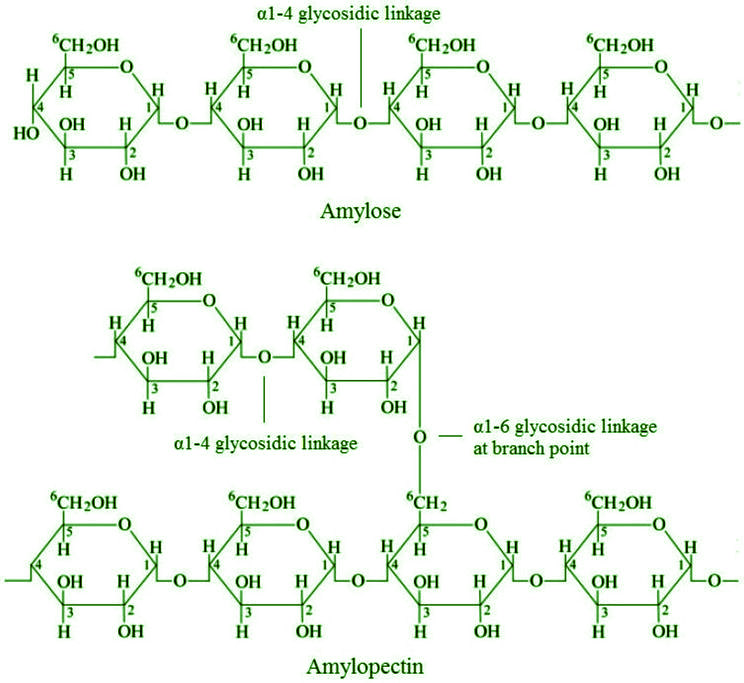
- It's a polymer made up of α–D- glucose subunits that comes in two varieties: amylose and amylopectin.
- Amylose is an unbranched polymer made up of α–D– glucose subunits linked by α–1,4 glycosidic bonds.
- An amylopectin is a branching form of starch in which the α–D– glucose subunits are joined by α–1,6 glycosidic bond.
- Approximately every 20 to 30 glucose residues in the chain, branching emerges.
- Amylase enzymes found in saliva and the small intestine rapidly hydrolyze starch.
- Amylose is found in a coiled form in nature. It has gaps to accommodate the iodine molecules that form amylose-iodine complexes in this condition. These complexes are blue-black in colour, thus when starch is treated with iodine, it turns blue-black.
- Cellulose
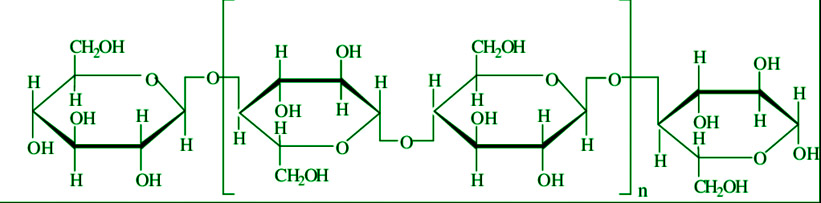
- Another main polymer of β–D- glucose discovered in plants is this one.
- It's a fibrous, tough, and insoluble water polymer.
- Glucose units are connected in a straight chain by β–1,4 glycosidic connections.
- Hydrogen bonding occurs between the adjacent chains,
- Resulting in a fibril with tensile strength.
- Because humans lack the enzyme 'cellulase,' which breaks down the beta bonds in cellulose, they are unable to digest it.
- Glycogen
- In mammals, glycogen is the major storage polysaccharide.
- Glycogen is similar to plant starch and is often referred to as animal starch.
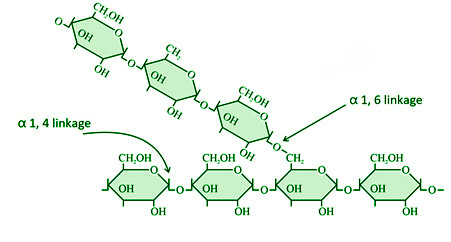
- Glycogen, like starch, is a polymer of glucose.
- In straight chains, glucose units are joined by α–1,4 glycosidic links, while branching points are linked by α–1,6 glycosidic linkages.
- The difference between starch and glycogen is that glycogen has a lot of branching in its chains.
- The average length of the chain is 8-10 glucose residues.
- Glycogen is largely stored in the liver and muscles in animals, while glycogenesis occurs primarily in the liver.
- It functions as the animal body's energy reserve.
- Glycogen serves as a glucose storage facility in the body.
- Hemicellulose
- It's a polysaccharide made up of a variety of sugars found in plants.
- Hemicellulose contains glucose and acetyl derivatives of glucose.
- Hemicellulose, like cellulose, is found in the plant cell wall and provides strength to the cells.
- Inulin
- Many plants generate inulin, which is a naturally occurring carbohydrate.
- It's a polymer made up of beta fructose residues linked by β–1,2 links.
- Inulin is a storage polysaccharide found naturally in plants that do not retain starch.
- Chicory root is the primary source of commercial inulin extraction.
- Inulin is used in food manufacture as a sugar, fat, and wheat substitute, as well as in medicine to assess kidney function.
- Inulin has antibacterial effects as well.
- Chitin
- Chitin is carbohydrate-containing nitrogen that is mostly found in arthropods and fungi.
- A polymer made up of monomers of N-acetyl-D-glucosamine connected by a β–1,4 glycosidic bond.
- It is a key component of the exoskeleton of insects such as beetles, bees, and cockroaches, as well as arthropod creatures such as crabs and prawns.
- A significant component of the fungal cell wall is chitin.
- Chitosan is a chitin derivative that is water-soluble.
- Commercially, it's employed as a biopesticide in agriculture and in winemaking. Because of its therapeutic characteristics, it is also employed in medicine.
- Pectin
- Pectin is a heteropolysaccharide found in plant cells' cell walls.
- Galacturonic acid, a galactose derivative, is the main component.
- It's found in plant cells' primary and middle lamellae, as well as their cell walls.
- Fruit fiber is also a source of this nutrient.
- Commercially, pectin is utilised as a gelling ingredient in jams and jellies.
- Pectin is used in wound healing as well as speciality medical adhesives.
- Bacterial Polysaccharides
- Bacterial polysaccharides are a group of polysaccharides and carbohydrate derivatives found in bacterial cell walls and membranes.
- Peptidoglycans, lipopolysaccharides, and exopolysaccharides are examples of bacterial polysaccharides.
- The main component of the bacterial cell wall is peptidoglycan.
- Thick mucus-like polysaccharides secreted by pathogenic bacteria form a capsule-like structure around them.
Sample Questions
Question 1: What are Polysaccharides?
Answer:
Polysaccharides are linear or branching chains made up of monosaccharide units linked together by glycosidic bonds. Polysaccharides are polymers made up of monosaccharide monomers. The monosaccharide units are linked together using glycosidic bonds.
Question 2: What are the functions of polysaccharides?
Answer:
Polysaccharides have two purposes.
- They are used by plants and animals to store food reserves.
- They make up the structural components of living species' bodies.
Question 3: What are the food sources of polysaccharides?
Answer:
Few examples of foods that are high in polysaccharides:
- Tubers—Starch is found in potatoes, sweet potatoes, and tapioca.
- Starch is found in seed grains such as rice, wheat, and maize.
- Fruits contain pectin;
- Polysaccharides are abundant in plant gums and resins.
Question 4: What are the examples of polysaccharides?
Answer:
Polysaccharides include cellulose, starch, glycogen, and chitin . In plants and animals, starch and glycogen are store polysaccharides, whereas cellulose and chitin are structural polysaccharides.
Question 5: What is Hemicellulose?
Answer:
It's a polysaccharide composed of many sugars found in plants. Glucose and glucose acetyl derivatives are found in hemicellulose. Hemicellulose, like cellulose, is found in the cell wall of plants and gives them strength.