Reactivity Series (original) (raw)
Last Updated : 8 Apr, 2026
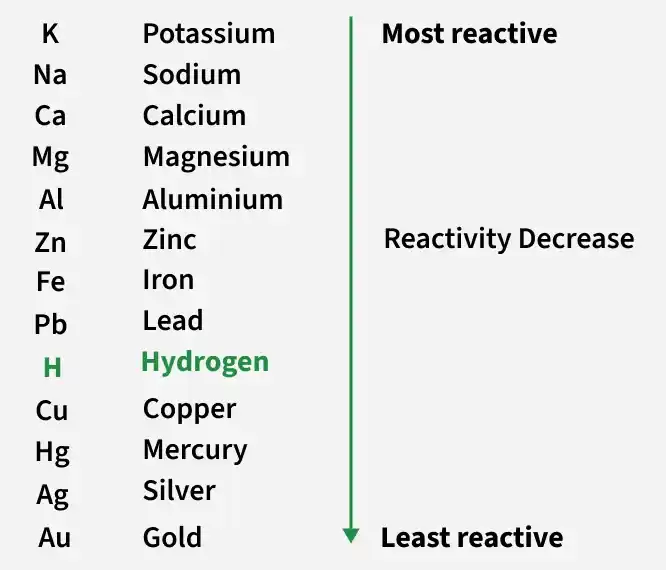
The reactivity series (or activity series) is a list of metals arranged in decreasing order of their reactivity. The most reactive metals, such as potassium and sodium, are placed at the top, while the least reactive metals, such as gold and platinum, are placed at the bottom.
Reactivity refers to the tendency of a metal to lose electrons and form positive ions. Metals that lose electrons easily are highly reactive, whereas those that do not are less reactive. Some Key Features to Remember:
- Metals at the top are highly reactive and easily oxidized.
- Metals at the bottom are less reactive and more stable.
- Reactivity decreases down the series.
- Metals above hydrogen can displace hydrogen from acids.
- Highly reactive metals corrode easily and may react violently with water or air.
- Lower metals are often found in a native (free) state.
**Important Reactions
**1. Reaction with Water
Metals like potassium, sodium, and calcium react with water to form metal hydroxide and hydrogen gas.
**Example: 2K + 2H₂O → 2KOH + H₂
- Top metal : React with cold water
- Middle metals : React with steam
- Lower metals : No reaction with water
with cold water
**2. Reaction with Acids
Metals above hydrogen react with dilute acids to produce salt and hydrogen gas.
**Example: Fe + H₂SO₄ → FeSO₄ + H₂
**3. Single Displacement Reaction
A more reactive metal displaces a less reactive metal from its compound in solution.
**Example: Cu + 2AgNO₃ → Cu(NO₃)₂ + 2Ag
**4. Reaction with Bases (Special Case)
Some metals like zinc react with strong bases to form complex salts and hydrogen gas.
**Example: Zn + 2NaOH → Na₂ZnO₂ + H₂
**Properties of Reactivity Series
- Metals at the top have high reducing power and lose electrons easily
- The electropositive character decreases down the series
- The ability to reduce other metals decreases down the series
- Extraction of highly reactive metals requires more energy
**Uses of Reactivity Series
- Predicts reactions of metals with water, acids, and bases.
- Helps determine displacement reactions.
- Useful in metallurgy (extraction of metals).
- Explains corrosion behavior of metals.
**NOTE:
- Aluminum is reactive but protected by a thin oxide layer, preventing corrosion.
- Gold and platinum are very unreactive and resist corrosion
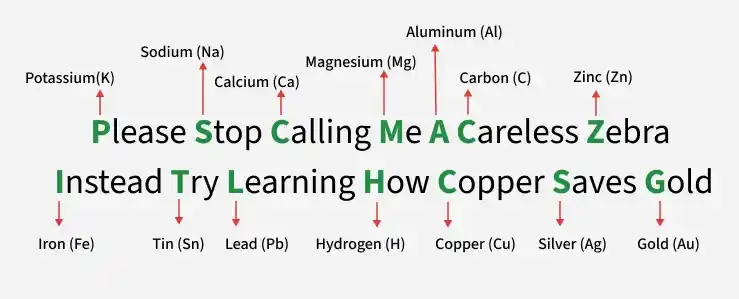
Mnemonic To Learn Reactivity Series