Saturated and Unsaturated Solutions (original) (raw)
Last Updated : 23 Jul, 2025
Saturated and Unsaturated Solutions are the types of solutions based on the concentration of solute in the solvent for any given solution. A saturated solution is one that contains the maximum amount of solute capable of being dissolved at a given temperature, whereas unsaturated solutions contain less than the maximum amount of solute capable of being dissolved at a given temperature. Because carbonated water is saturated with carbon, it emits carbon through bubbles. Sand in water is an example of an unsaturated.
Solution Definition
Solution is a homogenous mixture of two components: solute and solvent. The solute is the component that is present in the minority and the solvent is the component that is present in the majority. A solute must be added to a solvent in order for a solution to form. At first, the solute dissolves in a solvent and forms a homogeneous solution. A solution in which solutes dissolve is referred to as an unsaturated solution. A solution is made up of two types of particles: solutes and solvents. Water is commonly used as a solvent (which is one of the reasons why water is also called the universal solvent) Some examples of solutions are,
- A solution of sugar in water
- A solution of salt in water
- A solution of air in water
- A solution of oxygen in nitrogen
**Saturated Solution
**Saturated Solution is defined as follows,
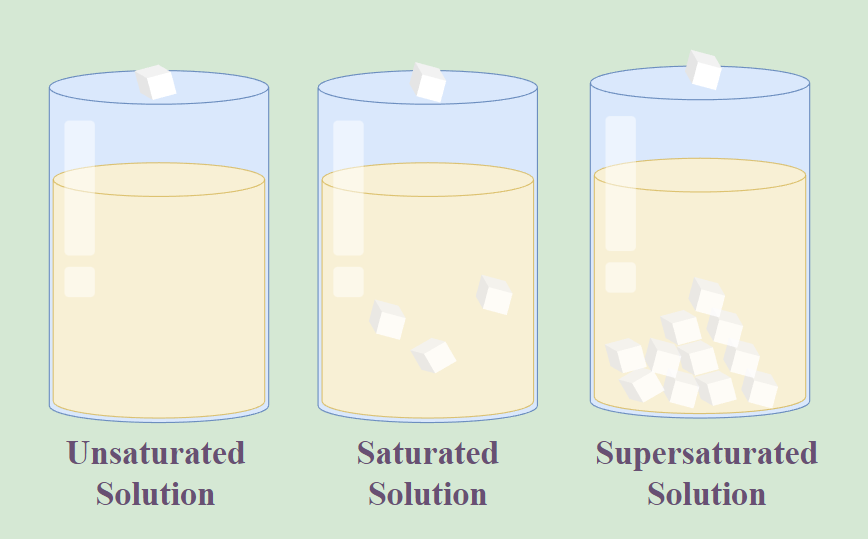
A saturated solution is a chemical solution that contains the largest quantity of solute contained in the solvent at the given temperature. The solute cannot be dissolved anymore in a saturated solution at that temperature.
The saturation point of any liquid is determined by the type of the material and the temperature. A saturated solution is one in which the quantity of dissolved solute equals the saturation point of the solvent. A solvent can dissolve some particular types of solutes in it.
When the maximum amount of solute is dissolved in a solvent at a specified temperature then the solution can be termed as **saturated solution. A saturated solution must not be heated as on heating the solution will become unsaturated. A solution cannot dissolve any more solute further upon reaching saturation. The undissolved substances remain at the bottom. The point at which the solute stops dissolving in the solvent is termed the **saturation point.
**Examples of Saturated Solution
Some examples of Saturated Solutions are as follows:
- Soil is a saturated mixture consisting of nitrogen. On attaining the saturation point, the excess nitrogen is emitted out into the air in the form of gas.
- Beverages, such as cold drinks are saturated solutions of dissolved CO2 in water.
- Protein drinks which is a saturated solution of protein powder in milk or any other solvent.
**Unsaturated Solution
**Unsaturated Solution is defined as,
The solution in which more solute can be added at a given temperature is called unsaturated solution. Unsaturated solutions have the ability to dissolve additional solute until they achieve saturation. Solutes will no longer dissolve in the solvent after reaching the saturation threshold, resulting in unsaturated solutions.
As a result, all solutions are considered to be largely unsaturated in nature before being transformed into saturated solutions by adding solute to them. The amount of solute that is contained in lesser amounts than the maximum value, that is before the solution reaches the saturation level is called an **unsaturated solution. An unsaturated solution is basically a chemical solution that has a solute concentration lesser than its corresponding equilibrium solubility.
**Examples of Unsaturated Solution
Some examples of Unsaturated Solutions are as follows:
- Salt or sugar dissolved in the water below the saturation point.
- Air or mist.
- Iced coffee.
- Vinegar is the acetic acid solution in water.
**Interconversion of Saturated and Unsaturated Solution
Saturated solution on heating becomes unsaturated whereas an unsaturated solution becomes saturated upon cooling. On heating the saturated solution, the solubility of that particular solute increases in the given solvent. As a result of this, more solute can be dissolved into the solvent. However, in the case of cooling a solution, the solute particles which were initially dissolved in the solvent separate out as crystals.
Supersaturated Solution
**Supersaturated Solution is defined as,
The solution in which more solute is added exceeding the saturation limit at given temperature is called Supersaturated Solution.
A supersaturated solution is prepared by adding more and more solute upon heating. We know that upon heating a saturated solution becomes unsaturated on heating, in this heated solution add more solute and keep this process going by elevating the temperature and adding more solutes and cooling it thus making the solution supersaturated as compared to the initially saturated solution.
Difference between Saturated and Unsaturated Solution
The key differences between Saturated and Unsaturated solutions are as follows:
| **Property | **Saturated Solution | **Unsaturated Solution |
|---|---|---|
| Dissolved Solute Concentration | Contains the maximum amount of solute that can be dissolved at a given temperature | Contains less solute than the maximum amount that can be dissolved at a given temperature |
| Equilibrium State | In a dynamic equilibrium where the rate of dissolution equals the rate of precipitation | Not in a dynamic equilibrium, as the rate of dissolution is higher than the rate of precipitation |
| Solvent Capacity | Solvent is unable to dissolve any additional solute without changing temperature or pressure | Solvent has the potential to dissolve more solute |
| Precipitation | No visible precipitation occurs under normal conditions | Precipitation may occur when an additional solute is added |
| Temperature Effect | Saturated solution temperature affects solubility (higher temperature can dissolve more solute) | Temperature has no significant effect on solubility |
| Conductivity | Conductivity is at its maximum as ions are in equilibrium | Conductivity is lower due to fewer ions in the solution |
| Appearance | Appears clear and transparent | May appear cloudy or contain undissolved particles |
How to find whether the given Solution is Saturated or Unsaturated?
To find whether any given solution is saturated or not, we can use the following steps:
**Step 1: Add a small amount of solute to the solution.
**Step 2: Stir the solution thoroughly.
**Step 3: If the solute dissolves, the solution is unsaturated.
**Step 4: If the solute does not dissolve, the solution is saturated.
**Read More,