Some Commercially Important Alcohols (original) (raw)
Last Updated : 27 Mar, 2026
Commercial alcohol is alcohol that is utilized for commercial purposes. Methanol and ethanol are the most commonly used commercial alcohols.
Methanol and ethanol are the most basic members of the primary alcohol family, with numerous applications in the fuel industry.
Methanol
Methanol is also known as methyl alcohol. It is also called "wood spirit" or "wood alcohol" since it was first made via destructive distillation of wood. It has the chemical formula CH₃OH.
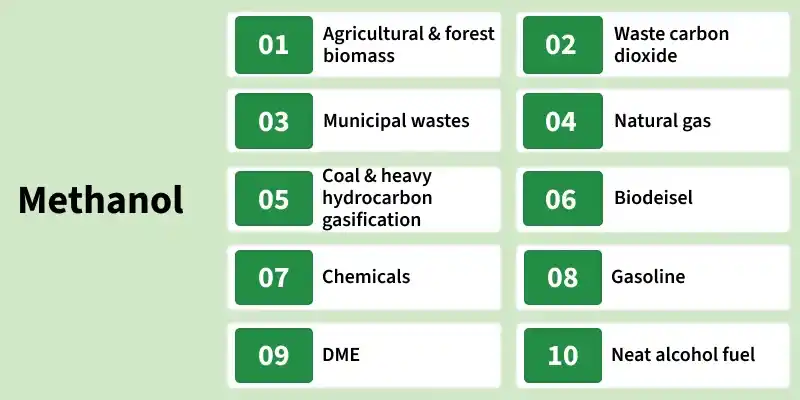
**Uses of Methanol
- As a paint and varnish solvent.
- As an antifreeze for car radiators.
- In the production of formaldehyde, which is commonly utilized in the production of plastics.
- To denaturize ethyl alcohol, that is, to render it unfit for human consumption. Methylated spirit is another name for denatured alcohol.
- As a vehicle fuel
- In the production of fragrances, pharmaceuticals, and varnishes.
Ethanol
Ethanol is also known as ethyl alcohol. It is the most important member of the alcohol family and is simply referred to as alcohol. Because it may be made from starch grains, it is also known as grain alcohol. It has the chemical formula C₂H₅OH.
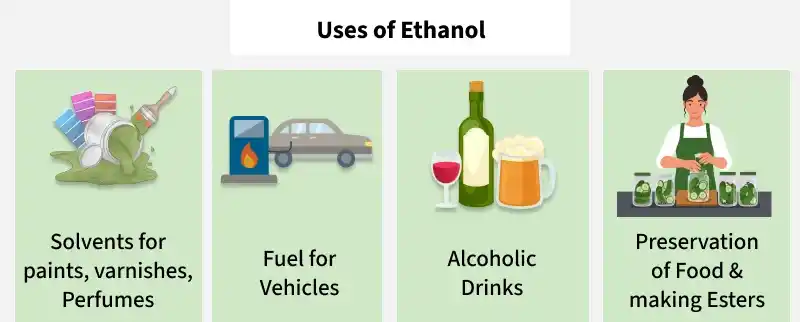
**Uses of Ethanol
- As an industrial solvent for paints, lacquers, dyes, varnishes, costumes, perfumes, and other similar products.
- In the production of ether, chloroform, iodoform, acetaldehyde, acetic acid, and other chemicals.
- Thermometers and spirit levels are examples of scientific instruments.
- In automobile radiators as an antifreeze.
- As biological specimen preservation.
Industrial Alcohols
Ethanol is one of the most significant basic ingredients and is widely used. It is available in various purity grades for a variety of applications. Among them are:
**1. Ethanol is widely used in different purity levels.
**2. Absolute alcohol (100% ethanol):
- Obtained by removing water from 95% ethanol using benzene and distillation.
- Used in fuels, solvents, and alcoholic drinks.
**3. Alcoholic beverages: Contain ethanol as the intoxicating agent.
- _Undistilled: Wine (from fruits)
- _Distilled: Whiskey, rum, brandy, gin (higher alcohol content)
**4. Methylated spirit (denatured alcohol):
- Ethanol mixed with methanol, copper sulfate, and pyridine to make it undrinkable.
- Used as fuel, in cleaning (e.g., glass cleaners), and in industries.
**5. Power alcohol:
- Mixture of 20% ethanol and 80% petrol (with solvent added).
- Used as an alternative fuel, especially useful where petrol is limited.
Harmful Effects of Drinking Alcohol
When drunk in significant amounts, ethanol depresses the central nervous system by delaying metabolic processes. This can lead to a loss of coordination, mental disorientation, and tiredness. Drunkenness is caused by the consumption of modest amounts of weak ethanol, and a person may feel comfortable after taking alcohol but lose his sense of judgement. Muscular coordination may be severely compromised as well. In addition, long-term alcohol consumption causes major health concerns.
Methanol consumption is extremely dangerous and may result in death. It is metabolized to methane in the liver and rapidly interacts with cell components, causing protoplasm coagulation. It also has an effect on the visual nerve, which can lead to blindness.