Stoichiometry and Stoichiometric Calculations (original) (raw)
Last Updated : 6 May, 2026
Stoichiometry is the branch of Chemistry that deals with the quantitative relationships between reactants and products in a chemical reaction. It helps us determine how much of each substance is needed or produced in a reaction. It is based on the Law of Conservation of Mass, which states that matter cannot be created or destroyed during a chemical reaction. Therefore, the number of atoms of each element remains the same before and after the reaction.
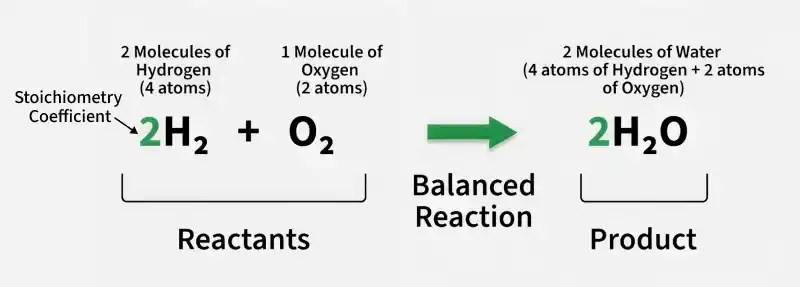
In general, all chemical reactions depend on one key factor: the amount of substance present. Stoichiometry helps measure and calculate important quantities, such as:
- Mass of reactants and products
- Number of moles involved
- Molecular and molar masses
- Volume of gases participating in reactions
**Stoichiometric Coefficient
The stoichiometric coefficient is the number written in front of a chemical formula in a balanced chemical equation. It represents the number of molecules or moles of a substance participating in the reaction.
Consider the following equation:
aA + bB ⇌ cC + dD
The Stoichiometric coefficients of A, B, C, and D, respectively, are a, b, c, and d in this equation.
- Stoichiometric coefficients establish the mole ratio between reactants and products.
- These coefficients are usually written as whole numbers, although fractional coefficients can be used during intermediate steps.
**Example:
3Fe + 4H_2O \rightarrow Fe_3O_4 + 4H_2
- 3 moles of iron react with 4 moles of water
- 1 mole of iron oxide and 4 moles of hydrogen gas are formed
**Balanced Reactions and Mole Ratios
- In Stoichiometry, calculations are based on a Balanced Chemical Equation.
- A balanced equation is a chemical equation in which the number of atoms of each element is the same on both sides of the equation.
- This follows the Law of Conservation of Mass, which states that matter cannot be created or destroyed during a chemical reaction.
- Balancing an equation ensures that the reactants and products are in the correct proportion.
Example:
2H2+O2→2H2O
The number of atoms on both sides is equal:
- Hydrogen atoms = 4 on both sides
- Oxygen atoms = 2 on both sides
- The Mole Ratio is the ratio of moles of one substance to another substance in a balanced chemical equation.
- The mole ratio is obtained from the coefficients of the balanced equation.
**Example:
2H2+O2→2H2O
The mole ratios are:
- H2 : O2 = 2 : 1
- H2 : H2O = 2 : 2
- O2 : H2O = 1 : 2
Order of Balancing Chemical Equations (Stoichiometry)
While balancing a chemical equation, elements are balanced in a systematic order to ensure conservation of mass. The general rule is to start with elements that appear in the fewest compounds and leave the most common elements for the end.
- Write the unbalanced equation and list all atoms on both sides.
- Adjust stoichiometric coefficients (numbers in front of formulas), not subscripts.
- Polyatomic ions that remain unchanged (e.g., SO₄²⁻, NO₃⁻) should be treated as a single unit.
- Hydrogen and oxygen are balanced last because they appear in many compounds, making them harder to isolate.
- Finally, verify atom counts and reduce coefficients to the smallest whole-number ratio.
**Limiting Reagent
- The Limiting Reagent (or limiting reactant) is the reactant that is completely used up first in a chemical reaction.
- Because it is used up first, it limits the amount of product that can be formed.
- In most chemical reactions, reactants are not always present in the exact required ratio.
- The reactant that finishes first stops the reaction, even if other reactants are still left.
- When two or more substances react together, the limiting reagent determines how much product will be produced.
- Once the limiting reagent is consumed, the reaction cannot continue further.
**Example:
2H2 + O2 → 2H2O
According to the balanced equation:
- 2 moles of hydrogen react with 1 mole of oxygen.
Suppose we have:
- 2 moles of H2
- 2 moles of O2
But the reaction only needs 1 mole of O2 to react with 2 moles of H2.
So:
- Hydrogen will be completely used
- Oxygen will remain in excess
Therefore, hydrogen (H2) is the limiting reagent.
**Stoichiometry in Chemical Analysis
Stoichiometric calculations are widely used in chemical analysis to determine the concentration or amount of substances in a sample. There are two main analytical methods:
**1. Gravimetric Analysis
This method determines the quantity of a substance by measuring its mass. It is highly accurate because mass can be measured precisely.
Types include:
- Precipitation gravimetry – formation and weighing of a precipitate
- Volatilization gravimetry – separation by heating or decomposition
- Electrogravimetry – deposition of metal ions on an electrode
**2. Volumetric Analysis
This method involves measurement based on volume. Where a solution of known concentration reacts with a solution of unknown concentration until the reaction is complete. The principle is:
\boxed {N_1 V_1 = N_2 V_2}
Important terms:
- **Titration – process of determining concentration
- **Titrant – solution of known strength
- **Titrate – solution of unknown strength
- **Indicator – substance that shows completion of reaction by colour change
Solved Examples
**Question 1: Calculate how much sodium hydroxide will be needed to make 500 mL of a 0.10 M solution.
**Solution:
The molar mass of NaOH = 40g
Volume of NaOH= 500ml = 0.5 L
Molarity = 0.10M
Molarity = moles / volume in litres
So, weight of NaOH = molar mass of NaOH x volume x molarity
= 0.10 x 40 x 0.5
= 2 g
**Question 2: To make 3 M 400 ml HCl, how much 11 M HCl should be diluted with water?
**Solution:
Given that, M1 = 11M, and M2 = 3M
Also, V1 = ? , and V2= 400ml
Now, M1 x V1 = M2 x V2
V1 = (3×400) / 11
= 109 ml
**Question 3: By reacting nitrogen with hydrogen, how many moles of nitrogen are required to make 8.2 moles of ammonia?
**Solution:
The balanced chemical equation is N2 + 3H2 → 2NH3
2 mole of NH3 are produced from = 1 mole of N2
8.2 mole of NH3 are produced from = (1/2) x 8.2
= 4.1 mol of N2