Solutions (original) (raw)
Last Updated : 6 Apr, 2026
A solution is a homogeneous mixture in which one substance is completely dissolved in another substance. The substance that becomes dissolved is called the solute, and the substance in which it dissolves is called the solvent.
Solutions are found everywhere in daily life, like in soda, sugar water, salt solutions, medicines, deodorants, and cleaning products.
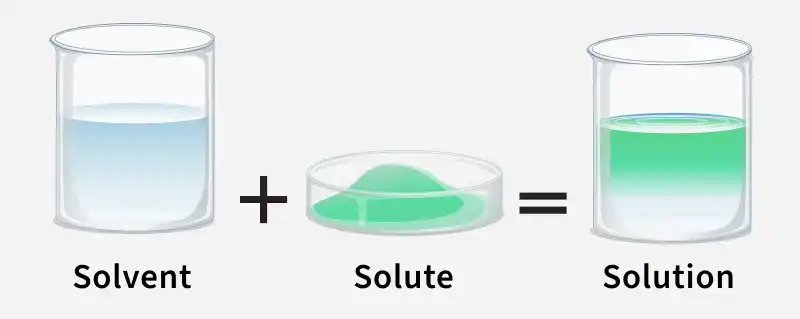
**Examples:
- Sugar dissolved in water – sugar is the solute, and water is the solvent, forming a sweet solution
- Salt dissolved in water – common salt solution
- Soda (carbonated water with dissolved carbon dioxide)
- Vinegar (acetic acid dissolved in water)
Components of a Solution
The components of a solution are the substances that combine to form it. In every solution, one substance dissolves in another to form a uniform mixture.
**Solvent: The material is in a more significant quantity. It dissolves the solute, and defines the physical condition of the solution.
**Examples: Water (most common solvent), Alcohol, acetone, benzene
**Solute: The material is in lesser quantity. It is then dissolved in the solvent.
**Examples: Salt in water, Sugar in tea, Oxygen dissolved in water, Zinc in dental amalgam
Types
Solutions can be classified into different types depending on various factors, such as the nature of the solvent, the amount of solute dissolved, the concentration comparison, uniformity, and the number of components present.
1. Based on Solvent
Solutions can be classified depending on the nature of the solvent used. Depending on whether water or a substance other than water acts as the solvent, solutions are divided into the following types:
**a) Aqueous Solution
- A solvent consisting of water.
**Examples: Sugar in water Salt in water.
**b) Non-Aqueous Solution
- This is a case where the solvent is not water.
**Examples: Iodine in alcohol Carbon disulphide Sulphur.
2. Based on Dissolved Solute
Solutions can be classified by the amount of solute dissolved in the solvent at a given temperature. Depending on the dissolving capacity of the solution, they are categorized into different types:
**a) Unsaturated Solution
- A solution that is able to dissolve more solute at a specific temperature.
**Example: Weak sugar solution.
**b) Saturated Solution
- The solution is no longer able to dissolve any more solutes at a specific temperature.
**Example: Sugar solution in which sugar was not dissolved.
**c) Supersaturated Solution
- A solution that contains more dissolved solute than a saturated solution at the same temperature
- It is unstable.
**Examples: Sodium acetate solution.
3. Based on the Amount of Solvent
Solutions may also be classified according to the relative proportion of solute and solvent present. Depending on whether the amount of solute is small or large compared to the solvent, solutions are described accordingly.
**a) Dilute solution
- The dilute solution can be defined as the solution in which a lesser amount of solute is dissolved in a large amount of solvent.
**Examples: salt solution, sugar solution, etc.
**b) Concentrated solution
- **The concentrated solution can be defined as the solution in which a large amount of solute is dissolved in a lesser amount of solvent.
**Examples: orange juice, dark-coloured tea, etc.
4. Based on the Concentration of Two Solutions
When two solutions are compared, they can be classified based on the relative concentration of solute particles present in them. This classification helps understand osmotic behavior.
**a) Hypertonic Solutions
- In two solutions, whichever of the solutions has a higher concentration of solutes (particles) compared to another solution is called a hypertonic solution.
**Examples: concentrated saline solutions or solutions with high sugar concentrations.
**b) Hypotonic Solutions
- Out of two solutions that are under observation, a solution with a lower concentration of solutes compared to another solution is called a hypotonic solution.
**Example: Distilled water
**c) Isotonic Solutions
- If both solutions have similar concentrations of the solutes, then the solutions are called isotonic solutions.
- Normal saline solution (0.9% NaCl) is often used as an isotonic solution in medical settings.
5. Based on the Uniformity of Solution
Solutions can be categorized based on the uniformity of composition throughout the mixture. Depending on whether the composition is uniform or non-uniform, solutions are divided into different types.
**Homogeneous Solution
- The solutions in which the composition and phase of solute and solvent are the same throughout are called homogeneous solutions.
**Example: salt dissolved in water.
**Heterogeneous Solution
- The solution in which the composition and phase of solute and solvent are distinct is called a heterogeneous solution.
**Example: oil dissolved in water
6. Based on the Number of Components
Solutions may be classified according to the number of components (solute and solvent) present in them. The total number of substances determines the type of solution.
**a) Binary solution
- A binary solution has only two components: one solute and one solvent.
Example: sugar solution in water.
**b) Ternary Solution
- A ternary solution has three components.
- Generally, it has two solutes and one solvent.
**Example: ORS solution which we make at home contains salt and sugar as solutes and water as a solvent, thus making it a ternary solution.
**c) Quaternary Solution
- A quaternary solution has four components in it.
**Example: solution of salt, sugar, lemon, and water.
Solutions can also be classified based on the physical state of the solute and solvent. Depending on whether the components are solids, liquids, or gases, different types of solutions are formed.
**1. Gaseous Solution
- **Gas-Gas Solution: The solution in which both the solute and solvent are present in the gas state is called a gas solution.
**Examples: a mixture of nitrogen and oxygen, carbon dioxide and oxygen, etc.
- **Liquid-Gas Solution: The solution in which the solute is present in the liquid state is called a liquid-gas solution.
**Examples: a mixture of nitrogen gas and chloroform.
- **Solid-Gas Solution: The solution in which the solute is present in the solid state is called a solid-gas solution.
**Examples: a mixture of nitrogen gas and camphor.
**2. Liquid Solution
- **Liquid-Gas Solution: The solution in which the solute is present in a gas state is called a liquid-gas solution.
**Example: a mixture of oxygen and water.
- **Liquid-Liquid Solution: The solution in which both the solvent and solute are present in the liquid state is called a liquid-liquid state.
**Example: a mixture of ethanoic acid and water also known as vinegar solution.
- **Liquid-Solid Solution: The solution in which the solute is present in a solid state is called a liquid-solid solution.
**Example: a mixture of sugar and salt.
**3. Solid Solution
- **Solid-Gas Solution: The solution in which the solute is present in a gas state is called a solid-gas solution.
**Example: a mixture of palladium and hydrogen.
- **Solid-Liquid Solution: The solution in which the solute is present in a liquid state is called a solid-liquid solution.
**Example: a mixture of salt and water.
- **Solid-Solid Solution: The solution in which both the solute and solvent are present in a solid state is called a solid-solid solution.
**Example: a mixture of silver and gold.
| Types of Solution | Solute | Solvent | Examples |
|---|---|---|---|
| Solid-solid | solid | solid | Alloys like brass, bronze, etc. |
| Solid-liquid | solid | liquid | The solution of sugar, salt, etc in water. |
| Solid-gas | solid | gas | Sublimation of substances like iodine, camphor, etc., into the air. |
| Liquid-solid | liquid | solid | Hydrated salts, mercury in amalgamated zinc, etc. |
| Liquid-liquid | liquid | liquid | Alcohol in water, benzene in toluene |
| Liquid-gas | liquid | gas | Aerosol, water vapor in the air. |
| Gas-solid | gas | solid | Hydrogen absorbed in palladium |
| Gas-liquid | gas | liquid | Aerated drinks |
| Gas-gas | gas | gas | A mixture of gases, etc. |
Concentration of a Solution
The composition of solutions can be described by going through their concentration, which can be expressed qualitatively or quantitatively. The following are the terms used in the concentration of solution:
**1. Mass Percentage
Mass percentage is also called weight-by-weight concentration of solute. Mass percent is defined as the amount of solute (in grams) present in 100 gm of the solution.
Mass Percentage = \frac{\text{Mass of component}}{\text{Total mass of solution}} \times 100
**2. Volume Percentage
Volume percentage is also called volume by volume concentration of solute. It is defined as the amount of solute (in ml) present in 100 ml of the solution.
Volume Percentage = \frac{\text{Volume of component}}{\text{Total volume of solution}} \times 100
**3. Mole Fraction
Mole fraction is the ratio of the number of moles of one component to the total number of moles present in the solution.
Mole Fraction of Component = \frac{\text{Moles of component}}{\text{Total moles of solution}}
4. Molarity
Molarity of a solution refers to the number of moles of solute dissolved per liter of solution.
Molarity = \frac{n}{V}
5. Molality
Molality of a solution refers to the number of moles of solute dissolved per kilogram of solvent.
Molality = \frac{n}{W}
6. Parts Per Million
Parts per million means the number of parts of solute present per 1 million parts of the solution. Parts per million is used to measure the concentration of quantities present in trace amounts. For example, if you have to calculate the presence of a mineral in seawater, then the concept of PPM is used.
PPM = \frac{\text{Parts of solute}}{\text{Parts of solution}} \times 10^{6}