Hydrocarbons (original) (raw)
Last Updated : 27 May, 2026
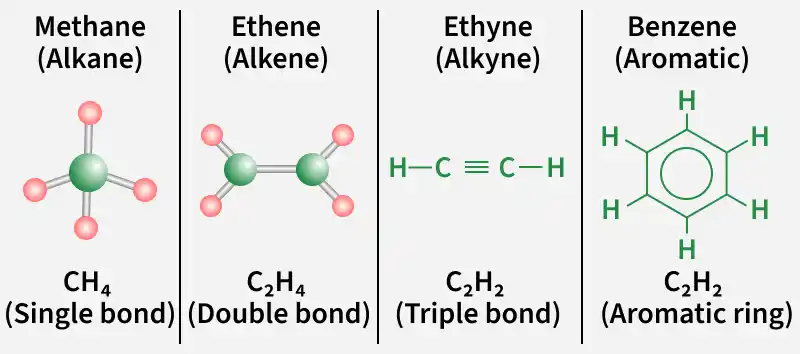
Hydrocarbons are organic compounds composed entirely of carbon and hydrogen atoms. They form the basic framework of organic chemistry and are among the most important compounds found in nature. Hydrocarbons occur naturally in petroleum, natural gas and coal, and are widely used as fuels and industrial raw materials. Hydrocarbons are further classified into alkanes, alkenes and alkynes.
1. Alkanes
Alkanes contain only single covalent bonds or sigma bond between carbon atoms.
- Carbon atoms are sp3 hybridised
- Geometry is tetrahedral
- Bond angle is 109.5∘
**Example: Methane (CH4)
2. Alkenes
Alkenes contain at least one carbon-carbon double bond.
- Carbon atoms are sp2 hybridised
- One double bond contains one sigma (σ) bond and one pi (π) bond
- Geometry is trigonal planar
- Bond angle is 120∘
**Example: Ethene (C2H4)
3. Alkynes
Alkynes contain at least one carbon-carbon triple bond.
- Carbon atoms are sp hybridised
- One triple bond contains one sigma (σ) bond and two pi (π) bonds
- Geometry is linear
- Bond angle is 180∘
**Example: Ethyne (C2H2)
Nomenclature of Hydrocarbons
Nomenclature of hydrocarbons refers to the systematic naming of hydrocarbons according to the rules recommended by IUPAC (International Union of Pure and Applied Chemistry). Proper nomenclature helps in identifying the structure and arrangement of carbon atoms in a compound.
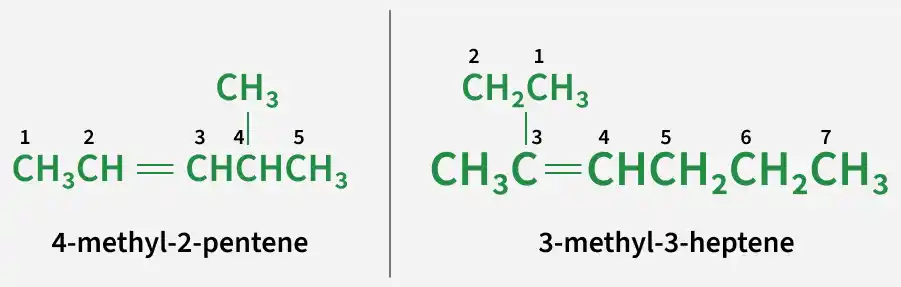
**Rule 1: Select the Longest Carbon Chain
Choose the longest continuous chain of carbon atoms as the parent chain.
**Rule 2: Number the Carbon Atoms
Number the carbon atoms in such a way that substituents, double bonds, or triple bonds get the lowest possible number.
**Rule 3: Identify and Name the Substituents
Identify the side chains attached to the parent chain and write their positions.
**Rule 4: Write the Name in Correct Order
The name is written in the following order:
Prefix + Word Root + Suffix
Isomerism in Hydrocarbons
Isomerism is the phenomenon in which two or more compounds have the same molecular formula but different arrangements of atoms or different structures. Such compounds are called isomers. Hydrocarbons show isomerism due to differences in the
arrangement of carbon atoms or the position of multiple bonds in the molecule.
Hydrocarbons mainly show structural isomerism and Geometrical isomerism.
1. Structural Isomerism
Structural isomerism arises due to different arrangements of carbon atoms in the molecule.
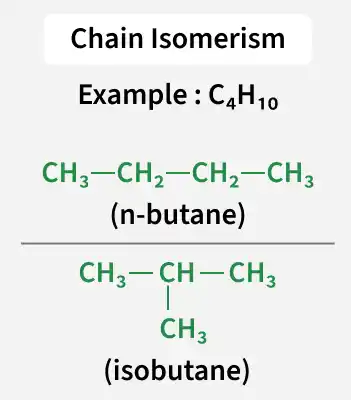
**a) Chain Isomerism: Chain isomerism occurs when compounds have the same molecular formula but different arrangements of carbon chains.
**Example: Butane (C4H10)
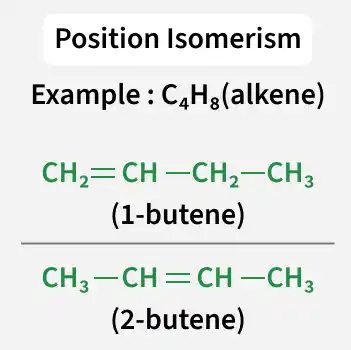
**b) Position Isomerism: Position isomerism occurs when the position of a double bond, triple bond or substituent differs in the carbon chain.
**Example: Butene (C4H8)
2. Geometrical Isomerism
Geometrical isomerism is shown by compounds containing a carbon-carbon double bond due to restricted rotation around the double bond. It exists in two forms:
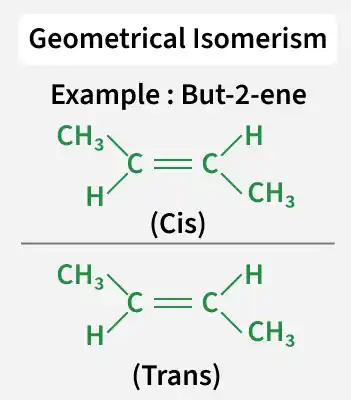
**a) Cis Isomer: In cis isomer, similar groups are present on the same side of the double bond.
**Example: Cis-but-2-ene
**b) Trans Isomer: In trans isomer, similar groups are present on opposite sides of the double bond.
**Example: Trans-but-2-ene
Physical Properties of Hydrocarbons
The physical properties of hydrocarbons depend mainly on molecular mass, shape and intermolecular forces. Since hydrocarbons are non-polar compounds, they possess characteristic physical properties.
**1. Physical State: The physical state of hydrocarbons changes with increase in molecular mass. Lower hydrocarbons are gases , middle hydrocarbons are liquids and higher hydrocarbons are solids.
**2. Solubility: Hydrocarbons are insoluble in water and soluble in organic solvents. This is because hydrocarbons are non-polar while water is polar.
**3. Boiling Point and Melting Point: Boiling point and melting point increase with increase in molecular mass due to stronger intermolecular forces. Straight-chain hydrocarbons generally have higher boiling points than branched-chain hydrocarbons.
**4. Density: Hydrocarbons are generally lighter than water. Their density increases slightly with increase in molecular mass.
**5. Colour and Odour: Most hydrocarbons are colourless and nearly odourless.
Chemical Properties of Hydrocarbons
The chemical properties of hydrocarbons depend upon the type of bonds present between carbon atoms.
**1. Combustion: Hydrocarbons burn in the presence of oxygen to produce carbon dioxide, water and heat.
CH4 + 2O2 → CO2 + 2H2O
**2. Halogenation: Alkanes undergo substitution reactions with halogens in the presence of sunlight or heat.
CH4 + Cl2 → CH3Cl + HCl
**3. Addition Reactions: Alkenes and alkynes undergo addition reactions due to the presence of multiple bonds.
- Hydrogenation: Hydrogen adds across the double or triple bond in the presence of catalyst.
CH2 = CH2 + H2 → CH3−CH3
- Halogen Addition: Halogens add across double or triple bonds.
CH2 = CH2 + Br2 → CH2Br −CH2Br
**4. Oxidation: Unsaturated hydrocarbons are oxidised by alkaline potassium permanganate or ozone.
CH2 = CH2 + [O] → HO − CH2 − CH2 − OH