Cloud Computing Service & Deployment Model (original) (raw)
Last Updated : 2 Mar, 2026
Cloud Computing is a paradigm where computing resources such as servers, storage, databases, networking, and software are delivered over the internet. Instead of investing heavily in physical, on-premises infrastructure, companies can utilize these resources dynamically to reduce costs, improve scalability, and streamline operations.
Understanding cloud computing requires looking at it from two different angles: Service Models (what type of service is being delivered) and Deployment Models (where and how that infrastructure is hosted).
Cloud Service Models
Cloud Service Models define the level of abstraction and management responsibility the user has versus the cloud provider.
**1. Infrastructure as a Service (IaaS)
- **Definition: Provides virtualized computing resources (servers, storage, and networking) over the internet.
- **User Role: Users retain full control over the infrastructure, customizing and managing virtual machines, operating systems, and network configurations.
- **Examples: Amazon Web Services (AWS) EC2, Microsoft Azure Virtual Machines.
**2. Platform as a Service (PaaS)
- **Definition: Provides a ready-to-use platform and environment for developers to build, deploy, and manage applications.
- **User Role: Developers focus solely on writing code and managing the application lifecycle, while the provider handles the underlying infrastructure, databases, and middleware.
- **Examples: Google App Engine, Heroku.
**3. Software as a Service (SaaS)
- **Definition: Delivers fully developed software applications over the internet on a subscription basis.
- **User Role: End-users simply access the application via a web browser or app, eliminating the need for local installation, maintenance, or patching.
- **Examples: Salesforce, Google Workspace, Microsoft 365.
**4. Serverless Computing
- **Definition: An execution model that heavily abstracts server management. Resources automatically scale up or down based on the exact demand of the application triggers.
- **User Role: Developers deploy code functions without ever provisioning or managing the underlying servers. You strictly pay for the compute time consumed.
- **Examples: AWS Lambda, Azure Functions, Google Cloud Functions.
Difference Between IaaS, PaaS, SaaS And Serverless
The following are the differences between IaaS, PaaS, SaaS and Serverless:
| **Aspect | **IaaS | **PaaS | **SaaS | **Serverless Computing |
|---|---|---|---|---|
| **What it Provides | Virtualized hardware & infrastructure | Frameworks & platforms for development | Fully developed software applications | Abstracted, event-driven compute power |
| **Management Focus | Users manage VMs, OS, and storage | Provider manages underlying infrastructure | Vendor manages everything | Developers focus strictly on code |
| **Customization | High (full infrastructure control) | Moderate (limited to the platform) | Minimal (limited to app settings) | High for code, zero for infrastructure |
| **Scalability | Scaled at the infrastructure level | Scaled at the application level | Scaled at the user/license level | Automatically scales per execution |
Cloud Computing Deployment Models
They are different approaches in managing and setting up the cloud services including cloud computing deployment models such as Public, private, hybrid, community and mulit-cloud deployments. These deployments provides scalability, control and flexibility with fulfilling special benefits meeting to various goals and demands of a business. In the below section we are discussing the types of cloud deployment models in more detail.
The following are the types of cloud also known as cloud deployment models as follows:
- Public cloud
- Private cloud
- Hybrid cloud
- Community cloud
- Multicloud
**1. Public Cloud
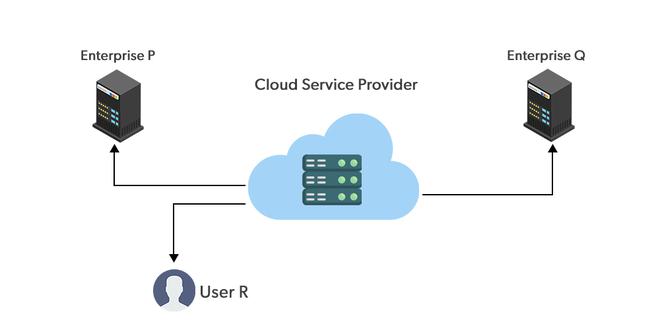
- Public clouds are managed by third parties which provide cloud services over the internet to the public, these services are available as pay-as-you-go billing models.
- They offer solutions for minimizing IT infrastructure costs and become a good option for handling peak loads on the local infrastructure. Public clouds are the go-to option for small enterprises, which can start their businesses without large upfront investments by completely relying on public infrastructure for their IT needs.
- The fundamental characteristics of public clouds are **multitenancy. A public cloud is meant to serve multiple users, not a single customer. A user requires a virtual computing environment that is separated, and most likely isolated, from other users.
**Examples: Amazon EC2, IBM, Azure, GCP
Advantages of Public Cloud
The following are the advantages of public cloud:
- Public cloud is easily able to scale up and down resources as per the demand of traffic and workload. It facilitates with performance optimization and cost efficiency.
- It works on pay-as-you-go cloud model and helps in resolving the investments needs in hardware and infrastructure reducing overall costs.
Disadvantages of using Public Cloud
The following are the disadvantages of Public Cloud:
- It is difficult to trust and maintain data to a third-party provider may raise concerns about control and ownership
- The shared infrastructure of public cloud resources increases the risk of data breaches and unauthorized access. It raises security and privacy concerns.
- Public cloud comes with limited transparency about the underlying infrastructure which may make it challenging to monitor and manage performance effectively.
2****. Private cloud**
- Private clouds are distributed systems that work on private infrastructure and provide the users with dynamic provisioning of computing resources. Instead of a pay-as-you-go model in private clouds, there could be other schemes that manage the usage of the cloud and proportionally billing of the different departments or sections of an enterprise. Private cloud providers are HP Data Centers, Ubuntu, Elastic-Private cloud, Microsoft, etc.
**Examples: VMware vCloud Suite, OpenStack, Cisco Secure Cloud, Dell Cloud Solutions, HP Helion Eucalyptus

Advantages Of Private Cloud
- **Customer information protection: In the private cloud security concerns are less since customer data and other sensitive information do not flow out of private infrastructure.
- **Infrastructure ensuring SLAs: Private cloud provides specific operations such as appropriate clustering, data replication, system monitoring, and maintenance, disaster recovery, and other uptime services.
- **Compliance with standard procedures and operations: Specific procedures have to be put in place when deploying and executing applications according to third-party compliance standards. This is not possible in the case of the public cloud.
**Disadvantages Of Private Cloud
- **The restricted area of operations: Private cloud is accessible within a particular area. So the area of accessibility is restricted.
- **Expertise requires: In the private cloud security concerns are less since customer data and other sensitive information do not flow out of private infrastructure. Hence skilled people are required to manage & operate cloud services.
**3. Hybrid cloud
- A hybrid cloud is a heterogeneous distributed system formed by combining facilities of the public cloud and private cloud. For this reason, they are also called **heterogeneous clouds.
- A major drawback of private deployments is the inability to scale on-demand and efficiently address peak loads. Here public clouds are needed. Hence, a hybrid cloud takes advantage of both public and private clouds.
- **Examples: AWS Outposts, Azure Stack, Google Anthos, IBM Cloud Satellite, Oracle Cloud at Customer

Benefits of Hybrid Cloud Computing
The following are the advantages of using Hybrid Cloud:
- Hybrid cloud is available at a cheap cost than other clouds because it is formed by a distributed system.
- It works comes up with working fast with lower cost and facilitates in reducing the latency of the data transfer process.
- Most important thing is security. A hybrid cloud is totally safe and secure because it works on the distributed system network.
**Disadvantages of Using Hybrid Cloud
The following are the disadvantages of using Hybrid Cloud:
- It's possible that businesses lack the internal knowledge necessary to create such a hybrid environment. Managing security may also be more challenging. Different access levels and security considerations may apply in each environment.
- Managing a hybrid cloud may be more difficult. With all of the alternatives and choices available today, not to mention the new PaaS components and technologies that will be released every day going forward, public cloud and migration to public cloud are already complicated enough. It could just feel like a step too far to include hybrid.
- Community clouds are distributed systems created by integrating the services of different clouds to address the specific needs of an industry, a community, or a business sector. But sharing responsibilities among the organizations is difficult.
- In the community cloud, the infrastructure is shared between organizations that have shared concerns or tasks. An organization or a third party may manage the cloud.
- **Examples: CloudSigma, Nextcloud, Synology C2, OwnCloud, Stratoscale

The following are the advantages of using Community Cloud:
- Because the entire cloud is shared by numerous enterprises or a community, community clouds are cost-effective.
- Because it works with every user, the community cloud is adaptable and scalable. Users can alter the documents according to their needs and requirements.
- Public cloud is less secure than the community cloud, which is more secure than private cloud.
- Thanks to community clouds, we may share cloud resources, infrastructure, and other capabilities between different enterprises.
The following are the disadvantages of using Community Cloud:
- Not all businesses should choose community cloud.
- Gradual adoption of data
- It's challenging for corporations to share duties.
The following are the applications of community clouds:
- **Media industry: Media companies are looking for quick, simple, low-cost ways for increasing the efficiency of content generation. Most media productions involve an extended ecosystem of partners. In particular, the creation of digital content is the outcome of a collaborative process that includes the movement of large data, massive compute-intensive rendering tasks, and complex workflow executions.
- **Healthcare industry: In the healthcare industry community clouds are used to share information and knowledge on the global level with sensitive data in the private infrastructure.
- **Energy and core industry: In these sectors, the community cloud is used to cluster a set of solution which collectively addresses the management, deployment, and orchestration of services and operations.
- **Scientific research: In this organization with common interests in science share a large distributed infrastructure for scientific computing.
5. Multicloud
- Multicloud is the use of multiple cloud computing services from different providers, which allows organizations to use the best-suited services for their specific needs and avoid vendor lock-in.
- This allows organizations to take advantage of the different features and capabilities offered by different cloud providers.
- **Examples: Cloud Foundry, Kubernetes, Apache Mesos, Red Hat OpenShift, Docker Swarm
**Advantages of using Multi-Cloud
The following are the advantages of using multi-cloud:
- **Flexibility: Using multiple cloud providers allows organizations to choose the best-suited services for their specific needs, and avoid vendor lock-in.
- **Cost-effectiveness: Organizations can take advantage of the cost savings and pricing benefits offered by different cloud providers for different services.
- **Improved performance: By distributing workloads across multiple cloud providers, organizations can improve the performance and availability of their applications and services.
- **Increased security: Organizations can increase the security of their data and applications by spreading them across multiple cloud providers and implementing different security strategies for each.
Disadvantages of using Multi-Cloud
The following are the disadvantages of using Multi-Cloud:
- **Complexity: Managing multiple cloud providers and services can be complex and require specialized knowledge and expertise.
- **Increased costs: The cost of managing multiple cloud providers and services can be higher than using a single provider.
- **Compatibility issues: Different cloud providers may use different technologies and standards, which can cause compatibility issues and require additional resources to resolve.
- **Limited interoperability: Different cloud providers may not be able to interoperate seamlessly, which can limit the ability to move data and applications between them.
Difference Between Public Cloud, Private Cloud And Hybrid Cloud
The following are the differences between public, private and Hybrid Clouds:
| **Aspect | **Public Cloud | **Private Cloud | **Hybrid Cloud |
|---|---|---|---|
| **Infrastructure | Shared among multiple distinct organizations. | Dedicated exclusively to a single organization. | A customized mix of shared and dedicated resources. |
| **Cost Model | Pay-as-you-go; minimal upfront costs. | High initial investment and ongoing maintenance. | Variable; optimizes costs by routing workloads efficiently. |
| **Control & Security | Managed by the provider; lower control for the user. | Full internal control; highest level of security. | Shared responsibility; requires complex security routing. |
| **Flexibility | High resource flexibility, low configuration flexibility. | High configuration flexibility, restricted scaling capability. | Ultimate flexibility leveraging the best of both worlds. |