Dynamic Programming (DP) and Directed Acyclic Graphs (DAG) (original) (raw)
Last Updated : 23 Jul, 2025
**Pre-Requisite:
What is Directed Graph? | Directed Graph meaning
Dynamic Programming (DP) Tutorial with Problems
Every Dynamic Programming problem can be represented as a Directed Acyclic Graph(DAG). The nodes of the DAG represent the subproblems and the edges represents the transitions between the subproblems.

Table of Content
- Relationship Between Dynamic Programming (DP) and Directed Acyclic Graphs (DAG)
- What happens when the graph is not DAG?
- How to Solve Dynamic Programming (DP) Problems on Directed Graphs
- Practice Problems on Dynamic Programming (DP) and Directed Acyclic Graphs (DAG)
Relationship Between Dynamic Programming (DP) and **Directed Acyclic Graphs (DAG):
**1. Subproblems and DAG Nodes:
- Dynamic Programming involves breaking down a problem into similar subproblems and these subproblems are solved independently and their result is used to solve the original problem.
- Nodes of Directed Acyclic Graph represents the subproblems. We can also say these nodes represent a state.
**2. Transitions and DAG Edges:
- Like the Nodes represents subproblems in the DAG, similarly the edges represent transition.
- The transition from one subproblem to another is represented by an edge.
**3. Cycles and Redundancy:
- The reason it's a directed acyclic graph is that if there are cycles in the directed graph then some states would lead back to themselves after a series of transitions leading to redundancy.
Let's take an example to understand the above points:
****Problem:**Finding Longest Path in Directed Acyclic Graphs (DAG):
The **dp state and the transition in this case will be:
Let **dp[v] denote the length of the longest path ending at the node **v. Initialize all the positions in dp array as **1. Clearly,
**For every edge from node u to node v, dp[v] = max (dp[u]+1)
At the end check for the maximum value in dp[] array, which will be the longest path in the DAG.
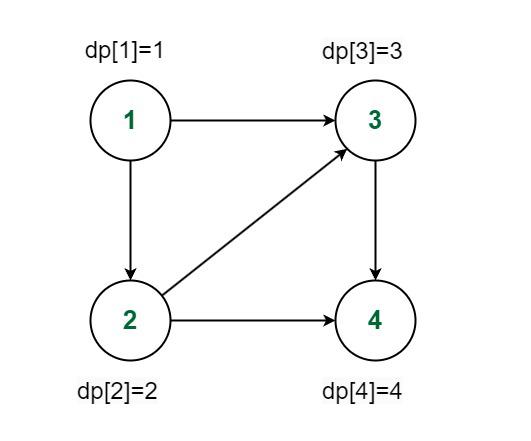
DP on Directed Graphs
What happens when the graph is not Directed Acyclic Graphs (DAG)?
If the graph contains a cycle, then some states would lead back to themselves after a series of transitions. This would lead to infinite calculations. Thus, answer will not exist if the graph is cyclic in this case. As shown in below image, we potentially keep traversing the cycle indefinitely, making it impossible to find the longest path.
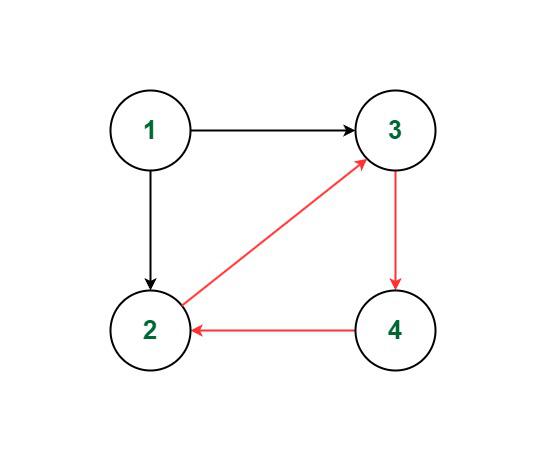
DP on Directed Graphs
How to Solve Dynamic Programming (DP) Problems on Directed Graphs:
Let us consider few problems which will tell how to define the states and make the transition:
Count the number of different ways to reach a node:
Given a Directed Acyclic Graph consisting of **N nodes and **M edges. The task is to determine the number of different ways to reach Node N from Node 1.
**Solution: The problem can be solved in following steps:
**1. Define the States: As mentioned above each Nodes of Directed Acyclic Graph represents a state. Let dp[v] be the number of ways to reach Node N from the vertex v.
**2. Make the Transitions: Like the Nodes represents states in the DAG, similarly the edges represent transition. Thus dp[v] can be calculated by:
**dp[v] = Σdp[u], for every edge v->u
**3. Topological Consideration: We process the nodes topologically i.e., if edge **v->u exists then dp[u] should be computed before dp[v].
Hence ,dp[1] will be our final answer.
Below is the implementation of above approach:
C++ `
#include <bits/stdc++.h> using namespace std;
// Recursive function to perform depth-first search // and calculate the number of ways to reach Node N from // vertex curr int dfs(int n, vector<vector >& adj, vector& dp, vector& vis, int curr) { // If the node has already been visited, return its // stored value if (vis[curr] == 1) return dp[curr];
// Mark the current node as visited
vis[curr] = 1;

// Traverse all adjacent nodes and recursively calculate
// the number of ways
for (auto x : adj[curr]) {
    if (!vis[x]) {
        dfs(n, adj, dp, vis, x);
    }

    // Update the number of ways to reach Node N from
    // the current node
    dp[curr] += dp[x];
}

// Return the calculated value for the current node
return dp[curr];
}
// Function to calculate the number of ways to reach Node N // from Node 1 int noOfWays(int n, vector<vector >& edges) { // Adjacency list to represent the directed acyclic // graph vector<vector > adj(n + 1);
// Populate the adjacency list using the provided edges
for (vector<int> i : edges) {
    adj[i[0]].push_back(i[1]);
}

// Initialize dp array to store the number of ways to
// reach Node N from each vertex
vector<int> dp(n + 1, 0);

// Initialize visited array to keep track of visited
// nodes during DFS
vector<int> vis(n + 1, 0);

// Set the base case for Node N, i.e., there is one way
// to reach N from N
dp[n] = 1;

// Mark Node N as visited
vis[n] = 1;

// Call the recursive DFS function to calculate the
// number of ways
int res = dfs(n, adj, dp, vis, 1);

// Return the result, which represents the number of
// ways to reach Node N from Node 1
return res;
}
int main() { // Example inputs int N = 5; vector<vector > edges = { { 1, 2 }, { 1, 3 }, { 2, 4 }, { 3, 4 }, { 4, 5 } };
// Function call
int result = noOfWays(N, edges);

// Output the result
cout << "No. of ways to reach Node N from Node 1: "
     << result << endl;

return 0;
}
Java
import java.util.ArrayList; import java.util.List;
public class WaysToReachNodeN {
// Recursive function to perform depth-first search
// and calculate the number of ways to reach Node N from
// vertex curr
private static int dfs(int n, List<List<Integer>> adj, int[] dp,
                       int[] vis, int curr) {
    // If the node has already been visited, return its
    // stored value
    if (vis[curr] == 1)
        return dp[curr];

    // Mark the current node as visited
    vis[curr] = 1;

    // Traverse all adjacent nodes and recursively calculate
    // the number of ways
    for (int x : adj.get(curr)) {
        if (vis[x] == 0) {
            dfs(n, adj, dp, vis, x);
        }

        // Update the number of ways to reach Node N from
        // the current node
        dp[curr] += dp[x];
    }

    // Return the calculated value for the current node
    return dp[curr];
}

// Function to calculate the number of ways to reach Node N
// from Node 1
private static int noOfWays(int n, List<List<Integer>> edges) {
    // Adjacency list to represent the directed acyclic
    // graph
    List<List<Integer>> adj = new ArrayList<>(n + 1);

    // Populate the adjacency list using the provided edges
    for (int i = 0; i <= n; i++) {
        adj.add(new ArrayList<>());
    }

    for (List<Integer> edge : edges) {
        adj.get(edge.get(0)).add(edge.get(1));
    }

    // Initialize dp array to store the number of ways to
    // reach Node N from each vertex
    int[] dp = new int[n + 1];

    // Initialize visited array to keep track of visited
    // nodes during DFS
    int[] vis = new int[n + 1];

    // Set the base case for Node N, i.e., there is one way
    // to reach N from N
    dp[n] = 1;

    // Mark Node N as visited
    vis[n] = 1;

    // Call the recursive DFS function to calculate the
    // number of ways
    int res = dfs(n, adj, dp, vis, 1);

    // Return the result, which represents the number of
    // ways to reach Node N from Node 1
    return res;
}

public static void main(String[] args) {
    // Example inputs
    int N = 5;
    List<List<Integer>> edges = List.of(
            List.of(1, 2), List.of(1, 3), List.of(2, 4), List.of(3, 4), List.of(4, 5)
    );

    // Function call
    int result = noOfWays(N, edges);

    // Output the result
    System.out.println("No. of ways to reach Node N from Node 1: " + result);
}
}
C#
using System; using System.Collections.Generic;
class Program { // Recursive function to perform depth-first search // and calculate the number of ways to reach Node N from // vertex curr static int DFS(int n, List<List> adj, List dp, List vis, int curr) { // If the node has already been visited, return its // stored value if (vis[curr] == 1) return dp[curr];
    // Mark the current node as visited
    vis[curr] = 1;

    // Traverse all adjacent nodes and recursively calculate
    // the number of ways
    foreach (int x in adj[curr])
    {
        if (vis[x] == 0)
            DFS(n, adj, dp, vis, x);

        // Update the number of ways to reach Node N from
        // the current node
        dp[curr] += dp[x];
    }

    // Return the calculated value for the current node
    return dp[curr];
}

// Function to calculate the number of ways to reach Node N
// from Node 1
static int NoOfWays(int n, List<List<int>> edges)
{
    // Adjacency list to represent the directed acyclic
    // graph
    List<List<int>> adj = new List<List<int>>(n + 1);

    // Initialize adjacency list
    for (int i = 0; i <= n; i++)
    {
        adj.Add(new List<int>());
    }

    // Populate the adjacency list using the provided edges
    foreach (List<int> i in edges)
    {
        adj[i[0]].Add(i[1]);
    }

    // Initialize dp array to store the number of ways to
    // reach Node N from each vertex
    List<int> dp = new List<int>(new int[n + 1]);

    // Initialize visited array to keep track of visited
    // nodes during DFS
    List<int> vis = new List<int>(new int[n + 1]);

    // Set the base case for Node N, i.e., there is one way
    // to reach N from N
    dp[n] = 1;

    // Mark Node N as visited
    vis[n] = 1;

    // Call the recursive DFS function to calculate the
    // number of ways
    int res = DFS(n, adj, dp, vis, 1);

    // Return the result, which represents the number of
    // ways to reach Node N from Node 1
    return res;
}

static void Main()
{
    // Example inputs
    int N = 5;
    List<List<int>> edges = new List<List<int>>
    {
        new List<int> {1, 2},
        new List<int> {1, 3},
        new List<int> {2, 4},
        new List<int> {3, 4},
        new List<int> {4, 5}
    };

    // Function call
    int result = NoOfWays(N, edges);

    // Output the result
    Console.WriteLine($"No. of ways to reach Node N from Node 1: {result}");
}
}
JavaScript
// Function to perform depth-first search // and calculate the number of ways to reach Node N from vertex curr function dfs(n, adj, dp, vis, curr) { // If the node has already been visited, return its stored value if (vis[curr] === 1) return dp[curr];
// Mark the current node as visited
vis[curr] = 1;

// Traverse all adjacent nodes and recursively calculate the number of ways
for (let x of adj[curr]) {
    if (vis[x] === 0) {
        dfs(n, adj, dp, vis, x);
    }

    // Update the number of ways to reach Node N from the current node
    dp[curr] += dp[x];
}

// Return the calculated value for the current node
return dp[curr];
}
// Function to calculate the number of ways to reach Node N from Node 1 function noOfWays(n, edges) { // Adjacency list to represent the directed acyclic graph let adj = new Array(n + 1).fill().map(() => []);
// Populate the adjacency list using the provided edges
for (let edge of edges) {
    adj[edge[0]].push(edge[1]);
}

// Initialize dp array to store the number of ways to reach Node N from each vertex
let dp = new Array(n + 1).fill(0);

// Initialize visited array to keep track of visited nodes during DFS
let vis = new Array(n + 1).fill(0);

// Set the base case for Node N, i.e., there is one way to reach N from N
dp[n] = 1;

// Mark Node N as visited
vis[n] = 1;

// Call the recursive DFS function to calculate the number of ways
let res = dfs(n, adj, dp, vis, 1);

// Return the result, which represents the number of ways to reach Node N from Node 1
return res;
}
// Example inputs let N = 5; let edges = [ [1, 2], [1, 3], [2, 4], [3, 4], [4, 5] ];
// Function call let result = noOfWays(N, edges);
// Output the result console.log("No. of ways to reach Node N from Node 1:", result);
Python3
from collections import defaultdict
def dfs(n, adj, dp, vis, curr): # If the node has already been visited, return its stored value if vis[curr] == 1: return dp[curr]
# Mark the current node as visited
vis[curr] = 1

# Traverse all adjacent nodes and recursively calculate the number of ways
for x in adj[curr]:
    if vis[x] == 0:
        dfs(n, adj, dp, vis, x)

    # Update the number of ways to reach Node N from the current node
    dp[curr] += dp[x]

# Return the calculated value for the current node
return dp[curr]
def no_of_ways(n, edges): # Adjacency list to represent the directed acyclic graph adj = defaultdict(list)
# Populate the adjacency list using the provided edges
for edge in edges:
    adj[edge[0]].append(edge[1])

# Initialize dp array to store the number of ways to reach Node N from each vertex
dp = [0] * (n + 1)

# Initialize visited array to keep track of visited nodes during DFS
vis = [0] * (n + 1)

# Set the base case for Node N, i.e., there is one way to reach N from N
dp[n] = 1

# Mark Node N as visited
vis[n] = 1

# Call the recursive DFS function to calculate the number of ways
res = dfs(n, adj, dp, vis, 1)

# Return the result, which represents the number of ways to reach Node N from Node 1
return res
Example inputs
N = 5 edges = [ (1, 2), (1, 3), (2, 4), (3, 4), (4, 5) ]
Function call
result = no_of_ways(N, edges)
Output the result
print("No. of ways to reach Node N from Node 1:", result)
`
Output
No. of ways to reach Node N from Node 1: 2
**Time Complexity: O(N), Where ‘N’ is the number of nodes in the given graph.
**Auxiliary Space: O(N)
Find the largest number of nodes colored with the most occurring color on any path of DAG:
Given a Directed Acyclic Graph consisting of **N nodes and **M edges. Each node is assigned a lowercase alphabet representing the color of that node ('a' to 'z'). The task is to determine the largest value of any path. The value of a path is defined as the number of nodes which are colored with the most occurring color in the path.
**Solution: The problem can be solved in following steps:
**1. Define the States: We can observe that there are total 26 colors possible. So, we can make a **2D dp[][] array of size N*26. Let dp[v][i] represent the maximum count of vertices having color i of any path starting from vertex v.
**2. Make the Transitions: Again, like the Nodes represent states in the DAG, similarly the edges represent transitions. Thus dp[v][i] can be calculated by:
**dp[v][i] = max(dp[u][i]+col, dp[v][i]), for each edge v->u and each color i from 0 to 25. The value of **col will be 1 if color of vertex v is equal to i otherwise it will be 0.
**3. Topological Consideration: Again, we process the nodes topologically i.e., if edge **v->u exists then the node u should be processed before node v.
Hence, our final answer will be maximum of dp[v][i] for each vertex from 1 to N and color from 0 to 25.
Below is the implementation of above approach:
C++ `
#include <bits/stdc++.h> using namespace std;
// Recursive function to perform depth-first search // and calculate the maximum count of vertices having a specific color void dfs(int n, vector<vector>& adj, vector<vector>& dp, vector& vis, int curr, string& s) { // If the node has already been visited, return if (vis[curr] == 1) return;
// Mark the current node as visited
vis[curr] = 1;

// Initialize the color count for the current node
dp[curr][s[curr - 1] - 97] = 1;

// Traverse all adjacent nodes and recursively calculate
// the maximum count of vertices having each color
for (auto x : adj[curr]) {
    if (!vis[x]) {
        dfs(n, adj, dp, vis, x, s);
    }

    // Update the count of vertices having each color
    for (int j = 0; j < 26; j++) {
        int col = 0;
        if (s[curr - 1] - 97 == j)
            col = 1;
        dp[curr][j] = max(dp[curr][j], dp[x][j] + col);
    }
}
}
// Function to calculate the maximum count of vertices // having the most occurring color in any path int maxcolorpath(int n, vector<vector>& edges, string s) { // Adjacency list to represent the directed acyclic graph vector<vector> adj(n + 1);
// Populate the adjacency list using the provided edges
for (vector<int> i : edges) {
    adj[i[0]].push_back(i[1]);
}

// Initialize dp array to store the maximum count of vertices
// having each color for each vertex
vector<vector<int>> dp(n + 1, vector<int>(26, 0));

// Initialize visited array to keep track of visited nodes during DFS
vector<int> vis(n + 1);

// Call the recursive DFS function to calculate the maximum count
dfs(n, adj, dp, vis, 1, s);

// Find the maximum count of vertices having the most occurring color
int res = 0;
for (int i = 1; i <= n; i++) {
    for (int j = 0; j < 26; j++) {
        res = max(res, dp[i][j]);
    }
}
return res;
}
int main() { // Example inputs int N = 5; vector<vector> edges = { {1, 2}, {1, 3}, {2, 4}, {3, 4}, {4, 5} }; string color = "abaca";
// Function call
int result = maxcolorpath(N, edges, color);

// Output the result
cout << "Maximum count of vertices having the most occurring color: "
     << result << endl;

return 0;
}
Java
import java.util.ArrayList; import java.util.Arrays;
public class MaxColorPath {
// Recursive function to perform depth-first search
// and calculate the maximum count of vertices having a specific color
static void dfs(int n, ArrayList<ArrayList<Integer>> adj, int[][] dp,
                int[] vis, int curr, String s) {
    // If the node has already been visited, return
    if (vis[curr] == 1)
        return;

    // Mark the current node as visited
    vis[curr] = 1;

    // Initialize the color count for the current node
    dp[curr][s.charAt(curr - 1) - 'a'] = 1;

    // Traverse all adjacent nodes and recursively calculate
    // the maximum count of vertices having each color
    for (int x : adj.get(curr)) {
        if (vis[x] == 0) {
            dfs(n, adj, dp, vis, x, s);
        }

        // Update the count of vertices having each color
        for (int j = 0; j < 26; j++) {
            int col = (s.charAt(curr - 1) - 'a' == j) ? 1 : 0;
            dp[curr][j] = Math.max(dp[curr][j], dp[x][j] + col);
        }
    }
}

// Function to calculate the maximum count of vertices
// having the most occurring color in any path
static int maxColorPath(int n, int[][] edges, String s) {
    // Adjacency list to represent the directed acyclic graph
    ArrayList<ArrayList<Integer>> adj = new ArrayList<>(n + 1);

    for (int i = 0; i <= n; i++) {
        adj.add(new ArrayList<>());
    }

    // Populate the adjacency list using the provided edges
    for (int[] edge : edges) {
        adj.get(edge[0]).add(edge[1]);
    }

    // Initialize dp array to store the maximum count of vertices
    // having each color for each vertex
    int[][] dp = new int[n + 1][26];

    // Initialize visited array to keep track of visited nodes during DFS
    int[] vis = new int[n + 1];

    // Call the recursive DFS function to calculate the maximum count
    dfs(n, adj, dp, vis, 1, s);

    // Find the maximum count of vertices having the most occurring color
    int res = 0;
    for (int i = 1; i <= n; i++) {
        for (int j = 0; j < 26; j++) {
            res = Math.max(res, dp[i][j]);
        }
    }
    return res;
}

public static void main(String[] args) {
    // Example inputs
    int N = 5;
    int[][] edges = {
            {1, 2}, {1, 3}, {2, 4}, {3, 4}, {4, 5}
    };
    String color = "abaca";

    // Function call
    int result = maxColorPath(N, edges, color);

    // Output the result
    System.out.println("Maximum count of vertices having the most occurring color: " + result);
}
}
C#
using System; using System.Collections.Generic; using System.Linq;
class Program { // Recursive function to perform depth-first search // and calculate the maximum count of vertices having a specific color static void Dfs(int n, List[] adj, int[][] dp, int[] vis, int curr, string s) { // If the node has already been visited, return if (vis[curr] == 1) return;
    // Mark the current node as visited
    vis[curr] = 1;

    // Initialize the color count for the current node
    dp[curr][s[curr - 1] - 97] = 1;

    // Traverse all adjacent nodes and recursively calculate
    // the maximum count of vertices having each color
    foreach (var x in adj[curr])
    {
        if (vis[x] == 0)
        {
            Dfs(n, adj, dp, vis, x, s);
        }

        // Update the count of vertices having each color
        for (int j = 0; j < 26; j++)
        {
            int col = 0;
            if (s[curr - 1] - 97 == j)
                col = 1;
            dp[curr][j] = Math.Max(dp[curr][j], dp[x][j] + col);
        }
    }
}

// Function to calculate the maximum count of vertices
// having the most occurring color in any path
static int MaxColorPath(int n, int[][] edges, string s)
{
    // Adjacency list to represent the directed acyclic graph
    var adj = new List<int>[n + 1];
    for (int i = 0; i < adj.Length; i++)
    {
        adj[i] = new List<int>();
    }

    // Populate the adjacency list using the provided edges
    foreach (var i in edges)
    {
        adj[i[0]].Add(i[1]);
    }

    // Initialize dp array to store the maximum count of vertices
    // having each color for each vertex
    var dp = new int[n + 1][];
    for (int i = 0; i < dp.Length; i++)
    {
        dp[i] = new int[26];
    }

    // Initialize visited array to keep track of visited nodes during DFS
    var vis = new int[n + 1];

    // Call the recursive DFS function to calculate the maximum count
    Dfs(n, adj, dp, vis, 1, s);

    // Find the maximum count of vertices having the most occurring color
    int res = 0;
    for (int i = 1; i <= n; i++)
    {
        for (int j = 0; j < 26; j++)
        {
            res = Math.Max(res, dp[i][j]);
        }
    }
    return res;
}

static void Main()
{
    int N = 5;
    int[][] edges = {
        new int[] {1, 2}, new int[] {1, 3}, new int[] {2, 4}, new int[] {3, 4}, new int[] {4, 5}
    };
    string color = "abaca";

    // Function call
    int result = MaxColorPath(N, edges, color);

    // Output the result
    Console.WriteLine("Maximum count of vertices having the most occurring color: "
         + result);
}
}
JavaScript
// Recursive function to perform depth-first search // and calculate the maximum count of vertices having a specific color function dfs(n, adj, dp, vis, curr, s) { // If the node has already been visited, return if (vis[curr] === 1) return;
// Mark the current node as visited
vis[curr] = 1;

// Initialize the color count for the current node
dp[curr][s.charCodeAt(curr - 1) - 97] = 1;

// Traverse all adjacent nodes and recursively calculate
// the maximum count of vertices having each color
for (let x of adj[curr]) {
    if (!vis[x]) {
        dfs(n, adj, dp, vis, x, s);
    }

    // Update the count of vertices having each color
    for (let j = 0; j < 26; j++) {
        let col = 0;
        if (s.charCodeAt(curr - 1) - 97 === j)
            col = 1;
        dp[curr][j] = Math.max(dp[curr][j], dp[x][j] + col);
    }
}
}
// Function to calculate the maximum count of vertices // having the most occurring color in any path function maxcolorpath(n, edges, s) { // Adjacency list to represent the directed acyclic graph let adj = new Array(n + 1).fill(null).map(() => []);
// Populate the adjacency list using the provided edges
for (let i of edges) {
    adj[i[0]].push(i[1]);
}

// Initialize dp array to store the maximum count of vertices
// having each color for each vertex
let dp = new Array(n + 1).fill(null).map(() => new Array(26).fill(0));

// Initialize visited array to keep track of visited nodes during DFS
let vis = new Array(n + 1).fill(0);

// Call the recursive DFS function to calculate the maximum count
dfs(n, adj, dp, vis, 1, s);

// Find the maximum count of vertices having the most occurring color
let res = 0;
for (let i = 1; i <= n; i++) {
    for (let j = 0; j < 26; j++) {
        res = Math.max(res, dp[i][j]);
    }
}
return res;
}
// Example inputs let N = 5; let edges = [ [1, 2], [1, 3], [2, 4], [3, 4], [4, 5] ]; let color = "abaca";
// Function call let result = maxcolorpath(N, edges, color);
// Output the result console.log("Maximum count of vertices having the most occurring color: " + result); //this code is contributed by Adarsh.
Python3
Recursive function to perform depth-first search
and calculate the maximum count of vertices having a specific color
def dfs(n, adj, dp, vis, curr, s): # If the node has already been visited, return if vis[curr] == 1: return
# Mark the current node as visited
vis[curr] = 1

# Initialize the color count for the current node
dp[curr][ord(s[curr - 1]) - 97] = 1

# Traverse all adjacent nodes and recursively calculate
# the maximum count of vertices having each color
for x in adj[curr]:
    if not vis[x]:
        dfs(n, adj, dp, vis, x, s)

    # Update the count of vertices having each color
    for j in range(26):
        col = 0
        if ord(s[curr - 1]) - 97 == j:
            col = 1
        dp[curr][j] = max(dp[curr][j], dp[x][j] + col)
Function to calculate the maximum count of vertices
having the most occurring color in any path
def maxcolorpath(n, edges, s): # Adjacency list to represent the directed acyclic graph adj = [[] for _ in range(n + 1)]
# Populate the adjacency list using the provided edges
for i in edges:
    adj[i[0]].append(i[1])

# Initialize dp array to store the maximum count of vertices
# having each color for each vertex
dp = [[0] * 26 for _ in range(n + 1)]

# Initialize visited array to keep track of visited nodes during DFS
vis = [0] * (n + 1)

# Call the recursive DFS function to calculate the maximum count
dfs(n, adj, dp, vis, 1, s)

# Find the maximum count of vertices having the most occurring color
res = 0
for i in range(1, n + 1):
    for j in range(26):
        res = max(res, dp[i][j])
return res
Example inputs
N = 5 edges = [ [1, 2], [1, 3], [2, 4], [3, 4], [4, 5] ] color = "abaca"
Function call
result = maxcolorpath(N, edges, color)
Output the result
print("Maximum count of vertices having the most occurring color:", result)
This code is contributed by prachi
`
Output
Maximum count of vertices having the most occurring color: 3
**Time Complexity: O(N), Where ‘N’ is the number of nodes in the given graph.
**Auxiliary Space: O(N)