Introduction of JPEG (original) (raw)
Last Updated : 29 May, 2026
JPEG stands for Joint Photographic Experts Group. It is a widely used image compression technique that reduces file size using lossy compression while maintaining good image quality.
- JPEG uses lossy compression to reduce image size.
- It is commonly used for digital photographs and web images.
- JPG and JPEG are different extensions of the same format.
- It removes less noticeable image data to save storage space.
Working of JPEG compression
JPEG compression reduces the size of image files while maintaining good image quality. It uses mathematical transformations and encoding techniques to remove less noticeable image details and compress the image efficiently.
Steps of JPEG Compression
- The image is converted from RGB to the Y-Cb-Cr color model.
- The image is divided into small 8×8 pixel blocks.
- DCT (Discrete Cosine Transform) converts the image from the spatial domain to the frequency domain.
F(W)={\frac{a(u)}{2}}\displaystyle\sum_{n=0}^{N-1}f(n) \cos(\frac{wr}{8}(n+{\frac{1}{2}}))
M/div>
- Quantization removes high-frequency details that are less visible to the human eye.
- Zigzag scanning groups low-frequency coefficients together.
- Run Length Encoding and Huffman Coding generate the final compressed image.
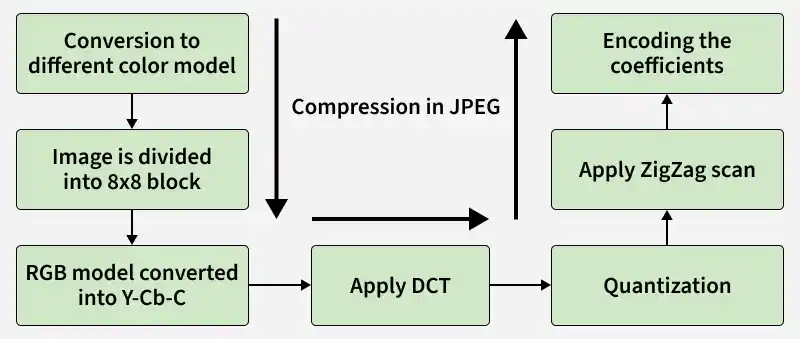
History of JPEG
JPEG was developed to provide an efficient standard for image compression and transmission. It was created by the Joint Photographic Experts Group and officially introduced in 1992.
- ISO formed the Photographic Experts Group in 1982 for image research.
- In 1987, different research groups combined to form JPEG.
- JPEG standard was created in 1992 and updated in 1994.
Characteristics of JPEG
JPEG is an image compression standard that reduces file size using lossy compression while maintaining good image quality. It removes less visible image details to make storage and transmission more efficient.
- JPEG uses lossy compression to reduce image size.
- It removes unnecessary color details that the human eye cannot easily notice.
- JPEG automatically selects efficient compression methods.
- It supports multiple image processing and storage formats.
- JPEG includes standards such as JFIF and SPIFF extensions.
Advantages of JPEG
JPEG is widely used because it provides high image quality with a smaller file size. It supports fast image processing and is compatible with most digital devices and platforms.
- JPEG provides high compression with good image quality.
- It supports 24-bit color with millions of color combinations.
- JPEG files are small in size and save disk space.
- Image processing and transmission are faster in JPEG format.
- It is compatible with computers, mobile phones, cameras, and photo editors.
Disadvantages of JPEG
JPEG uses lossy compression, which can reduce image quality by removing some image details. It is less effective for images with sharp edges, text, or transparency.
- JPEG compression may cause loss of important image details and reduce quality after repeated editing.
- It is not suitable for text-based images, sharp lines, transparency, or layered images.
- JPEG provides limited support for black-and-white and motion images.