Basic Frame Structure of SDLC (original) (raw)
Last Updated : 17 Dec, 2025
Synchronous Data Link Control (SDLC) is an IBM-developed data link layer protocol that ensures reliable communication using structured frames and a primary–secondary model.
- Developed by IBM in 1974 for Systems Network Architecture (SNA)
- Operates at the data link layer
- Supports point-to-point, multipoint, and packet-switched networks
- Uses a primary–secondary station communication model
- Organizes data and control information into SDLC frames
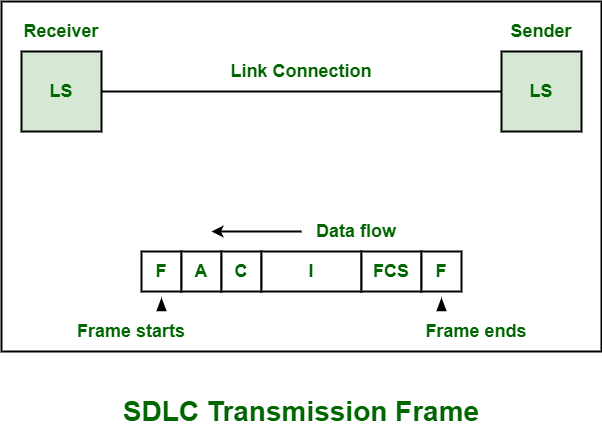
Purpose of an SDLC Frame
An SDLC frame enables the receiving station to:
- Identify the start and end of a frame
- Determine whether the frame is intended for it
- Understand what action to perform on the received data
- Detect transmission errors
- Acknowledge successful frame reception
Frame Format :
Transmission frame of each of SDLC has specific frame format. Each frame is made up of following fields :
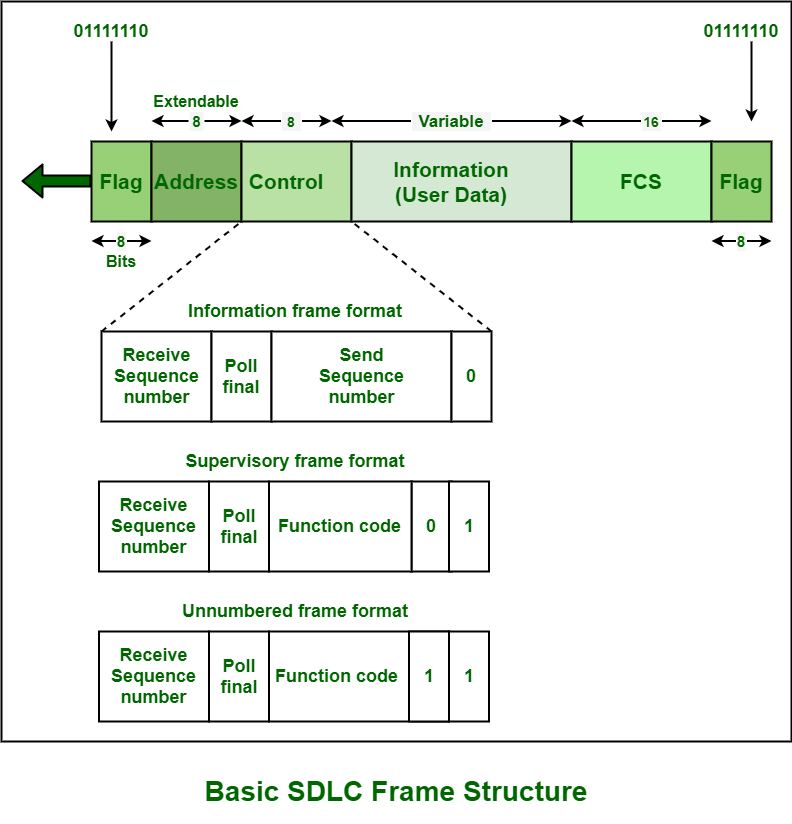
**SDLC Frame Format
Each SDLC frame consists of the following fields:
**1. Flag Field
- Marks the beginning and end of a frame
- Helps detect frame boundaries and synchronization
**2. Address Field
- Identifies the secondary station involved
- Supports individual, group, and broadcast addressing
**3. Control Field
- Defines the function and type of the frame
- Supports three formats:
- **Unnumbered (U) Frame: Link setup, disconnection, and control functions
- **Supervisory (S) Frame: Acknowledgments, flow control, and error reporting
- **Information (I) Frame: Data transfer and sequence control
**4. Information Field
- Optional field containing user data to be transmitted
**5. Frame Check Sequence (FCS)
- Used for error detection
- Ensures the integrity of the received frame
**6. Ending Flag Field
- Indicates the end of the transmission frame
Key Advantages of SDLC
Below are some of the key advantages of SDLC:
- Reliable data transmission
- Strong error detection and flow control
- Supports multiple network configurations
- Structured and efficient frame management
SDLC laid the foundation for many modern data link protocols by introducing robust framing, error control, and communication management techniques.