Bit Stuffing in Computer Network (original) (raw)
Last Updated : 3 Oct, 2025
Bit stuffing is a technique used in computer networks to ensure data is transmitted correctly. The data link layer is responsible for framing, which is the division of a stream of bits from the network layer into manageable units (called frames). Frames could be of fixed size or variable size. In variable-size framing, we need a way to define the end of the frame and the beginning of the next frame. A **Bit stuffing is the insertion of non-information bits into data. Note that stuffed bits should not be confused with overhead bits. **Overhead bits are non-data bits that are necessary for transmission (usually as part of headers, checksums, etc.).
What is Bit Stuffing?
Bit stuffing is a method used in data communication to avoid confusion between data and special control signals (like start or end markers). When a specific sequence of bits appears in the data an extra bit is added to break the pattern. This prevents the receiver from mistaking the data for control information. Once the data is received the extra bit is removed restoring the original message. This technique helps ensure accurate data transmission.
What is Byte Stuffing?
Byte stuffing is the same as bit stuffing the only difference is that instead of a single bit, one byte of data is added to the message to avoid confusion between data and special control signals. This ensures accurate message transmission without misinterpreting the data.
How Bit Stuffing Work?
Below are the working of bit stuffing in computer network:
- **Sender Side: While sending data if the sender detects a sequence of bits that matches a special control pattern like five consecutive 1s it inserts an extra bit usually a 0 into the data stream to break the sequence.
- **Receiver Side: The receiver gets the data and removes the extra stuffed bit whenever it detects a specific bit pattern. This restores the data to its original form.
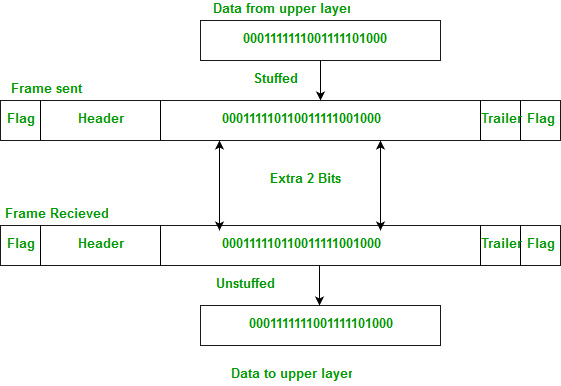
**Example of bit stuffing
Bit sequence: 110101111101011111101011111110 (without bit stuffing)
Bit sequence: 1101011111001011111**0101011111****010 (with bit stuffing)
After 5 consecutive 1-bits, a 0-bit is stuffed. Stuffed bits are marked bold
(No 6 consecutive 1's exist after stuffing).
**Applications of Bit Stuffing
- Synchronize several channels before multiplexing.
- Rate-match two single channels to each other.
- Run length limited coding.
**Run length limited coding : To limit the number of consecutive bits of the same value(i.e., binary value) in the data to be transmitted. A bit of the opposite value is inserted after the maximum allowed number of consecutive bits.
Bit stuffing technique does not ensure that the sent data is intact at the receiver side (i.e., not corrupted by transmission errors). It is merely a way to ensure that the transmission starts and ends at the correct places.
Advantages **of Bit Stuffing
- **Data Integrity: Bit stuffing helps ensure that the data is transmitted accurately without confusion between data and control signals. This prevents errors in message interpretation.
- **Error Prevention: By adding extra bits bit stuffing reduces the chances of misidentifying special bit patterns which can lead to data loss or corruption.
- **Flexible Data Handling: Bit stuffing allows networks to handle various data types without needing complex encoding schemes making the transmission process simpler.
- **Compatibility: It works well with existing communication protocols allowing for easy integration into systems that use bit-oriented protocols.
- **Easy Decoding: The technique is straightforward for receivers to implement as they simply need to look for the stuffed bits and remove them during data processing.
**Disadvantages of Bit Stuffing
- **Increased Data Size: Bit stuffing adds extra bits to the data stream which increases the overall size of the transmitted data leading to a slight increase in bandwidth usage.
- **More Processing: Both the sender and receiver need to process the data for bit stuffing and removal which can add complexity to the communication system.
- **Reduced Efficiency: In situations where many bits are stuffed the overhead can reduce the overall efficiency of the data transmission.
- **Limited to Specific Protocols: Bit stuffing is primarily used in bit-oriented protocols and may not be suitable for all types of communication systems.
- **Latency: The added processing and extra bits might introduce small delays in data transmission especially in systems where speed is critical.
Conclusion
In conclusion, bit stuffing is an essential technique in computer networks that helps maintain data integrity during transmission. By adding extra bits to avoid confusion with special control sequences it ensures that the receiver accurately interprets the message. This method enhances the reliability of data communication making it easier to manage and understand the information being sent across networks.