Brute Force Attack (original) (raw)
Last Updated : 23 Aug, 2025
Brute force is a method where attackers try all possible passwords until the right one is found. It doesn’t exploit software flaws but relies on trial-and-error testing. The attack may use common wordlists (dictionary) or full character sets. Though slow, weak passwords can be cracked quickly with powerful systems.
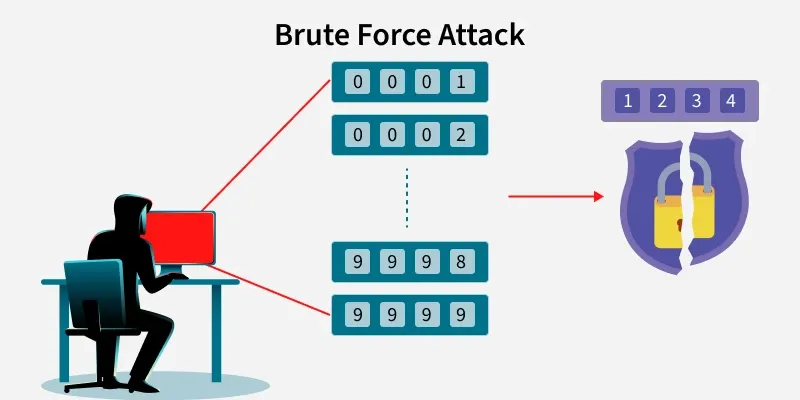
Brute Force Attack
**Types of Brute Force Attacks:
Here are some of the types of brute-force attacks
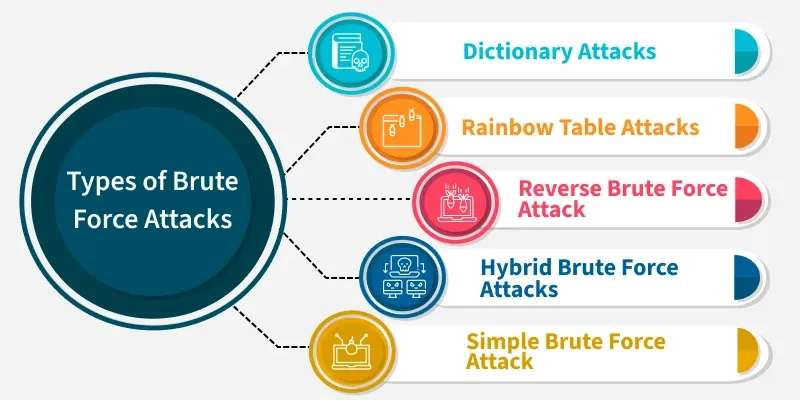
Types of Brute Force Attack
- **Dictionary Attacks: Attempts to guess usernames or passwords by using a predefined dictionary of likely words or phrases
- **Rainbow Table Attacks: A Rainbow Table is a precomputed database used to reverse cryptographic hash functions. It helps quickly find the original input from a hash, but only works for inputs up to a certain length and within a limited character set.
- **Reverse Brute Force Attack: It utilizes a typical password or a collection of passwords against numerous conceivable usernames. Focuses on a network of clients for which the attackers have recently acquired information.
- **Hybrid Brute Force Attacks: It begins from outer rationale to figure out which password variety might be destined to succeed, and next proceeds with the simple way to deal with attempt numerous potential varieties.
- **Simple Brute Force Attack: Utilizes an efficient way to deal with 'surmise' that doesn't depend on outside reasoning.
Brute Force Working
Here is the step-by-step process of how a brute force attack is done by attackers:
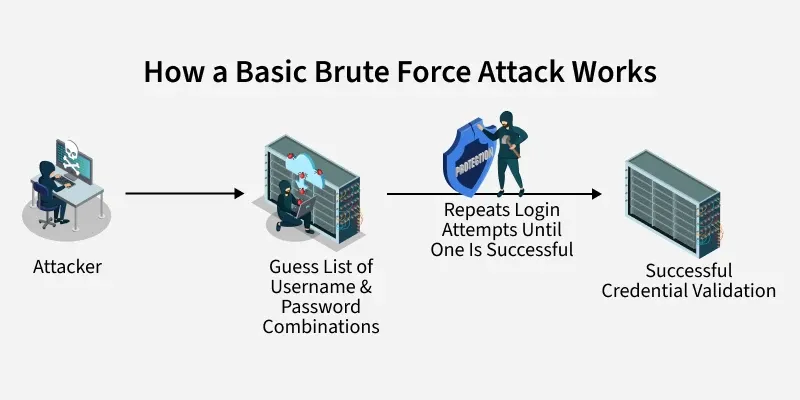
- Attacker selects a target account, service, or encrypted file.
- Attacker gathers clues about the possible password, like username (
admin,user1) - An attacker chooses an Online brute-force method to directly try passwords on the login page, SSH, RDP, etc.
- Select Tools & Wordlists like John the Ripper, Hashcat, Hydra, Medusa, and Aircrack-ng.
- The tool starts generating passwords systematically and sends each password systematically
- If the guess matches, the password is revealed. And if not, the tool continues with the next combination.
- Once cracked, the attacker logs in or decrypts the file.
**How to Prevent Brute Force Password Hacking?
To protect your organization from brute force password hacking, enforce the use of strong passwords.
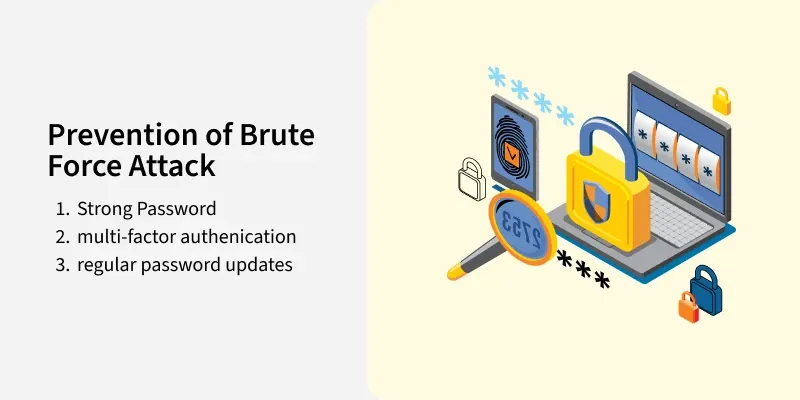
Passwords should:
- Never use information that can be found online (like names of family members).
- Have as many characters as possible.
- Combine letters, numbers, and symbols.
- Avoid common patterns.
- Be different for each user account.
- Change your password periodically
- Use a strong and long password
- Use multifactor authentication