Quality of Service and Multimedia (original) (raw)
Last Updated : 7 Feb, 2026
Quality of Service (QoS) refers to a set of traffic management and control mechanisms used in computer networks to prioritize and regulate data transmission based on the requirements of applications.
- It classifies traffic and marks packets so the network can treat them differently.
- It uses scheduling and queuing to forward high-priority traffic first when the network is busy.
- It manages bandwidth using shaping or policing to keep traffic within defined limits and prevent one flow from dominating.
- It improves reliability for real-time apps by reducing delay variation and limiting packet drops during congestion.
QoS Parameters
Quality of Service parameters are measurable factors used to evaluate and control network performance, especially for real-time and multimedia applications.
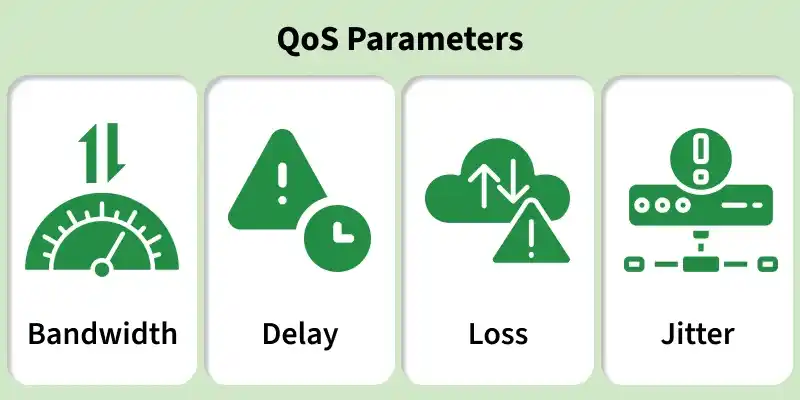
- **Packet Loss: Some packets get dropped in the network (often due to congestion). This reduces quality for calls, video, and downloads.
- **Jitter: Jitter refers to the variation in packet arrival times caused by congestion, routing changes, or timing differences.
- **Latency: Latency is the time taken for a packet to travel from the source to the destination.
- **Bandwidth: Bandwidth represents the maximum data-carrying capacity of a network link within a given time period
- **Mean Opinion Score (MOS): MOS is a subjective measure used to evaluate voice quality on a scale from 1 to 5, (5 = excellent, 1 = poor).
- **Throughput: Throughput is the actual rate at which data is successfully delivered over a network.
- **Error Rate: Error rate indicates the frequency of corrupted or lost packets during transmission.
Types of Quality of Service
Quality of Service mechanisms can be broadly classified into stateless and stateful solutions based on how network devices handle traffic information.
**1. Stateless Solutions:
- Routers do not maintain detailed information about individual traffic flows.
- This approach is highly scalable and robust, making it suitable for large networks.
- Traffic is treated based on predefined classes rather than per-flow analysis.
- It does not provide strict guarantees for delay, bandwidth, or performance.
- Commonly used where simplicity and scalability are more important than precise control.
**2. Stateful Solutions:
- Routers maintain per-flow state information for each traffic stream.
- This allows the network to provide strong QoS guarantees, such as assured bandwidth and controlled delay.
- It ensures efficient resource utilization and better protection for critical applications.
- The approach is less scalable and less robust due to higher processing and memory overhead.
- Best suited for networks where precise performance control is required.
How does QoS work?
Quality of Service (QoS) manages network traffic so important applications (voice/video) get better performance even during congestion. It does this by tagging traffic, separating it into queues, and sending higher-priority packets first.
- **Packet Marking: Packets are labeled (e.g., voice, video, data) so routers/switches can recognize priority and treat them accordingly.
- **Virtual Queues: Devices keep separate queues per priority. High-priority traffic goes into a faster queue and may get guaranteed bandwidth.
- **Handling Allocation: QoS decides which queue sends packets first and how much bandwidth each gets, so critical traffic stays smooth while other traffic shares the left bandwidth.
Importance
- **Prioritizes critical apps: QoS gives higher priority to real-time traffic like VoIP, video meetings, and streaming so it stays smooth.
- **Reduces latency and jitter: QoS lowers delay and delay variation, which improves call and video quality.
- **Minimizes packet loss: QoS reduces drops during congestion, protecting time-sensitive and important traffic.
- **Uses bandwidth efficiently: QoS distributes bandwidth smartly to avoid congestion and prevent one flow from consuming everything.
- **Improves reliability: QoS keeps performance more stable and predictable even when the network is heavily loaded.
- **Supports SLAs: QoS helps meet SLA targets for delay, throughput, and availability.
Implementing QoS
Implementing Quality of Service (QoS) requires a structured, phased approach to ensure efficient use of network resources and consistent performance for critical applications.
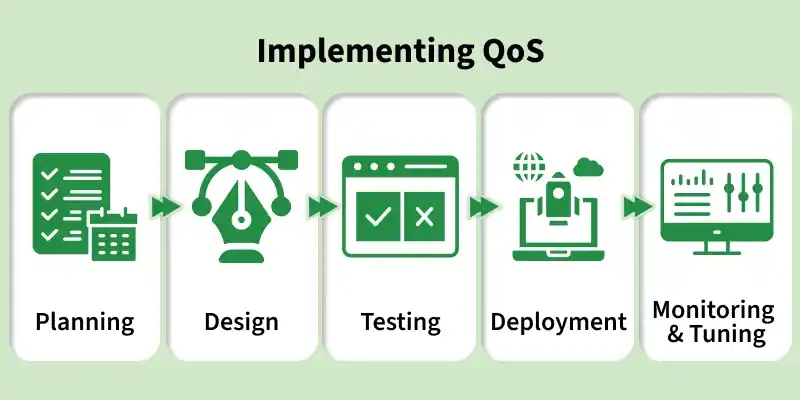
- **Planning: The team identifies which application need priority, chooses a QoS approach, and aligns stakeholders for a smooth rollout.
- **Design: The team plans required hardware/software changes and maps the QoS model to the current network and device limits.
- **Testing: The team validates policies in a lab or staging setup to catch marking, queuing, and performance issues before production.
- **Deployment: The team enables QoS step-by-step by site, segment, or feature to reduce risk and keep the network stable.
- **Monitoring & Tuning: The team continuously tracks performance metrics and adjusts QoS rules to maintain consistent results.
Models to Implement QoS
QoS models define how traffic is prioritized and how network resources are assigned to meet application performance needs.
**1. Integrated Services (IntServ)
Integrated Services (IntServ) provides strict QoS guarantees by reserving resources for each individual flow before traffic starts.
- IntServ works on a per-flow basis, so each session can get guaranteed delay, bandwidth, and loss limits.
- Routers keep state information per flow, which increases control but reduces scalability.
- The network uses admission control, meaning new sessions are accepted only if enough resources are available.
**IntServ QoS Components
- **Resource reservation: Routers reserve bandwidth/buffers for the flow and run admission checks at each hop.
- **QoS-aware scheduling: Schedulers like WFQ help share bandwidth fairly while meeting priorities.
- **QoS-aware routing: QoS routing tries to pick paths that can meet the required service level.
- **QoS packet discard: During congestion, lower-priority packets are dropped first to protect critical flows.
**RSVP (Resource Reservation Protocol)
RSVP is a signaling protocol used with Integrated Services to reserve network resources.
- Reservations are typically receiver-initiated (the receiver requests the resources).
- RSVP maintains soft state, so reservations must be refreshed periodically.
- PATH messages go forward to discover the route, and RESV messages return to reserve resources along that path.
- It can support multicast reservations.
**Call Admission Control
Call admission control ensures that the network only accepts traffic it can support without degrading existing services.
- Each session must declare its QoS requirements and traffic characteristics before transmission.
- **R-Specification (R-spec): Defines the requested QoS parameters such as delay bounds and acceptable packet loss.
- **T-Specification (T-spec): Describes traffic characteristics such as data rate and burstiness.
- A signaling protocol carries R-spec and T-spec to routers where reservations are required.
- Routers admit or reject calls based on current resource availability and existing allocations.
**2. Differentiated Services (DiffServ)
Differentiated Services (DiffServ) provides QoS by prioritizing traffic classes instead of reserving resources for every flow.
- Traffic is classified into classes (voice, video, best-effort) rather than handled per individual flow.
- Routers manage QoS using aggregated class behavior, which scales better in large networks.
- DiffServ offers relative priority (better treatment for higher classes), not strict end-to-end guarantees.
- Packets are marked (commonly using DSCP) so devices know which class and priority to apply.
- It reduces complexity by avoiding heavy per-flow signaling and per-flow router state.
IntServ vs DiffServ
| **Integrated Services (IntServ) | **Differentiated Services (DiffServ) |
|---|---|
| It provides QoS for each individual flow. | It provides QoS by grouping traffic into classes. |
| Routers store separate state information for every flow. | Routers store state information only for each traffic class. |
| RSVP signaling is used to reserve resources end-to-end. | End-to-end signaling is generally not required. |
| It offers strict guarantees for delay, bandwidth, and packet loss. | It offers relative priority rather than strict guarantees. |
| It is less scalable for large networks. | It is highly scalable for large networks. |
| It is more complex to configure and manage. | It is simpler to deploy and manage. |
| Explicit resource reservation is required. | Explicit per-flow reservation is not required. |
| It fits best in small or controlled networks. | It fits best in large enterprise and backbone networks. |
QoS tools are network techniques that classify and control traffic so critical applications get predictable performance.
- **Classification & marking: Identify traffic and mark packets (e.g., DSCP) for correct priority handling.
- **Shaping & policing: Shaping smooths traffic to a set rate; policing enforces limits by dropping or re-marking excess packets.
- **Queuing & scheduling: Use priority queues and schedulers to decide packet send order and share bandwidth.
- **Resource reservation: Reserve bandwidth/buffers for selected flows to guarantee service.
- **Congestion management: Control queue buildup to reduce delay and packet loss during high traffic.
QoS is essential for multimedia because audio and video traffic is highly sensitive to delay, jitter, packet loss, and bandwidth limits, so QoS helps keep media smooth even when the network is congested.
- QoS prioritizes real-time streams like VoIP, video calls, and live streaming to avoid interruptions.
- QoS controls latency and jitter so audio and video stay synchronized and playback remains stable.
- QoS reduces packet loss by giving media packets better treatment during congestion.
- QoS allocates bandwidth to multimedia flows so high-bitrate streams run properly without blocking other critical traffic.
- QoS improves user experience by reducing buffering, lag, and voice/video breaks.
- QoS optimizes resource usage by using scheduling and queuing so multimedia and normal data can share the network efficiently.
Multimedia is a digital way of presenting information by combining multiple media types (like text, images, audio, video, and animation) in one system, often with user interaction.
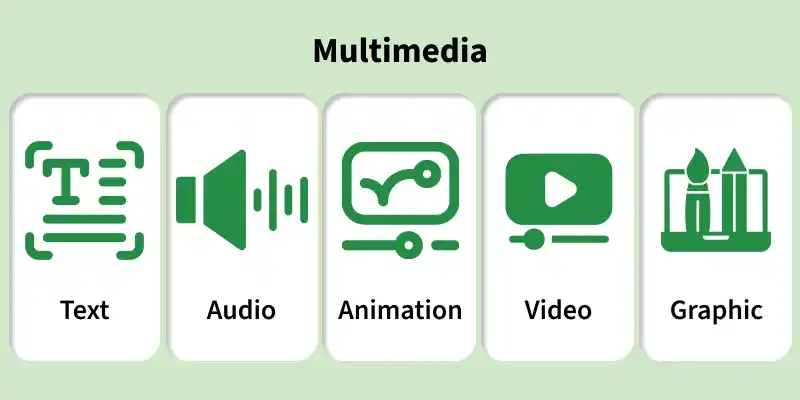
Components of Multimedia
- **Text: Written content used to display information clearly, with formatting like font, size, and style.
- **Graphics: Visual elements such as photos, diagrams, charts, and illustrations that improve understanding.
- **Animation: Moving visuals created by showing images in sequence to make content more engaging.
- **Video: Continuous moving frames (usually 15–30 fps) often with audio, used for demonstrations and streaming.
- **Audio: Sound like speech, music, and effects that adds realism and improves user experience (e.g., MP3, WMA).