Controlled Access Protocols in Computer Network (original) (raw)
Last Updated : 3 Oct, 2025
In computer networks, Controlled Access Protocols (CAPs) manage how multiple devices share a common communication medium. These protocols control the right to transmit in such a way that collisions are avoided, efficiency is maintained, and fair access is ensured.
**Note: Unlike random access methods (e.g., ALOHA, CSMA), in controlled access, stations do not transmit at will. Instead, they follow a systematic method to determine which station has the right to send at a given time.
What is Controlled Access?
In Controlled Access, before transmitting data, a station must first obtain permission to access the channel. At any given time, only one node can send data, preventing collisions. This coordination is achieved using one of three methods:
- Reservation
- Polling
- Token Passing
Reservation
In this method, stations reserve slots in advance before transmission. The timeline has two parts:
- Reservation Interval (fixed length): divided into slots, one per station.
- Data Transmission Period (variable length): reserved stations send data in order.
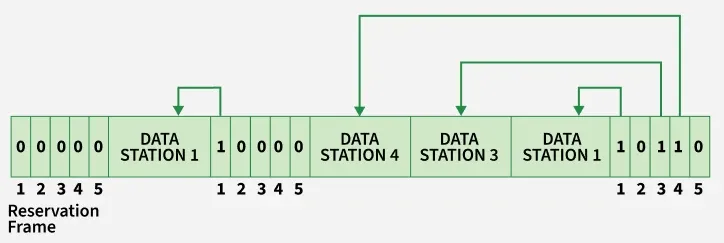
Reservation
**Example: If there are M stations, the reservation interval is divided into M slots. Each station signals intent by inserting a bit into its slot. Then, only the reserved stations transmit in the data phase.
Advantages
- Predictable access time and throughput.
- Priorities can be set for faster access.
- Supports QoS (Quality of Service) for applications like real-time audio/video.
- Efficient bandwidth utilization.
Disadvantages
- Performance decreases under light loads (wasted slots).
- High dependency on controlled synchronization.
Polling
Here, a controller (primary station) polls each node (secondary station) in sequence, granting permission to send. The controller sends a message with the address of a station. The addressed station responds:
- Sends data (if available)
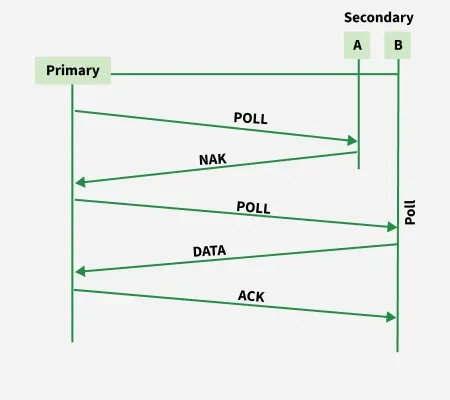
Polling
- Sends a NAK (poll reject) if no data is pending.
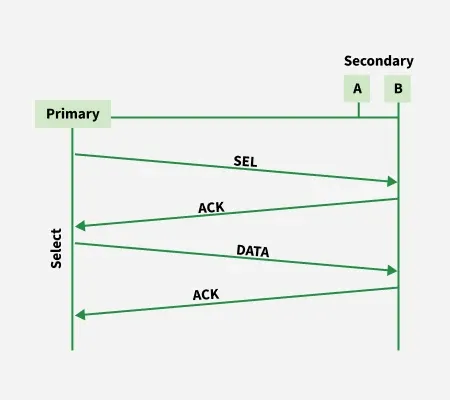
Polling
Advantages
- Predictable access times and bandwidth.
- High efficiency, since no slot is wasted.
- Priorities can be assigned.
Disadvantages
- Extra overhead due to polling messages.
- High dependence on controller reliability.
- Turnaround time increases under light loads.
Efficiency formula
\eta = \frac{T_t}{T_t + T_{poll}}
**where:
- T_t =data transmission time
- T_{poll} = polling overhead time
Token Passing
In Token Passing, stations are logically connected (ring or bus). A special frame called a token circulates among stations:
- The token represents permission to transmit.
- A station can send data only when it holds the token.
- If no data is ready, the token is simply passed on.
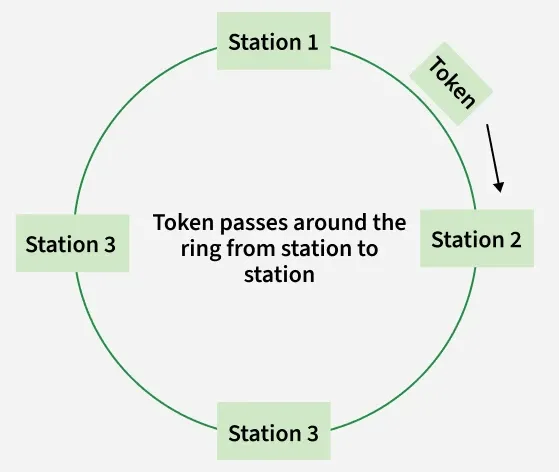
Token Passing
Common Implementations
- **Token Ring – token passed in a ring topology.
- **Token Bus – stations use a bus medium but pass the token in a predefined logical order.
Advantages
- Excellent performance under high loads.
- Built-in error recovery and debugging features.
- Predictable throughput.
Disadvantages
- Expensive setup and hardware.
- Token management issues (lost/duplicate tokens, station failures).
- Complex implementation.
Performance Parameters
- Delay: Average delay = a/N, where a = T_p/T_t.
- Throughput:
1. For a<1a < 1a<1: S = \frac{1}{1 + a/N}
2. For a>1a > 1a>1: S = \frac{1}{a(1 + 1/N)}
**where:
- N = number of stations
- T_p = propagation delay
- T_t = transmission delay
Comparison of Controlled Access Methods
| Feature | Reservation | Polling | Token Passing |
|---|---|---|---|
| Access Control | Slot-based reservation | Central controller polls | Token circulation |
| Efficiency | High (under heavy load) | Moderate (polling overhead) | High (predictable) |
| Collision Chance | None | None | None |
| Overhead | Reservation slots | Polling messages | Token management |
| Best For | Real-time multimedia | Small/medium networks | Large/high-load networks |