Applications of Data Link Layer (original) (raw)
Last Updated : 23 Jul, 2025
The Data Link Layer is the second layer of the OSI (Open Systems Interconnection) model. It acts as a bridge between the Physical Layer (which transmits raw bits) and the Network Layer (which handles logical addressing and routing). The primary function of the Data Link Layer is to ensure reliable data transfer between two directly connected nodes.
The Data Link Layer is further divided into two sublayers:
- **LLC (Logical Link Control) : Error checking and frame synchronization
- **MAC (Media Access Control) : Physical addressing and medium access control
The Data Link Layer plays a critical role in ensuring that data travels reliably and efficiently across physical media. Its applications span a wide range of domains from Ethernet LANs and wireless networks to satellite communications and industrial automation.
**Functions of the Data Link Layer
Before going into applications, it's important to understand what are the functions of Data Link Layer :
- **Framing: Divides data into manageable units called frames.
- **Error Detection and Correction: Detects and sometimes corrects errors using techniques like CRC (Cyclic Redundancy Check).
- **Flow Control: Ensures that the sender does not overwhelm the receiver.
- **MAC (Media Access Control): Determines how devices on a network share the communication medium.
- **Addressing: Uses MAC addresses to identify devices on the same network.
**Applications of Data Link Layer
It plays a vital role in making sure that data is sent and received correctly between devices that are directly connected. Here are the some applications of the Data Link Layer :
**Local Area Networks (LANs)
In home, school, or office networks, the Data Link Layer is essential for enabling devices like computers, printers, and smartphones to communicate.
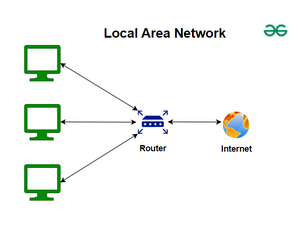
- Assigns MAC addresses to devices so they can recognize each other.
- Breaks data into frames for organized delivery.
- Uses rules to control who can send data and when (like CSMA/CD in Ethernet and CSMA/CA in Wi-Fi).
**Example:
In your home Wi-Fi network, your phone and laptop send data to the router using MAC addresses. The Data Link Layer ensures that these devices don’t talk over each other and that the data gets where it needs to go.
**Error Detection in Noisy Environments
In places with lots of interference like factories the Data Link Layer helps detect and correct errors in data transmission.
- Uses CRC (Cyclic Redundancy Check) to detect damaged data.
- Uses ARQ (Automatic Repeat request) to ask for retransmission when errors are found.
**Example: On a manufacturing floor, machines often communicate wirelessly. The Data Link Layer ensures that these critical messages are delivered without corruption or incorrectly.
**Point-to-Point Communication
Sometimes, communication is just between two devices directly connected, like a computer and a modem.
- Protocols like **PPP (Point-to-Point Protocol) allow smooth and private communication between two nodes.
**Example : When you connect your laptop to the internet using a dial-up modem or a direct cable, the Data Link Layer ensures a reliable link is maintained.
**Cellular and Mobile Networks
Mobile phones use this layer to communicate with towers and base stations in a reliable way.
- Helps set up and end connections between your phone and the cell tower.
- Detects errors and handles retransmissions of lost or damaged data.
- Manages airwave access, ensuring many devices can share the same signal space.
**Example: When you make a phone call or use mobile data, your phone uses the Data Link Layer to talk to the nearest cell tower without interference or data loss.
**Satellite Communication
Satellites are far from Earth, and data can easily get corrupted due to long distances.
- Frames the data to organize it for transmission.
- Sends acknowledgment**s to confirm receipt of data.
- Helps multiple devices share the satellite link efficiently.
**Example: In satellite internet or GPS systems, this layer ensures that commands and responses are correctly sent back and forth, despite delays and errors.
**ATM and Frame Relay Networks
These are older technologies used mostly in wide area networks (WANs), like telecom infrastructure.
- Establishes virtual circuits ,a fixed path for data to follow.
- Provides connection-oriented communication, ensuring data goes to the right place.
- Encapsulates data in frames suitable for transmission.
**Examples: These technologies were once used in bank networks, ISPs, and enterprise connections before Ethernet and IP-based networks became dominant.
**Industrial Control Systems
Factories and automated systems use specialized communication to control machinery.
- Data arrives exactly when expected.
- Controls access to the communication medium so devices don’t interfere with each other.
- Identifies machines using MAC addresses.
**Example: In systems like Modbus over Ethernet, machines and controllers exchange precise, real-time data to control robotic arms or conveyor belts.