Difference Between IP Addressing and Subnetting (original) (raw)
Last Updated : 23 Jul, 2025
In computer network IP addressing and subnetting both are improtant concepts. An IP address is a unique identifier assigned to devices on a network to enable communication. It consists of two parts the network and host address. Where as subnetting is a technique used to divide a larger IP network into smaller, more manageable sub-networks (subnets) to improve efficiency and security in IP management. Both IP Addressing and Sub-Networks are linked ideas. In this article, we will discuss the difference between IP Addressing and Subnetting in detail.
What is an IP Addressing?
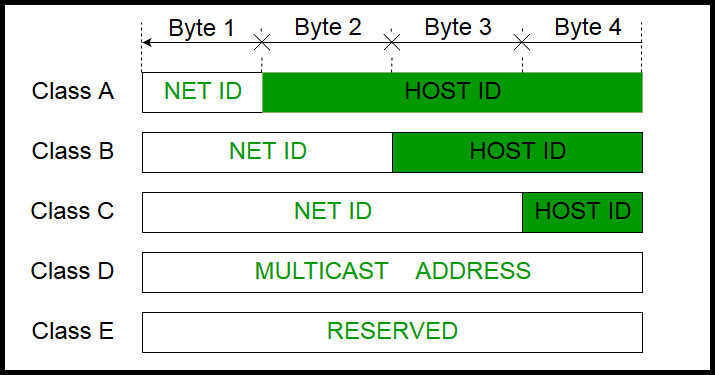
Each device that uses a network receives an IP address and a special identifier number. IP Addresses are necessary for routing data packets between devices and enabling Internet communication between devices. Dotted decimal notation, which depicts four sets of bit. The network, separated by periods, is the most common way to express IP addresses. The address is 32 bits, and every number corresponds to a byte of the address.
There are two primary forms of IP addresses IPv4 and IPv6. Because of the 32-bit length and the limited amount of unique IPv4 addresses, subnets and various methods for storing IP addresses have been developed. There are many more unique addresses available for IPv6 addresses that are 128-bit.
Advantages of IP Addressing
- You can generate a unique Identification Number with the help of IP Addressing for each device.
- For performing Data Routing, IP Addressing is necessary between different networks.
- You can access the device, servers, etc. with the internet with the help of IP Addressing,
Disadvantages of IP Addressing
- Only a limited number of IPv4 Addresses can be accessed with the help of IP Addressing.
- You will find complexity in configuring the IP Addresses.
- If the IP Addresses are exposed, there is a very high chance of security threats.
What is a Subnetting?
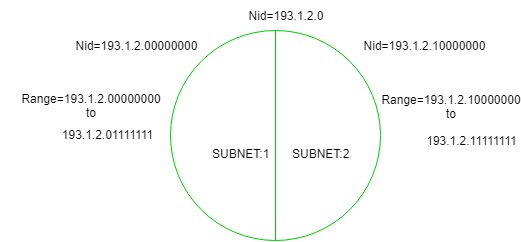
A network is divided into smaller subnetworks, or subnetworks, through the process known as a subnetwork. For this purpose, a network part of the IP address is created by taking bits from the host part. The host party identifies the specific device on the subnetwork, while the network party identifies the subnetwork as a whole.
The sub-network enables network managers to create more controllable and segmented networks for performance or security needs. For example, a large enterprise could segment its network into subnetworks for multiple divisions or locations.
Advantages of Subnetting
- A Subnet can use the IP Addresses effectively as it divides large networks into smaller ones.
- A Subnet can introduce additional security to the IP Addresses.
- A Subnet can increase the performance by reducing the network traffic.
Disadvantages of Subnetting
- If you want to expand or change the Subnet structure, it will be a bit difficult.
- To design the Subnetted Network, you have to perform good calculations and planning.
- If the configuration of the Subnet is not correct, it can bring many external threats.
Difference Between IP Addressing and Subnetting
| Parameters | IP Addressing | Subnetting |
|---|---|---|
| Purpose | Assign unique identifiers to devices on a network. | Divide a network into smaller subnetworks for better management and performance. |
| Process | Assigns unique IP addresses to devices on a network. | Divides a network into smaller subnets by borrowing bits from the host portion of the IP address to create a network portion. |
| Result | Each device on the network has a unique IP address. | The network is broken down into smaller subnets, each with its unique network ID and range of IP addresses. |
| Benefits | Enables devices to communicate with each other over the Internet. | Improves network performance and security by reducing network congestion, isolating network traffic, and making it easier to manage IP address assignments and security. |
| Types | IPv4 and IPv6 | CIDR (Classless Inter-Domain Routing) |
| Notation | Dotted decimal notation (e.g., 192.168.0.1) | Subnet mask (e.g., 255.255.255.0) or CIDR notation (e.g., /24) |
| Length | 32 bits (IPv4) or 128 bits (IPv6) | Variable (depends on the number of bits borrowed for the network portion of the IP address). |
| Example | 192.168.0.1 | 192.168.0.0/24 |
Conclusion
In conclusion, subnetting and IP addressing are both crucial ideas in computer networking. In contrast to subnetting, which involves partitioning a network into smaller subnetworks, IP addressing involves giving each device on a network a distinct address. The sub-network enables network managers to create smaller, more manageable networks that can be split for performance or security reasons.