Difference between Message and Packet Switching (original) (raw)
Last Updated : 29 Oct, 2024
The Message and the Packet Switching are a two fundamental methods of the data transmission in a computer networks. A Message Switching transmits the entire message as a single unit through a intermediate nodes using store and forward technique where each node must receive the complete message before forwarding it. A Packet Switching divides a messages into the smaller packets that are sent independently through the different network paths and reassembled at a destination. While the Message Switching requires a more storage and can cause the delays. Packet Switching offers a efficient resource utilization and forms the basis of a modern internet communications.
What is Message Switching?
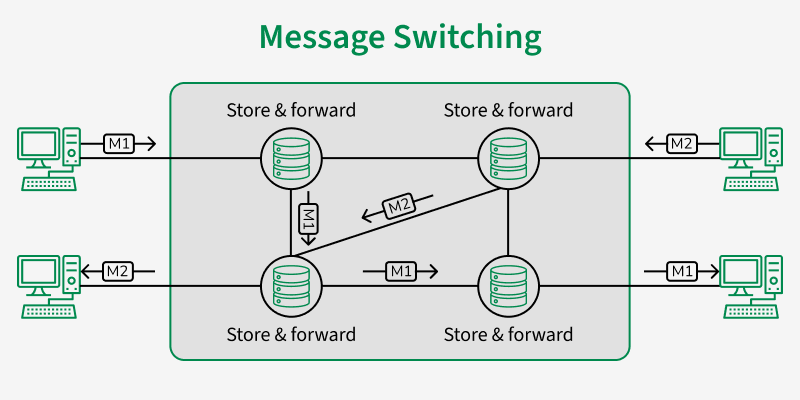
In this technique the entire message is transmitted without any break from one node to another. It firstly stores and then forwards information that requires more time. Due to this, the access time is increased. No direct link is present between the sender and the receiver.
Advantages of Message
- Messaging allows for a quick and a convenient communication enabling the people to stay connected regardless of distance or time zones. It provides written record of a conversations which can be useful for a reference or documentation purposes.
- Messaging platforms support the multimedia sharing allowing users to easily exchange the photos, videos and files. This versatility enhances the richness of a communication and facilitates collaboration in the both personal and professional settings.
- Messaging offers less intrusive form of a communication compared to the phone calls allowing recipients to respond at convenience. It also provides the options for group conversations making it easier to coordinate with a multiple people at same time.
Disadvantages of Message
- The instantaneous nature of a messaging can create the pressure for immediate responses leading to stress and a constant interruptions. This can negatively impact the productivity and personal time blurring the lines between a work and leisure.
- Messaging lacks the variation of face-to-face communication such as a tone of voice and body language which can lead to the misunderstandings. This limitation can sometimes result in a miscommunication or misinterpretation of the sender intent.
- Excessive reliance on a messaging can reduce in person interactions and potentially impact the development of a social skills. It may also contribute to sense of disconnection or isolation despite the increase in communication frequency.
What is Packet Switching?
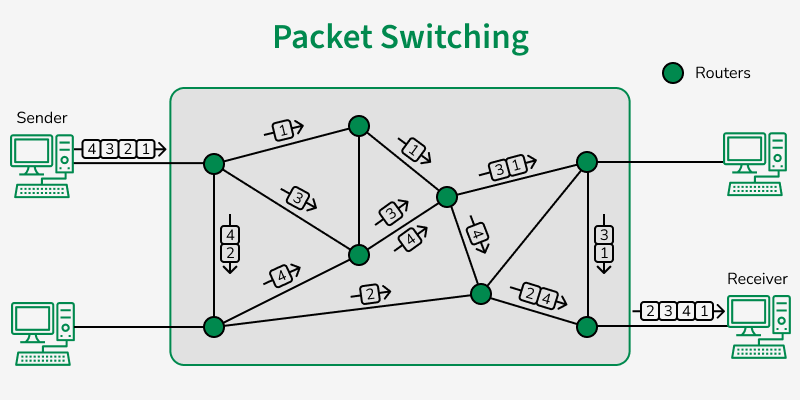
The packet switching information is transferred in the form of a data packets between the sender and the receiver. These packets are forwarded one by one from a sender to a receiver. Each packet is associated with a Header. Then, these packets then reassembled into the original message. This improves the performance as the time require to access the data packet is reduced. Due to this, the overall performance of the network is improved.
Advantages of Packet Switching
- Efficient use of network resources as multiple users can share the same communication lines simultaneously. This leads to better utilization of available bandwidth and reduced costs.
- Improved reliability through dynamic routing, allowing data to find alternative paths if one route is congested or fails. This enhances network resilience and ensures data delivery even in partial network failures.
- Flexibility in handling various types of data and traffic patterns. Packet switching can easily accommodate different data types and varying loads, making it adaptable to diverse network requirements.
Disadvantages of Packet Switching
- Potential for packet loss or out-of-order delivery, requiring additional protocols for error checking and sequencing. This can lead to increased complexity in network management and potential data integrity issues.
- Variable latency due to different routing paths and network conditions, which can affect real-time applications. This unpredictability can be problematic for time-sensitive services like voice or video communications.
- Overhead from packet headers and routing information, reducing the effective data transmission rate. Each packet carries extra information for routing and reassembly, which consumes some of the available bandwidth.
**Difference between Message and Packet Switching
| Message Switching | Packet Switching |
|---|---|
| A complete message is passed across a network. | Message is broken into smaller units known as Packets. |
| In this, computer language used is ASCII, baudot, morse. | In packet switching, binary type is used. |
| In message switching there is no limit on block size. | Packet switching places a tight upper limit on block size. |
| Message exist only in one location in the network. | Parts i.e. packets of the message exist in many places in the network. |
| Example: Hop-by-hop Telex forwarding and UUCP(UNIX-to-UNIX Copy Protocol) | Example: Frame Relay, IP, and X. 25 |
| Physical links are allocated dynamically. | Virtual links are made simultaneously. |
| Access time is reduced due to increase in performance as packets are stored in disk. | Packets are stored in main memory. |
Conclusion
Message switching and packet switching are two ways to send data across networks. Message switching sends entire messages as one unit, like a complete letter. Packet switching breaks data into smaller packets, sending each separately, like mailing a letter in pieces. Packet switching is more efficient and flexible, allowing better use of network resources. It's the basis for how the internet works, while message switching is mostly obsolete for data communications. Think of message switching as sending a postcard, and packet switching as sending a series of text messages.