Difference Between Stateless and Stateful Protocol (original) (raw)
Last Updated : 17 Mar, 2026
Interactions between clients and servers in networking significantly affect system performance. There are mainly two types of network protocols used for this communication: stateless and stateful protocols.
- Stateless protocols do not maintain state information, so a server does not need to retain information from prior requests.
- Stateful protocols maintain session state, enabling more consistent interaction between clients and servers.
Stateless Protocol
This is a network protocol in which a client sends a request to a server and the server responds solely based on its current state. It does not require the server to retain session information or status about each communicating partner for multiple requests.
- These protocols simplify the server's design.
- HTTP, UDP and DNS are examples of stateless protocols.
- Each communication is discrete and unrelated to those that precede or follow.
- This protocol requires fewer resources because the system does not need to track multiple link communications and session details.
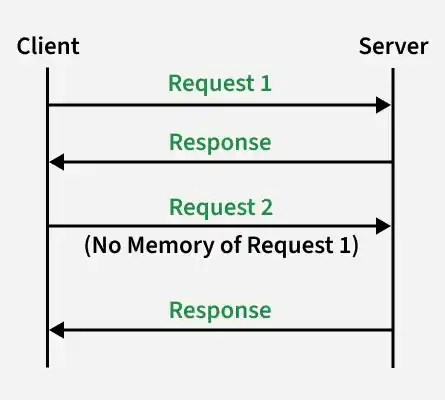
Stateless Protocol
Stateful Protocol
It is a communication protocol in which the server maintains information about the state of the interaction with the client across multiple requests. The server keeps track of data so that subsequent requests depend on previous interactions.
- Stateful applications require backing storage.
- FTP, TCP, and Telnet are examples of stateful protocols.
- Enable efficient and continuous communication.
- Stateful requests are always dependent on the server-side state.
- TCP sessions follow a stateful protocol because both systems maintain information about the session itself during its life.
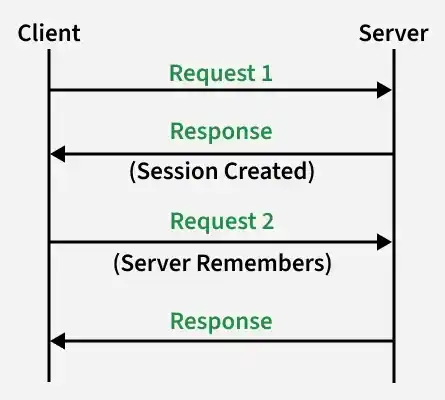
Stateful Protocol
Stateless vs Stateful Protocol
| Stateless Protocol | Stateful Protocol |
|---|---|
| The server does not store session information about previous requests. | The server stores session or connection information during communication. |
| Each request from the client is processed independently. | Requests may depend on previous interactions stored in the session state. |
| There is minimal dependency between client and server. | Communication maintains a continuous interaction between client and server. |
| Server design is simpler because no session tracking is required. | Server design is more complex due to session management. |
| Requests are self-contained and include all necessary information. | Requests may rely on previously stored state information. |
| Easier to scale because any server can handle any request. | Scaling can be more complex because session data must be maintained or shared. |
| Different servers can process different requests without coordination. | Session consistency may require the same server or shared session storage. |
| Suitable for highly scalable web services and APIs. | Suitable for applications requiring continuous interaction or sessions. |