Static and Dynamic Routing (original) (raw)
Last Updated : 26 Mar, 2026
Routing controls how data packets move from source to destination, ensuring efficient and reliable delivery. It can be done in the following two ways, static and dynamic routing.
1. Static Routing
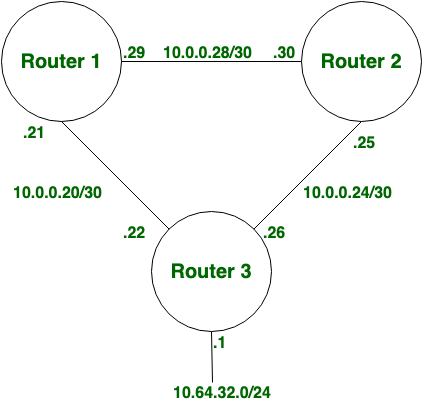
Static Routing is also known as non-adaptive routing, which doesn't change the routing table unless the network administrator changes or modifies it manually.
- It does not use complex routing algorithms.
- Provides higher or more security than dynamic routing.
Advantages
- No CPU overhead on routers, cheaper routers can be used.
- More secure, only the administrator controls the allowed routes.
- No bandwidth is consumed between routers.
Disadvantage
- Manually adding routes in large networks is time-consuming.
- It requires detailed knowledge of the network topology.
- New administrators must learn all routes to configure them correctly.
**2. Dynamic Routing
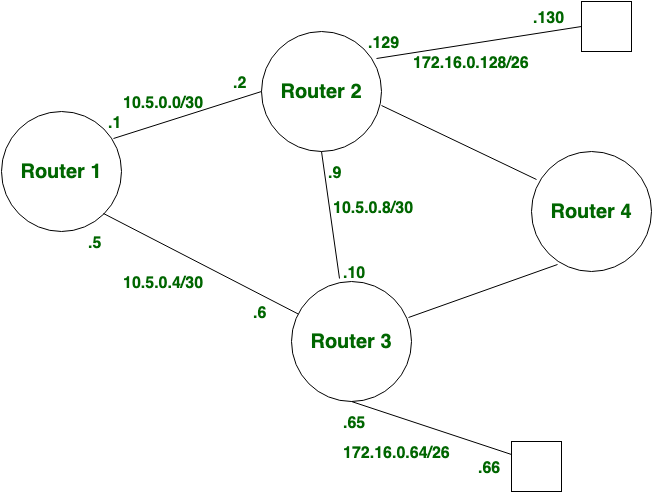
This routing is also known as adaptive routing, which automatically updates the routing table whenever there is a change in the network topology.
- It uses complex algorithms to calculate routes, but it is less secure compared to static routing.
- When a change occurs, routers exchange messages and recalculate the routes to ensure updated routing information is shared across the network.
Advantages
- **Automatic Route Updates: Routes are updated automatically when network topology changes
- **Efficient Path Selection: Chooses the best available path using metrics like hop count, cost, or delay
- **Scalability: Suitable for large and complex networks with multiple routers
- **Reduced Manual Configuration: Eliminates the need to manually configure and update routes
- **Fault Tolerance: Automatically reroutes traffic if a link or router fails
Disadvantages
- **Higher Bandwidth Usage: Consumes bandwidth for exchanging routing information between routers
- **Less Secure: Vulnerable to attacks if routing updates are not properly secured
- **Complex Configuration: Requires understanding of routing protocols and proper setup
- **Slower Convergence: Takes time to update routes after a network change
- **Resource Intensive: Uses more CPU and memory compared to static routing
**Static vs Dynamic Routing
| Static Routing | Dynamic Routing |
|---|---|
| Routes are manually configured by the administrator | Routes are automatically updated based on network changes |
| Does not use routing algorithms | Uses routing protocols and algorithms |
| More secure (no automatic updates) | Less secure if not properly configured |
| Suitable for small networks | Suitable for large and complex networks |
| Requires less bandwidth and resources | Requires more bandwidth and processing power |
| No automatic rerouting on failure | Automatically adapts to network failures |
| Also known as non-adaptive routing | Also known as adaptive routing |