Difference Between Symmetric and Asymmetric Key Encryption (original) (raw)
Last Updated : 29 Apr, 2026
Encryption is a core cryptographic technique used to protect data by converting it into an unreadable form, ensuring confidentiality, integrity, and secure communication in digital systems.
- Encryption safeguards sensitive information during storage and transmission from unauthorized access.
- It is a fundamental pillar of cybersecurity and modern digital communication.
- Encryption techniques are broadly classified into symmetric key and asymmetric key methods.
- Each method serves different purposes based on performance, security needs, and use cases.
- Modern systems often combine both methods to achieve optimal security and efficiency.
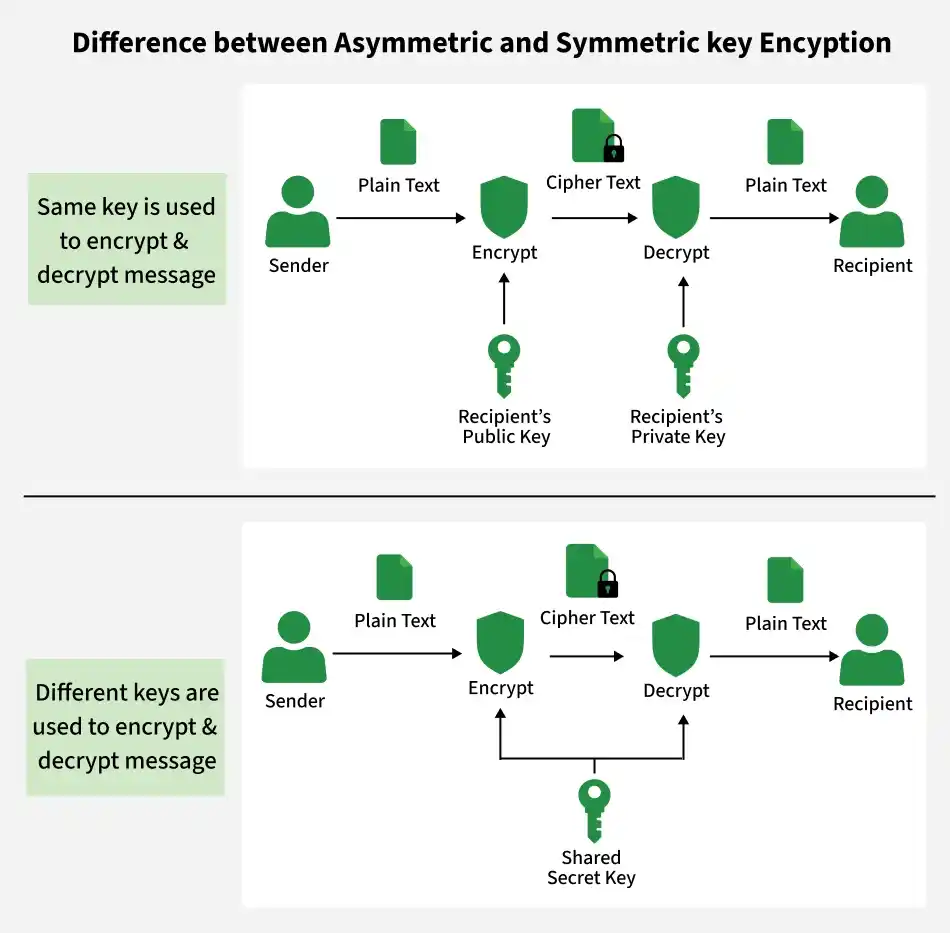
Symmetric Key Encryption
Symmetric key encryption is a method where the same secret key is used for both encrypting and decrypting data.
- Uses one shared secret key for encryption and decryption.
- Very fast and efficient, suitable for large volumes of data.
- Requires a secure key-sharing mechanism, which can be a risk.
- Common algorithms include AES, DES, 3DES, Blowfish, and RC4.
- Widely used in file encryption, VPNs, databases, and secure storage systems.
Asymmetric Key Encryption
Asymmetric key encryption uses a pair of keys a public key and a private key to secure data.
- Uses two keys: a public key for encryption and a private key for decryption.
- Eliminates the need to share a secret key, improving security.
- Slower and more resource-intensive compared to symmetric encryption.
- Common algorithms include RSA, ECC, Diffie-Hellman, ElGamal, and DSA.
- Commonly used in SSL/TLS, digital signatures, secure emails, and authentication systems.
Difference Between Symmetric and Asymmetric Key Encryption
| Symmetric Key Encryption | Asymmetric Key Encryption |
|---|---|
| It only requires a single key for both encryption and decryption. | It requires two keys, a public key and a private key, one to encrypt and the other to decrypt. |
| The size of cipher text is the same or smaller than the original plain text. | The size of cipher text is the same or larger than the original plain text. |
| The encryption process is very fast. | The encryption process is slow. |
| It is used when a large amount of data needs to be transferred. | It is used to transfer small amount of data. |
| It only provides confidentiality. | It provides confidentiality, authenticity, and non-repudiation. |
| The length of key used is 128 or 256 bits | The length of key used is 2048 or higher |
| In symmetric key encryption, resource utilization is low compared to asymmetric key encryption. | In asymmetric key encryption, resource utilization is high. |
| It is efficient as it is used for handling large amount of data. | It is comparatively less efficient as it can handle a small amount of data. |
| Security is lower as only one key is used for both encryption and decryption purposes. | Security is higher as two keys are used, one for encryption and the other for decryption. |
| Mathematical representation: P = D (K, E(K, P))whereK: encryption and decryption keyP: plain textD: Decryption **E(K, P): Encryption of plain text using K | Mathematical representation: P = D(Kd, E (Ke,P))whereK e : encryption keyK d : decryption keyD: Decryption**E(K e , P): Encryption of plain text using encryption key Ke. P --> plain text |
| **Examples: 3DES, AES, DES and RC4 | **Examples: Diffie-Hellman, ECC, El Gamal, DSA and RSA |
Choosing Between Symmetric and Asymmetric Encryption
Choosing between symmetric and asymmetric encryption depends on several factors such as:
1. Speed and Performance
- Use Symmetric Encryption if speed is a priority since it is much faster.
- Use Asymmetric Encryption for secure key exchange, even though it is slower.
2. Security Level
- Symmetric Encryption is secure but requires a secure way to share keys.
- Asymmetric Encryption is more secure for key exchange since it does not require sharing a secret key.
3. Use Case & Application
- Symmetric Encryption is ideal for encrypting large amounts of data, such as file encryption, VPNs, and database security.
- Asymmetric Encryption is best for digital signatures, SSL/TLS, secure email, and cryptocurrency transactions.
4. Key Management
- Symmetric Encryption requires a secure method for sharing keys between sender and receiver.
- Asymmetric Encryption simplifies key management as the public key can be shared openly while the private key remains secure.
5. Hybrid Approach (Best of Both)
- Many modern security systems use a hybrid approach, where asymmetric encryption is used to securely exchange a symmetric key, and symmetric encryption is used for actual data encryption (e.g., TLS/SSL in HTTPS).