Difference between Unicast and Broadcast (original) (raw)
Last Updated : 23 Jul, 2025
Data transmission in the area of computer networking can be done based on the destination or destinations involved. The two popular ones are unicast and broadcast. Unicast is defined as sending data to only one particular receiver, whereas broadcast is the sending of data to all devices connected to a network. Therefore, knowing the difference between unicast versus broadcast is very important when a person is either designing or managing a network. In this article, we discuss the difference between Unicast and Broadcast in detail.
**What is Unicast?
Unicast refers to data transmission from one sender to a single, specific receiver. During unicast transmission, a point-to-point link between the source and the target is established; therefore, only the destination endpoint gets the data. For example, if a device having IP address 10.1.4.0 in a network wants to send the traffic stream (data packets) to the device with IP address 20.14.4.2 in the other network, then unicast comes into the picture. It is the most common form of data transfer over the networks.
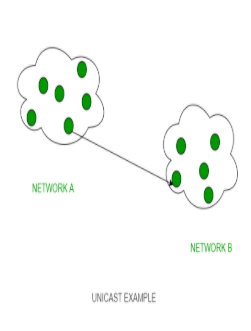
Advantages of Unicast
- **Efficient Use of Bandwidth: Since unicast directly transmits data to the receiver, there is no consumption of unnecessary bandwidth as it occurs in broadcast.
- **Secure Communication: Unicast communication is more secure since the information is only accessible to the receiving end.
- **Multi-Destination Scalability: While sending data to several destinations as individuals is resource-intensive, it does provide the efficiency for delivery with precision.
Disadvantages of Unicast
- **Limited in Large Networks: Unicast in large networks is a little limited because data are sent to each and every recipient in a case where there are numerous recipients.
- **Higher Consumption of Resources: Since the sender needs to create a separate communication channel for each destination, there is a subsequent increase in processing cost and bandwidth.
**What is Broadcast?
Broadcast transfer (one-to-all) techniques and can be classified into two types : Limited Broadcasting, Direct Broadcasting. In broadcasting mode, transmission happens from one host to all the other hosts connected on the LAN. The devices such as bridge uses this. The protocol like ARP implement this, in order to know MAC address for the corresponding IP address of the host machine. ARP does ip address to mac address translation. RARP does the reverse.
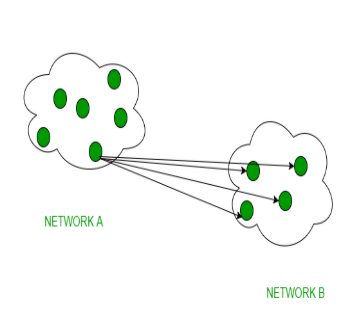
Advantages of Broadcast
- **Easy Transmission: Broadcasting is simple because the data is sent to all the devices without determining receivers in particular.
- **Handy for Network Discovery: In actual sense, it is widely adopted for network discovery protocols, as with Address Resolution Protocol (ARP) where devices have to announce their existence or find others in the network.
Disadvantages of Broadcast
- **Wasteful of Bandwidth : Broadcasting incurs traffic in the sense that the same information is sent to all devices, even those not needing it. This, therefore, causes a network to be clogged.
- **Vulnerability to Security: since data is sent to all, it risks getting sensitive information to the wrong hands. Broadcast traffic increases with the number of devices; thus, in N large networks, it's performance-degrading.
**Difference between Unicast and Broadcasting
| Feature | Unicast | Broadcast |
|---|---|---|
| Definition | Communication from one sender to one specific receiver. | Communication from one sender to all devices in the network. |
| Data Recipients | A single, specified recipient. | All devices on the network receive the data. |
| Use Case | Used for targeted communication like web browsing, video streaming. | Used for network discovery protocols, ARP requests. |
| Bandwidth Efficiency | Efficient, as data is sent only to the intended recipient. | Inefficient, as data is sent to all devices, even if not needed. |
| Security | More secure, as data is accessible only to the intended recipient. | Less secure, as data is accessible to all devices. |
| Scalability | Scales well for one-to-one communication but can be inefficient for large numbers of recipients. | Does not scale well in large networks due to network congestion. |
| Transmission Type | Point-to-point communication. | One-to-all communication. |
| Resource Usage | Requires more resources for multiple recipients (separate connections for each). | Uses fewer resources but leads to network flooding in large networks. |
Conclusion
Unicast and broadcast are two of the major methodologies of network transmission applied to serve different purposes. Unicast would be best for any kind of targeted one-to-one communication in which data is supposed to be efficiently delivered to one recipient securely, hence being quite suitable for applications like web browsing or video streaming. On the other hand, broadcast applies when data is supposed to be destined for all devices within a network and it's usually seen in network discovery protocols. However, broadcasting is less efficient compared to bandwidth and can even be insecure because of the wide scope of receipt. This highlights a delicate balance between network size, scalability, and security concerns versus bandwidth consumption. Each of these distinctions has further importance to be fully understood for the best performance of any network or the success of communication across different network configurations.