Difference between Unicast and Multicast (original) (raw)
Last Updated : 23 Jul, 2025
In networking, data transmission techniques play important role. It define the way data is transmitted between devices. Unicast transmission means sending data single node and Multicast transmission is sending information to multiple nodes. In this article we will see difference between unicast and multicast data transmission.
**What is Unicast?
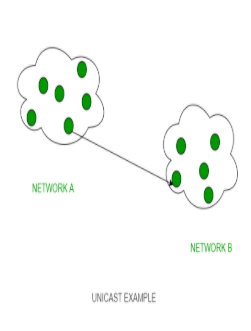
Unicast is a type of information transfer and it is used when there is a participation of single sender and single recipient. So, in short, you can term it as a one-to-one mapping. For example, a device having IP address 10.1.4.0 in a network wants to send the traffic stream (data packets) to the device with IP address 20.14.4.2 in the other network, then unicast comes into the picture. It is the most common form of data transfer over the networks.
Advantages of Unicast
- **Simplicity: Unicast is very simple to implement as well as to manage since the data is transferred to a particular and explicit recipient.
- **Reliable Communication: As the data is sent to one receiver it provides the assurance of delivery and the acknowledgment from the receiver end which makes it ideal for reliable methods of communication such as TCP.
- **Security: Since these are one-to-one communications, it is safer than the broadcast or multicast and can be used for transferring data.
Disadvantages of Unicast
- **Inefficiency for Group Communication: For that reason, with the same data that needs to be sent to multiple receivers, Unicast may prove highly inefficient because each requires a separate transmission.
- **Increased Bandwidth Usage: When data is sent to many receivers individually in large networks it leads to the wastage of bandwidth.
**What is Multicast?
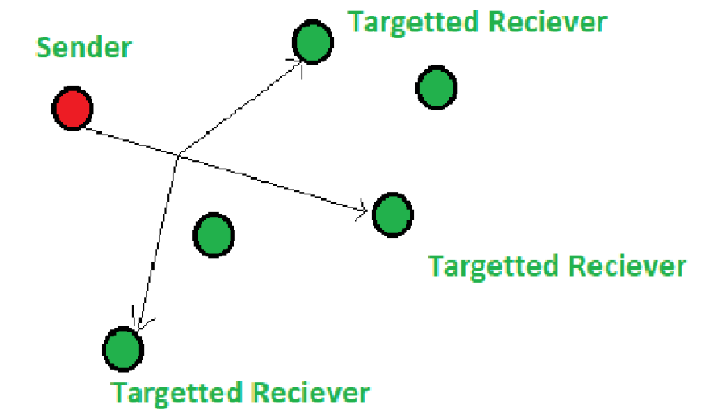
Multicasting has one/more senders and multiple recipients participate in data transfer traffic. In multicasting traffic recline between the boundaries of unicast and broadcast. It server’s direct single copies of data streams and that are then simulated and routed to hosts that request it. IP multicast requires support of some other protocols such as Internet Group Management Protocol (IGMP), Multicast routing for its working. And also in Classful IP addressing Class D is reserved for multicast groups.
Advantages of Multicast
- **Efficiency: Compared with unicast communication, multicast helps in cutting down the number of data that is transmitted across the network since the data transmitted can be received by several persons; this is otherwise known as ‘Broadcast’.
- **Scalability: Multicast is suitable for application that requires distribution of information or sharing resource to many users that can elicit the flood the network principle to narrow scale thus making it opportune for scalable applications.
- **Cost-Effective: Being a method that reduces the number of data set transmitted across the network, multicast helps in cutting down the overall expenditure on networks especially for the large scale broadcasts.
Disadvantages of Multicast
- **Complex Implementation: Whereas in multicast setting, up and managing a multicast network is a little bit more complicated than unicast since an appropriate routing protocols and settings are necessary.
- **Less Reliable: Multicast unfortunately can use connectionless protocols such as UDP unlike unicast thus making it incur in reliability as far as delivery is concerned.
- **Security Challenges: Multicast communication is less secure as compared to unicast as the data is sent to multiple recipients thus posing a high risk of interception by unauthorized persons.
**Difference between Unicast and Multicast
| Unicast | Multicast |
|---|---|
| It has one sender and one receiver. | It has one or more senders and multiple receivers. |
| It sends data from one device to single device. | It sends data from one device to multiple devices. |
| It works on Single Node Topology. | It works on star, mesh, tree and hybrid topology. |
| It does not scale well for streaming media. | It does not scale well across large networks. |
| Multiple unicasting utilizes more bandwidth as compared. | It utilizes bandwidth efficiently. |
| Web surfing, file transfer is an example of a unicast. | Video Streaming,Online gaming is an example of a multicast . |
| It has one-to-one mapping. | It has one-to-many mapping. |
| Network traffic is high. | Network traffic is low. |
| Mobile is a unicast device. | Switch is a multicast device. |
Conclusion
The main distinction between Unicast and Multicast is based on how these two schemes deliver data. Unicast is most efficient for one to one communication, while Multicast is the most efficient for one to many communication. Unicast is easier and more accurate in reaching the target but a bit ineffective when it comes to multicasst messaging. Multicast is a more efficient way of using networks since it uses less bandwidth and expends less traffic; however, it involves more complications and may have reliability problems as well.