Digital Subscriber Line (DSL) (original) (raw)
Last Updated : 11 Jul, 2025
The Digital Subscriber Line (DSL), _originally, a **digital subscriber loop is a communication medium, which is used to transfer the internet through copper wire telecommunication lines. Along with cable internet, DSL is one of the most popular ways _ISPs provide broadband internet access.
Properties of DSL
- Its aim is to maintain the high speed of the data being transferred.
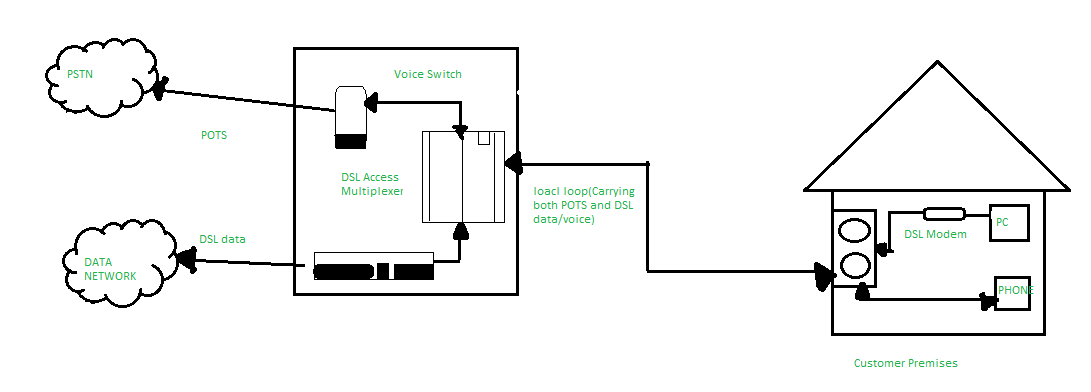
- If we ask how we going to achieve such a thing i.e., both telephone and internet facilities, then the answer is by using _splitters or DSL filters(shown in the below diagram). Basically, the _splitter is used to split the frequency and make sure that it can't get interrupted.
**Types of DSL
**Symmetric DSL
SDSL, _splits the upstream and downstream frequencies evenly, providing equal speeds to both uploading and downloading data transfer. This connection may provide _2 Mbps upstream and downstream.it is mostly preferred by small organizations.
**Asymmetric DSL
ADSL, provides a wider frequency range for downstream transfers, which offers several times faster downstream speeds. an ADSL connection may offer _20 Mbps downstream and 1.5 Mbps upstream, it is because most users download more data than they upload.
Features of DSL
- **Speed: DSL provides high-speed internet connectivity that is much faster than traditional dial-up connections. With DSL, users can expect download speeds of up to 25 Mbps and upload speeds of up to 3 Mbps, depending on the type of DSL service and the distance from the service provider.
- **Availability: DSL is widely available in many areas and is often the most accessible high-speed internet option for users who live in rural or remote areas. As long as there is a telephone line, DSL can be provided, making it an attractive option for users who don't have access to cable or fiber internet.
- **Security: DSL provides a secure connection, as the data transmitted over the telephone lines is encrypted. This means that hackers and other unauthorized users cannot intercept or access the data being transmitted.
- **Reliability: DSL is a reliable internet connection option, as the connection is always on and doesn't require users to dial in or connect manually. This makes it ideal for users who need a constant internet connection for work or other purposes.
- **Affordability: DSL is generally more affordable than other high-speed internet options, such as cable or fiber internet. This makes it an attractive option for users who need high-speed internet but don't want to pay the high prices associated with other options.
- **Compatibility: DSL is compatible with a wide range of devices, including computers, smartphones, tablets, and other internet-connected devices. This makes it easy for users to connect to the internet and access online services and applications.
**Benefits
- **No Additional Wiring - A DSL connection makes use of your existing telephone wiring, so you will not have to pay for expensive upgrades to your phone system.
- **Cost-Effective - DSL internet is a very cost-effective method and is best in connectivity
- Availability of DSL modems by the service providers.
- Users can use both telephone lines and the internet at the same time. And it is because the voice and digital signals are transferred in different frequencies.
- Users can choose between different connection _speeds and _pricing from various providers.
- **High-speed: DSL provides high-speed internet access, allowing users to stream, download, and upload large amounts of data quickly.
- **Simultaneous use: DSL allows users to make voice calls and use the internet at the same time, making it a convenient option for households with multiple users who need to use the internet and the telephone at the same time.
- **Reliable: DSL is a stable and reliable technology that provides consistent performance, making it a dependable option for internet access.
- **No data caps: Unlike some other internet technologies, DSL doesn't have data caps, allowing users to stream, download, and upload as much data as they need without worrying about additional charges or throttled speeds.
- **Easy setup: DSL is easy to set up and doesn't require any special equipment, making it a straightforward option for people who are new to the internet or need to get online quickly.
- **Supports multiple devices: DSL can support multiple devices simultaneously, making it an ideal option for households with multiple users and devices.
DSL Internet service only works over a limited physical distance and remains unavailable in many areas where the local telephone infrastructure does not support DSL technology. The service is not available everywhere. The connection is faster for receiving data than it is for sending data over the Internet.
**Features of DSL
- **High-speed internet: DSL technology provides high-speed internet access that can be up to 25 times faster than a dial-up connection.
- **Simultaneous voice and data transmission: DSL technology allows for simultaneous voice and data transmission over the same line, so users can make phone calls and use the internet at the same time.
- **Dedicated connection: DSL provides a dedicated connection, which means users do not have to share bandwidth with other users.
- **Distance limitations: DSL has distance limitations, and the speed of the connection can decrease as the distance from the central office increases.
- **Different types of DSL: There are different types of DSL, including Asymmetric DSL (ADSL), Symmetric DSL (SDSL), and Very High Bitrate DSL (VDSL), each with different features and capabilities.
- **Availability: DSL technology is widely available and can be used in areas where other high-speed internet options are not available.
- **Installation: DSL requires a modem to be installed at the user's premises and a DSLAM (Digital Subscriber Line Access Multiplexer) to be installed at the telephone company's central office.
- **Cost: DSL is typically less expensive than other high-speed internet options, such as cable or fiber-optic connections.
- **Security: DSL provides a more secure connection than a dial-up connection because it is always on and does not require users to dial in to access the internet.
- **Dedicated bandwidth: DSL provides users with dedicated bandwidth, which means that the speed of their internet connection is not affected by the number of users sharing the same network. This is in contrast to cable or fiber internet, where users often experience slower speeds during peak usage times.
- **Static IP addresses: DSL providers often offer static IP addresses to their customers, which can be useful for businesses or individuals who need to host websites or run servers. A static IP address makes it easier for other users to find your website or connect to your server.
- **Easy installation: DSL is relatively easy to install, as it only requires a telephone line and a DSL modem. Users can often install the modem themselves or with the help of their service provider, which can save time and money compared to other high-speed internet options that require professional installation.
- **Voice and data services: Some DSL providers offer bundled packages that include both internet and phone services, allowing users to save money on their monthly bills. This can be especially convenient for users who need both services and want to manage them through a single provider.
- **Distance tolerant: While the speed of DSL varies depending on the distance between the user and the service provider, it is generally more tolerant of longer distances than cable or fiber internet. This makes it a viable option for users who live in areas with limited high-speed internet options.
Disadvantages
- **Distance limitations: As mentioned earlier, the speed of the DSL connection decreases as the distance from the central office increases. This can limit the availability of high-speed internet in rural areas or in places with a large distance from the central office.
- **Speed inconsistencies: The speed of the DSL connection can vary depending on the quality of the copper telephone lines, the distance from the central office, and the number of users connected to the network at the same time. This can lead to inconsistent speed and performance.
- **Limited bandwidth: DSL technology provides limited bandwidth, which means that it may not be suitable for heavy data usage or for households with multiple users who require high-speed internet simultaneously.
- **Dependence on telephone lines: DSL technology is dependent on copper telephone lines, which can be prone to interference from other devices, such as microwaves, televisions, or other electronic devices.
- **Installation limitations: DSL technology requires the installation of a modem and a DSLAM at the central office, which can be costly and time-consuming for service providers. It may also require additional wiring and infrastructure, which can be difficult in some areas.
- **Security concerns: DSL connections may be vulnerable to hacking or other security breaches, just like any other internet connection. Users need to take proper security measures to protect their devices and data.
- **Availability of service providers: DSL services are provided by telephone companies, and in some areas, there may be limited options for service providers. This can limit the ability of users to choose the best service provider or the best plan for their needs.