Frequency Division Multiple Access (FDMA) Techniques (original) (raw)
Last Updated : 23 Jul, 2025
In Frequency-Division Multiple Access the channel bandwidth is subdivided into a variety of sub-channels. FDMA is used for voice and data transmission. During this method the general channel bandwidth is shared by multiple users, therefore a variety of users can transmit their data simultaneously. No code words and synchronization are required in FDMA. Power efficiency is reduced using FDMA, it’s an old and proven system used for analog signals. In this article, we will discuss Frequency Division Multiple Access (FDMA) Techniques.
What is FDMA?
FDMA is a type of channelization protocol. This bandwidth is divided into various frequency bands. Each station is allocated a band to send data and that band is reserved for the particular station for all the time which is as follows:
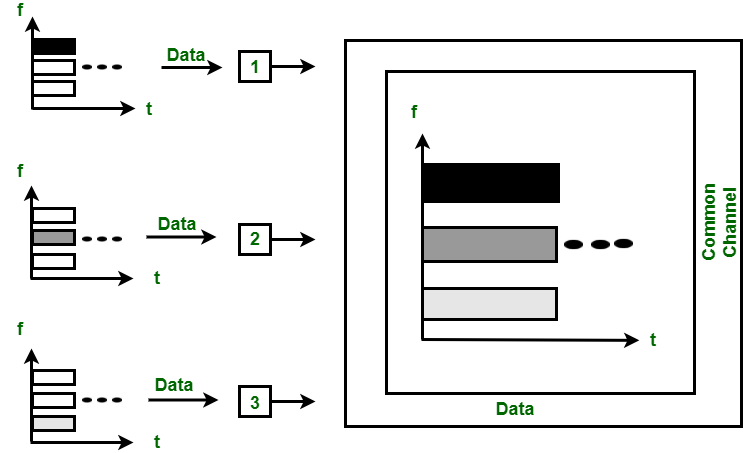
Frequency Division Multiple Access (FDMA) Techniques
- Multi-channel-per-carrier (MCPC) transmission
- Single-channel per carrier (SCPC) transmission
Multi-Channel-Per-Carrier Transmission
- Analog multiplexing is used at earth station in the early stages of communication, this helps in combining large numbers of telephone channels into a single baseband signal and thus modulating into a single RF carrier.
- Using **frequency division multiplexing (FDM) telephone signals can be combined in a group of channels, this is done by shifting the baseband frequency to a higher frequency.
- Upto 1800 telephone channels in a satellite are multiplexed using the FDM, thus making wide baseband that occupies bandwidth of 8 MHz.
- The wide baseband signals are then modulated onto the RF carrier using FM i.e. **Frequency Modulation.
- Different RF carrier for each and every earth station is used for frequency modulations.
- A common transponder for transmission is been shared from various earth stations for the FDM-FM-RF. This technique is called as FDM-FM-FDMA.
- So has various different telephone channels are been multiplexed for transmission over a single RF carrier, it is known as Multi-channel-per carrier (MCPC) transmission.
- The below attached images show fixed assigned FDM-FM-FDMA scheme for the two C-band transponders.

Transponder 1
Single-Channel-Per Carrier Transmission
- When a single signal on a carrier is been send via the earth station, this FDMA access technique is called as "Single-channel-per carrier (SCPC) transmission".
- Hence if a system in which large number of small earth station are used, for example mobile telephones, which access via a single transponder using FDMA is called a Single-channel-per carrier Frequency division multiple access scheme (SCPC-FDMA).
- The SCPC systems can be reconfigurable, this depends on the traffic condition which is been accumulated to that particular system, thus making it compatible with the demand assignment systems.
- So when the link is been activated then only the carrier for SCPS channel is transmitted.
- This helps in reducing the transponder power consumption.
Advantages of FDMA
- FDMA uses simple hardware resources and is easy to set up.
- It efficiently handles smaller groups of users.
- The system isn’t overly complicated.
- All stations can transmit continuously without waiting their turn.
- It lowers the amount of data transmitted, which can increase capacity.
- It reduces interference between symbols, improving communication quality.
Disadvantages of FDMA
- FDMA works only with analog signals.
- It lacks flexibility, so existing traffic patterns must change gradually.
- Transponders need extensive bandwidth.
- It doesn’t support high traffic capacity.
- RF filters must meet strict adjacent channel rejection standards, which can increase costs.
- The maximum bit rate per channel is small and remains fixed.
**Difference Between FDMA, CDMA and TDMA
| FDMA | TDMA | CDMA |
|---|---|---|
| FDMA stands for Frequency Division Multiple Access. | TDMA stands for Time Division Multiple Access. | CDMA stands for Code Division Multiple Access. |
| In this, sharing of bandwidth among different stations takes place. | In this, only the sharing of time of satellite transponder takes place. | In this, there is sharing of both i.e. bandwidth and time among different stations takes place. |
| There is no need of any codeword. | There is no need of any codeword. | Codeword is necessary. |
| In this, there is only need of guard bands between the adjacent channels are necessary. | In this, guard time of the adjacent slots are necessary. | In this, both guard bands and guard time are necessary. |
| Synchronization is not required. | Synchronization is required. | Synchronization is not required. |
| The rate of data is low. | The rate of data is medium. | The rate of data is high. |
| Mode of data transfer is continuous signal. | Mode of data transfer is signal in bursts. | Mode of data transfer is digital signal. |
| It is little flexible. | It is moderate flexible. | It is highly flexible. |
Conclsuion
Frequency-Division Multiple Access (FDMA) is a channelization protocol in which the channel bandwidth is divided into frequency bands and allotted to individual stations for continuous data delivery. FDMA is simple and effective for smaller user groups and analog transmissions, with benefits including continuous transmission and less interference. However, it lacks flexibility, has a lower traffic capacity, and requires a large amount of bandwidth. In comparison, TDMA and CDMA use distinct techniques to share bandwidth and time, with CDMA being more flexible and supporting higher data speeds.