Generic Routing Encapsulation (GRE) Tunnel (original) (raw)
Last Updated : 10 Oct, 2025
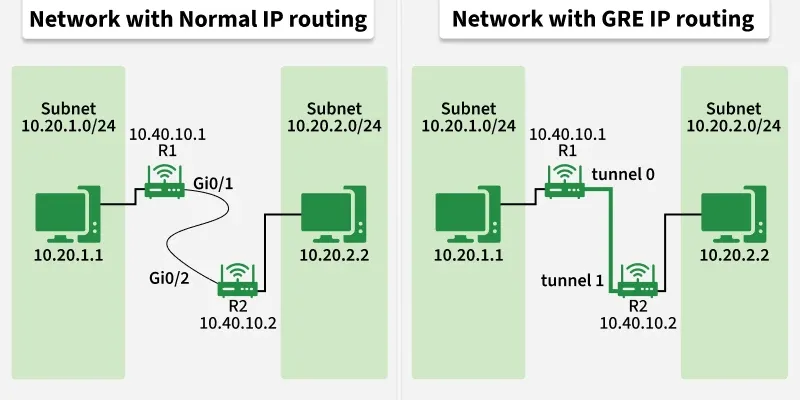
Generic Routing Encapsulation (GRE) is a tunneling protocol developed by Cisco that encapsulates one network protocol inside another. It is primarily used to transport packets from one network to another securely and efficiently. GRE creates a virtual point-to-point connection between routers, allowing different network segments or protocols to communicate as if they were directly connected.
Generic Routing Encapsulation
GRE Encapsulation Process
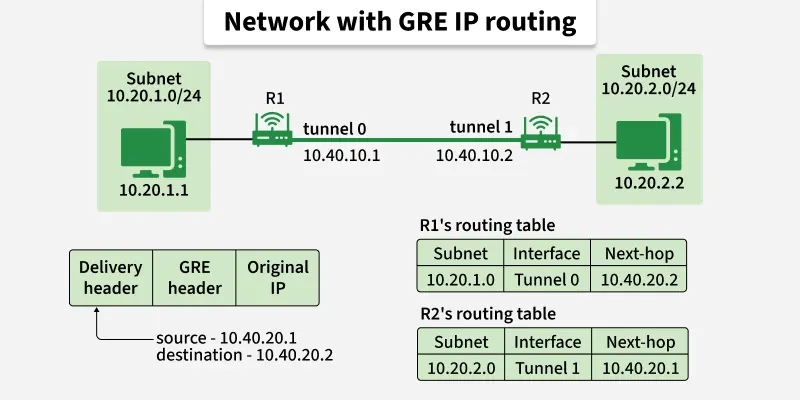
When GRE is configured between routers, the original IP packet is encapsulated with two additional headers:
- **GRE Header: Provides information for the tunnel, effectively acting as a new IP header.
- **Delivery Header: Contains the new source and destination IP addresses of the tunnel endpoints.
**Note: Generic Routing Encapsulation process hides the original IP packet during transit. Only the routers configured with GRE can encrypt, decrypt and interpret these headers.
- The original packet enters the GRE-enabled router.
- A GRE header is added, followed by a delivery header with tunnel interface IPs.
- The packet traverses the network in encapsulated form.
- At the destination router, the GRE and delivery headers are removed and the original IP packet is forwarded.
**Note: This mechanism simulates a tunnel between routers, hence the term GRE tunneling.
Routing Over GRE Tunnel
Without GRE, routers forward traffic based on their physical interfaces and normal IP routing. However, when GRE is configured:
- Routers use virtual interfaces (tunnel interfaces) instead of standard physical interfaces.
- Tunnel interfaces are assigned IP addresses from the organization’s IP pool, different from the physical interface addresses.
- GRE-enabled routers forward packets through these tunnels, encapsulating them with delivery and GRE headers.
Example Scenario
Network with GRE IP Routing
- PC1 sends data to a server in subnet 10.20.2.0/24.
- Router R1 receives the original packet and encapsulates it with -> GRE Header & Delivery Header (Source = 10.40.20.1, Destination = 10.40.20.2)
- The encapsulated GRE packet traverses the intermediate network based on routing protocols.
- Router R2 receives the GRE packet, removes both headers and forwards the original packet to the server.
**Note: GRE creates a transparent communication tunnel between R1 and R2, ensuring end-to-end connectivity across different or separated networks.
GRE Tunnel Benefits
- Supports multiprotocol traffic (IPv4, IPv6, multicast, etc.).
- Transparent communication across different networks.
- Simplifies routing by creating logical point-to-point links.
- Can work with other routing protocols (EIGRP, OSPF, BGP).
Limitations of GRE
- **No encryption: GRE provides encapsulation but not security. It is often paired with IPsec for secure tunneling.
- **Overhead: Additional headers increase packet size, which can impact performance.
- **Scalability: In large networks, managing multiple tunnels can become complex.