Identity and Access Management (IAM) in Cyber Security Roles (original) (raw)
Last Updated : 29 Apr, 2026
Identity and Access Management (IAM) is a security framework that controls who can access organizational systems and data, ensuring secure, authorized and appropriate use of resources.
- Manages digital identities and user access across systems and applications
- Ensures the right users access the right resources at the right time
- Prevents unauthorized access to sensitive and critical information
- Supports authentication, authorization and access monitoring
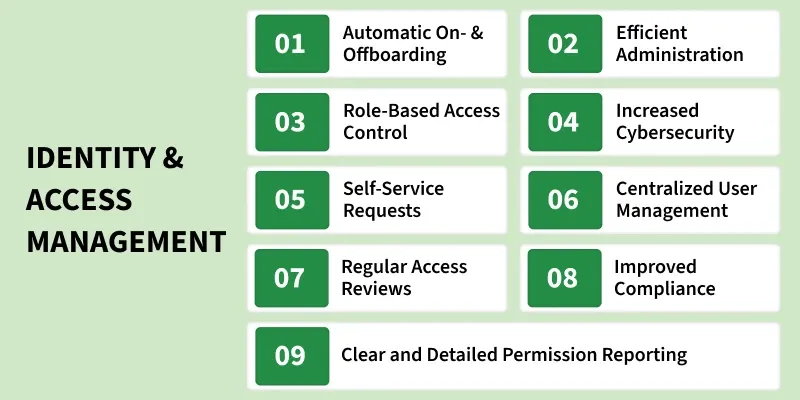
Benefits of Using an IAM System
IAM provides multiple organizational benefits by improving security, efficiency and compliance.
**1. Reduced Risk: IAM minimizes internal and external data breaches by enforcing controlled access and reducing dependency on weak or stolen credentials.
**2. Secure and Scalable Access: As organizations grow, IAM enables secure access for increasing numbers of users without weakening security controls.
**3. Compliance Management: IAM helps organizations meet regulatory requirements such as data protection laws, audit policies and industry standards.
**4. Reduced Help Desk Load: Self-service features like password resets and authentication verification reduce help desk dependency and operational overhead.
**5. Competitive Advantage: IAM allows controlled external access to partners and clients, improving collaboration without compromising security.
Implementation Guide for IAM
**1. Analyze Organizational Needs: IAM solutions should be selected based on the organization’s size, industry, workforce structure and device usage.
**2. Develop an IAM Integration Strategy: A structured strategy is required to manage identities across cloud services, on-premises systems and third-party tools.
**3. Select the Right IAM Tools: Key IAM components include:
- Access management systems
- Multi-factor authentication (MFA)
- Risk-based authentication
- Password tokens and identity verification tools
Rise in Importance of IAM
IAM has become a foundational element of cybersecurity as organizations increasingly rely on digital infrastructure. Key Areas of Focus:
- **Identity Data Management: Secure handling of identity data across systems and platforms.
- **Access Management: Use of MFA, federation and stronger authentication mechanisms.
- **Access Governance: Regular auditing and enforcement of access policies.
- **Identity Lifecycle Management: Controlled creation, modification and removal of identities.
- **Data Security and Analytics: Monitoring and analyzing access patterns to detect threats.
IAM and Existing Cybersecurity Protocols
IAM strengthens cybersecurity by enforcing precise access controls.
- **Restricted Data Access: Users only access data relevant to their roles.
- **View-Only Access: Prevents unauthorized modification or copying of sensitive data.
- **Platform Restrictions: Limits users to approved platforms and environments.
- **Data Transfer Prevention: Prevents unauthorized sharing or exfiltration of data.
IAM complements existing security systems by adding identity-centric protection layers.
IAM Policies
A successful IAM framework relies on well-defined policies:
- Identity recognition and authentication methods
- Role and responsibility assignment
- User lifecycle management (add, update, remove)
- Controlled access for individuals and groups
- Protection of sensitive data and systems from breaches
Advantages
- Enhances overall security by limiting unauthorized access
- Improves compliance with legal and regulatory frameworks
- Simplifies identity and access administration
- Enables Single Sign-On (SSO) for better user experience
- Provides visibility into user behavior and access patterns
Limitations
- Implementation complexity, especially in large organizations
- High initial and operational costs
- Possible user resistance due to stricter controls
- Integration challenges with legacy systems
- Requires continuous monitoring and maintenance