Introduction of Classful IP Addressing (original) (raw)
Last Updated : 9 Apr, 2026
Classful IP addressing was an early method (1981–1993) used to assign IP addresses and divide the IPv4 address space into fixed classes. Each IP address was categorized based on its leading bits, and the class determined its network and host portions.
- IP addresses were divided into five classes: A, B, C, D, and E.
- The class of an IP address was identified by its first few bits.
- Classes A, B, and C were used for unicast communication, supporting large, medium, and small networks, respectively.
- Class D was reserved for multicast communication.
- Class E was intended for experimental and research purposes.
Dotted Decimal Notation
It is a human-readable format used to represent IPv4 addresses, where the 32-bit binary address is divided into four 8-bit segments (bytes) and written as decimal numbers separated by dots.
- This notation makes IP addresses easier to read, write, and understand compared to their binary form.
- An IPv4 address consists of four decimal segments (bytes) separated by dots.
- The value of each segment ranges from 0 to 255, inclusive.
- Leading zeros are not allowed in any segment (for example, _054 is invalid, while _54 is valid).
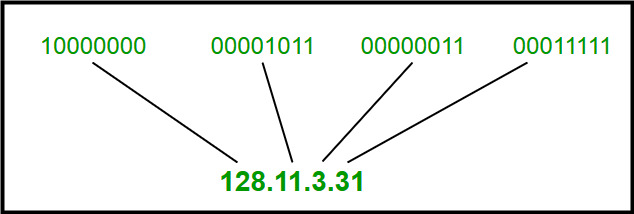
Dotted Decimal Notation
Hexadecimal Notation
This represent a IPv4 addresses in the 32-bit binary address is written using base-16 numbers. In this notation, each 8-bit segment (byte) of the IP address is converted into a two-digit hexadecimal value, making the address shorter and easier to read than its binary form.
- Uses base-16 digits (0–9 and A–F).
- Each byte (8 bits) is represented by two hexadecimal digits.
- An IPv4 address is written as four hexadecimal numbers, usually separated by dots.
- Provides a compact representation compared to binary notation.
- Less commonly used than dotted decimal notation in everyday networking.

Need For **Classful Addressing
As the Internet grew, classful addressing led to significant IP wastage and routing inefficiencies
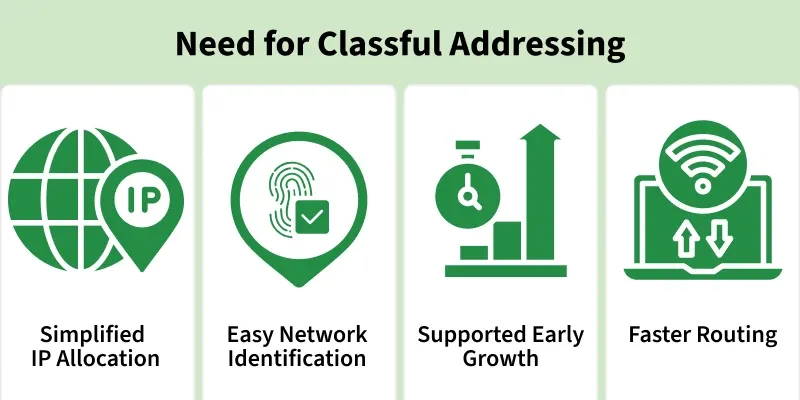
Need for Classful Addressing
- Fixed classes (A, B, C) made assigning and managing IP addresses straightforward.
- Routers could quickly identify the class from the first few bits, speeding up routing.
- Supported different network sizes large (Class A/B) and small (Class C).
- Fixed address ranges ensured compatibility across devices and protocols.
- Reduced the need for complex subnetting, saving resources and simplifying management.
**Classes of IP Addressing
The 32-bit IP address is divided into five sub-classes. These are given below:
- Class A
- Class B
- Class C
- Class D
- Class E
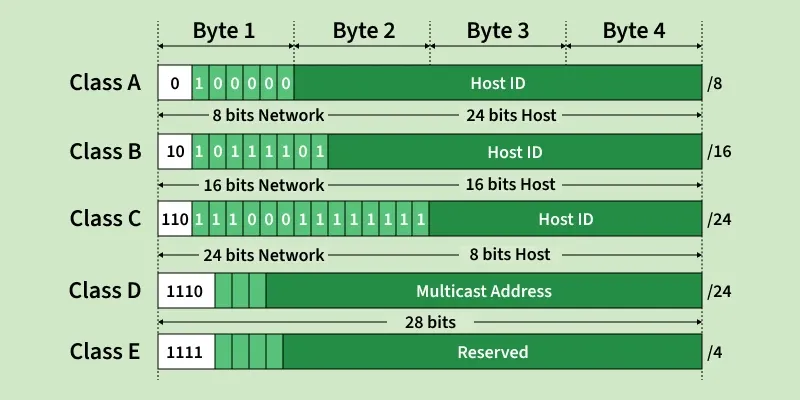
Classful Addressing
**Note:
- IP addresses are globally managed by the Internet Assigned Numbers Authority (IANA) and Regional Internet Registries (RIRs).
- While calculating the number of usable host IP addresses, two addresses are excluded from the total.
- The first IP address of a network is reserved as the network address.
- The last IP address of a network is reserved as the broadcast address.
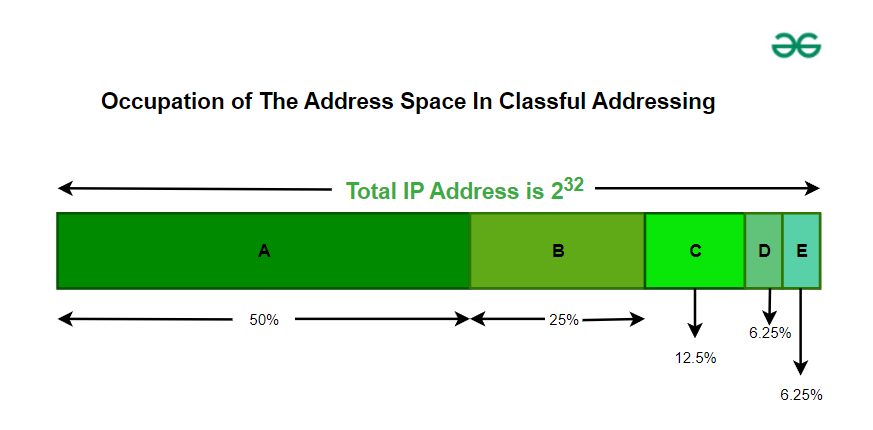
Occupation of The Address Space In Classful Addressing
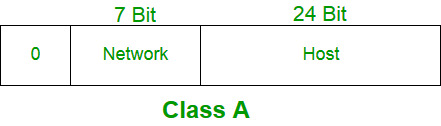
Class A
- Class A IP addresses are assigned to networks that require a very large number of hosts.
- The network ID in Class A is 8 bits long, while the host ID is 24 bits long.
- The most significant bit (MSB) of the first octet is always 0, and the remaining 7 bits are used to identify the network.
- The 24-bit host ID uniquely identifies hosts within the same network.
- The default subnet mask for Class A is 255.0.0.0.
- The total number of usable host addresses per network is 224 − 2 = 16,777,214 (excluding network and broadcast addresses).
- The IP address range for Class A is 0.0.0.0 to 127.255.255.255.
Class B
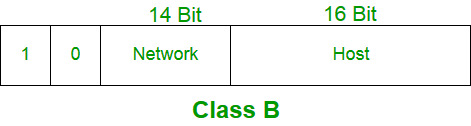
- Class B IP addresses are assigned to medium to large-sized networks.
- The network ID is 16 bits long, and the host ID is also 16 bits long.
- The first two bits of the first octet are always
10, which identifies a Class B address. - The remaining 14 bits are used to determine the network ID.
- The 16-bit host ID uniquely identifies hosts within the same network.
- The default subnet mask for Class B is 255.255.0.0.
- The total number of Class B networks is 214 = 16,384 networks.
- The total number of usable host addresses per network is 216 − 2 = 65,534 hosts.
- The IP address range for Class B is 128.0.0.0 to 191.255.255.255.
Class C
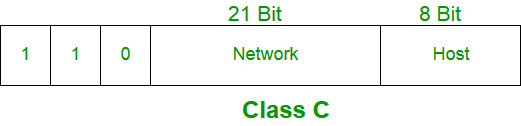
- Class C IP addresses are assigned to small-sized networks.
- The network ID is 24 bits long, while the host ID is 8 bits long.
- The first three bits of the first octet are always
110, which identifies a Class C address. - The remaining 21 bits are used to determine the network ID.
- The 8-bit host ID uniquely identifies hosts within the same network.
- The default subnet mask for Class C is 255.255.255.0.
- The total number of Class C networks is 2²¹ = 2,097,152 networks.
- The total number of usable host addresses per network is 2⁸ − 2 = 254 hosts.
- The IP address range for Class C is 192.0.0.0 to 223.255.255.255.
Class D
- Class D IP addresses are reserved for multicast communication.
- The first four bits of the first octet are always
1110, which identifies a Class D address. - The remaining 28 bits are used to represent the multicast group address that interested hosts can join.
- Class D addresses do not have a network ID or host ID division.
- No subnet mask is defined for Class D addressing.
- The IP address range for Class D is 224.0.0.0 to 239.255.255.255.

Class E
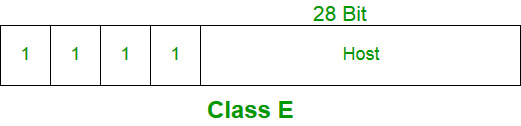
- Class E IP addresses are reserved for experimental and research purposes.
- The first four bits of the first octet are always
1111, which identifies a Class E address. - Class E addresses do not have network ID and host ID divisions.
- No subnet mask is defined for Class E addressing.
- The IP address range for Class E is 240.0.0.0 to 255.255.255.255.
Range of Special IP Addresses
- **169.254.0.0 – 169.254.255.255: Used as link-local addresses when a device cannot obtain an IP address from a DHCP server.
- **127.0.0.0 – 127.255.255.255: Reserved for loopback addresses, used to test network functionality on the local machine.
- **0.0.0.0 – 0.255.255.255 (0.0.0.0/8): Represents the current network and is used during initialization before a device is assigned a valid IP address.
Rules for Assigning Host ID
Host IDs are used to uniquely identify a host within a network and must follow these rules:
- **Uniqueness: Each host ID must be unique within the same network.
- **All-zeros restriction: A host ID with all bits set to 0 is not allowed, as it represents the network address.
- **All-ones restriction: A host ID with all bits set to 1 is not allowed, as it is reserved for the broadcast address used to reach all hosts in the network.
Rules for Assigning Network ID
The network ID identifies the physical network to which hosts belong. All hosts on the same physical network share the same network ID and it must follow these rules:
- **Loopback restriction: A network ID must not start with 127, as this range belongs to Class A and is reserved for loopback functions.
- **All-ones restriction: A network ID with all bits set to 1 is reserved for broadcast purposes and cannot be assigned to a network.
- **All-zeros restriction: A network ID with all bits set to 0 represents the local network, is not routed, and therefore is not used for general network identification.
Structure of Classful Addressing
| Class | Leading Bits | Net ID Bits | Host ID Bits | No. of Networks | Usable Hosts / Network | Start Address | End Address |
|---|---|---|---|---|---|---|---|
| A | 0 | 8 | 24 | 2⁷ = 128 | **2²⁴ − 2 = 16,777,214 | 0.0.0.0 | 127.255.255.255 |
| B | 10 | 16 | 16 | 2¹⁴ = 16,384 | **2¹⁶ − 2 = 65,534 | 128.0.0.0 | 191.255.255.255 |
| C | 110 | 24 | 8 | 2²¹ = 2,097,152 | **2⁸ − 2 = 254 | 192.0.0.0 | 223.255.255.255 |
| D | 1110 | — | — | — | — | 224.0.0.0 | 239.255.255.255 |
| E | 1111 | — | — | — | — | 240.0.0.0 | 255.255.255.255 |
In the above table No. of networks for class A should be 127. (Network ID with all 0 s is not considered)
Problems With Classful Addressing
Classful addressing resulted in inefficient IP address utilization due to fixed address classes.
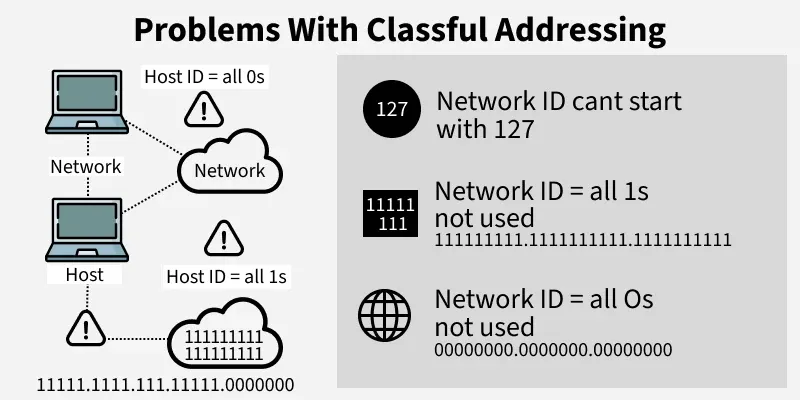
Since there are these problems, Classful networking was replaced by Classless Inter-Domain Routing (CIDR) in 1993. We will be discussing Classless addressing in the next post.
- The network ID is 24 bits long, and the host ID is 8 bits long.
- Total network addresses = 221=2,097,1522^{21} = 2,097,152221=2,097,152.
- Total host addresses per network = 28−2=2542^8 - 2 = 25428−2=254.
- The host ID must be unique within a network.
- Host ID with all 0s reserved for network ID.
- Host ID with all 1s reserved for broadcast address.
- Network IDs starting with 127 are reserved for loopback testing.
Classful and Classless Addressing
| **Classful Addressing | **Classless Addressing (CIDR) |
|---|---|
| IP addresses are divided into fixed classes (A, B, C, D, E) | IP addresses are allocated without fixed classes using variable-length prefixes |
| Less practical due to rigid address allocation | More practical and flexible in real networks |
| Network and host portions are fixed based on the class | Network and host portions are defined by the prefix length |
| Subnetting is not supported by default | Subnetting is inherently supported |
| Does not support Variable Length Subnet Mask (VLSM) | Supports VLSM |
| Poor utilization; leads to significant IP address wastage | Efficient utilization of IP addresses |
| Large routing tables; no route aggregation | Supports route aggregation, resulting in smaller routing tables |
| Does not support CIDR | Fully supports CIDR |
| Limited scalability due to fixed classes | Highly scalable for large and modern networks |
| Simpler but inefficient due to rigid structure | More efficient and manageable despite slightly higher complexity |
| Network ID and Host ID only | Network prefix and Host ID (flexible boundary) |