Introduction to Internet of Things IOT (original) (raw)
Last Updated : 11 Feb, 2026
The Internet of Things (IoT) is a network of physical objects embedded with sensors, software, and communication technologies, enabling them to connect to the Internet and exchange data automatically without direct human involvement.
- Focuses on connecting everyday physical objects such as devices, machines, and systems to computer networks
- Enables real-time data collection, monitoring, and automated actions
- Plays a key role in modern computer networks by extending Internet connectivity beyond traditional computers
- Improves efficiency, accuracy, and convenience in daily life and industrial applications
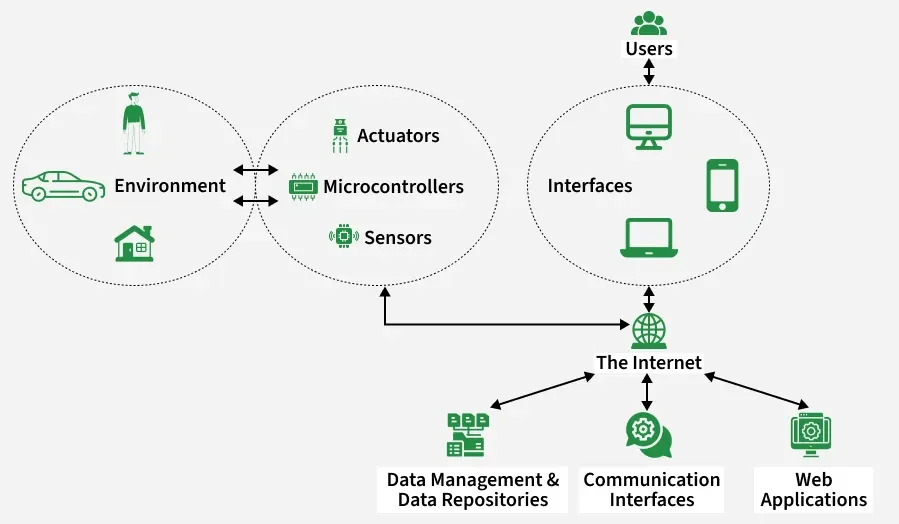
IoT Ecosystem
Sensors collect data and send it via the network to edge or cloud systems where the data is processed and analyzed. Results are delivered to users through apps or used to automatically drive actuators and systems.
**Components of IoT System
An IoT system is built using multiple interconnected components that work together to sense data, process it, transmit it over networks, and present useful information to users or trigger actions automatically.
- **IoT Devices (Things): Physical objects such as appliances, machines, vehicles, or wearables that sense data from the environment or perform actions.
- **Sensors and Actuators: Sensors collect environmental data like temperature, motion, or light, while actuators convert digital signals into physical actions.
- **Embedded Processing Units: Microcontrollers or microprocessors that process sensor data, execute control logic, and manage device operations.
- **Connectivity Modules: Enable devices to communicate over networks using technologies such as Wi-Fi, Bluetooth, cellular networks, or LPWAN.
- **IoT Gateways: Aggregate data from multiple devices, perform protocol translation, and securely transmit data to cloud or edge platforms.
- **Cloud / Edge Computing: Cloud platforms store and analyze large IoT data, while edge computing processes data near the source to reduce latency.
- **User Interface and Applications: Dashboards, mobile apps, or web interfaces that allow users to monitor data, control devices, and receive alerts.
**Note: Modern IoT systems also rely on low-power embedded systems, ensuring devices consume minimal energy while maintaining high performance.
IoT Architecture
IoT system are divided into layers to ensure smooth interaction between sensors, networks, data processing, and applications.
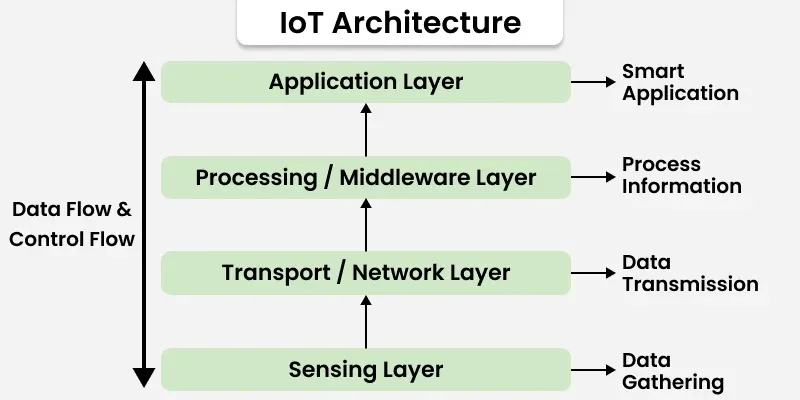
**Layers and Functions:
**1. Perception (Sensing) Layer
- Collects real-world data such as temperature, humidity, motion, light, or pressure using sensors.
- Uses actuators to perform physical actions like switching devices on/off or adjusting system parameters.
- Identifies and tracks physical objects using technologies such as RFID and NFC.
**2. Transport / Network Layer
- Transfers sensed data from IoT devices to gateways, edge nodes, or cloud platforms.
- Maintains reliable communication using wired and wireless technologies like Wi-Fi, Bluetooth, Zigbee, and cellular networks.
- Supports communication protocols to ensure efficient and secure data exchange between devices and systems.
**3. Processing / Middleware Layer
- Filters, analyzes, and stores incoming data for further use and decision-making.
- Manages connected devices, handles interoperability, and supports scalability across large IoT deployments.
- Ensures data integrity, authentication, and secure access to IoT services.
**4. Application Layer
- Provides dashboards, mobile apps, or web interfaces for monitoring and controlling IoT systems.
- Presents processed data in a meaningful form to support analysis and decision-making.
- Delivers domain-specific solutions such as smart homes, healthcare monitoring, industrial automation, and smart cities.
**Sensors and Actuators in IoT
Sensors and actuators allow IoT systems to connect with the physical environment by collecting real-world data and carrying out actions in response to system commands.
Role of Sensors in IoT
Sensors detect physical, chemical, or biological parameters from the environment and convert them into digital data. This data acts as the primary input for IoT systems and is used for monitoring, analysis, and automation.
**Types of Sensors in IoT:
- **Temperature Sensors: Measure heat or temperature changes in the environment or objects.
- **Image Sensors: Capture visual data for cameras and computer vision applications.
- **Gyro Sensors (Gyroscope): Detect angular velocity and orientation of objects.
- **Obstacle Sensors: Identify the presence of obstacles to avoid collisions.
- **RF Sensors: Use radio frequency signals for detection, tracking, and communication.
- **IR Sensors (Infrared): Detect heat signatures or motion using infrared radiation.
- **MQ-02 / MQ-05 Gas Sensors: Sense the presence and concentration of gases such as carbon monoxide, methane, or smoke.
- **LDR Sensor (Light Dependent Resistor): Measure light intensity and brightness levels.
- **Ultrasonic Distance Sensors: Calculate distance by emitting ultrasonic waves and measuring their reflection time.
Actuators receive control signals from IoT systems and convert them into physical actions. They enable automation by performing tasks such as switching devices on or off, controlling motors, or adjusting mechanical components based on sensor data.
Role of Actuators in IoT Systems
Actuators receive control signals from IoT systems and convert them into physical actions. They enable automation by performing tasks such as switching devices on or off, controlling motors, or adjusting mechanical components based on sensor data.
Enabling Technologies of IoT
Enabling technologies refer to the foundational technologies that support the core functionalities of IoT systems, such as sensing, connectivity, data processing, and intelligent decision-making.
- **RFID and NFC: Radio Frequency Identification (RFID) and Near Field Communication (NFC) are used for automatic identification and short-range data exchange. These technologies help IoT systems recognize objects and enable contactless communication.
- **Embedded Systems: Embedded systems are dedicated computing units integrated into IoT devices. They control sensors and actuators, process collected data, and manage communication with other devices or platforms.
- **Wireless Sensor Networks (WSN): Wireless sensor networks consist of multiple sensor nodes that communicate wirelessly to collect and transmit data. They are widely used for monitoring environmental and industrial conditions.
- **Cloud Computing and Big Data: Cloud computing provides scalable storage and computing resources for handling large volumes of IoT data, while Big Data technologies support efficient data analysis and management.
- **Edge and Fog Computing: Edge and fog computing process data closer to the source devices rather than sending all data to the cloud. This reduces latency, improves response time, and lowers network bandwidth usage.
**Working of IoT Devices
The working of IoT devices involves sensing data, communicating with networks, processing information, and performing actions based on system requirements.
Working of IoT Devices
- **Data Collection and Transmission: IoT devices use sensors to collect data from the environment based on application needs. This data is then transmitted to other devices, gateways, or processing systems for further use.
- **Data Processing and Trigger Generation: The received data is analyzed either by embedded processors, edge devices, or cloud platforms. Based on predefined conditions or user requirements, triggers are generated for appropriate actions.
- **Actuation Based on Triggers: Actuators perform physical actions when trigger conditions are satisfied. These actions may include switching devices on or off, controlling motors, or adjusting system parameters automatically.
- **Information Reception: IoT devices can also receive information from networks, other devices, or users. This information is used for analysis, configuration, or improving system behavior.
- **Communication Between Devices and Networks: IoT systems support communication between multiple devices and even across different networks. This communication is enabled using protocols such as MQTT, CoAP, ZigBee, HTTP, and FTP, ensuring reliable data exchange.
IoT Communication Protocols
IoT communication protocols are sets of rules that enable devices to exchange data efficiently and reliably over networks. Different protocols work at different layers—some focus on how data is delivered, others on how devices address and identify each other, and some define how applications interact with the data. Using the right protocol ensures IoT devices operate smoothly even under low power, limited bandwidth, or unreliable network conditions.
**1. Application Layer Protocols
- **MQTT (Message Queuing Telemetry Transport): A lightweight, low-overhead protocol using a publish/subscribe model. Devices send data to a broker, which distributes it to subscribers, making it ideal for remote or low-power IoT devices.
- **CoAP (Constrained Application Protocol): A simple, web-like protocol designed for constrained devices. It uses request/response messaging and can work over UDP, reducing bandwidth usage and enabling efficient communication for small sensors and actuators.
- **HTTP (Hypertext Transfer Protocol): A widely used protocol for web communication. In IoT, it connects devices to web servers or cloud platforms, allowing easy integration with web-based applications and dashboards.
**2. Transport Layer Protocols
- **TCP (Transmission Control Protocol): Provides reliable, ordered delivery with error checking. It ensures that no data is lost and packets arrive in the correct sequence, which is essential for applications where accuracy is critical.
- **UDP (User Datagram Protocol): A faster, connectionless protocol with minimal overhead. It doesn’t guarantee delivery, but it’s suitable for real-time applications like video streaming or sensor data where speed is more important than perfect reliability.
**3. Network Support Protocols
- **IPv6: Offers a huge address space, essential as IoT devices grow in number. It also provides better support for mobile devices and automatic configuration.
- **6LoWPAN (IPv6 over Low-Power Wireless Personal Area Networks): Allows small, low-power devices to use IPv6 by compressing headers and enabling communication over constrained wireless networks, such as sensor networks.
Applications
- **Smart Homes: Control lighting, heating, appliances, and security systems remotely for comfort, energy savings, and safety.
- **Smart Cities: Manage traffic, waste, street lighting, and environmental monitoring to improve urban living.
- **Healthcare and Wearables: Track health metrics, monitor patients remotely, and provide personalized care.
- **Industrial IoT (IIoT): Optimize factory operations with predictive maintenance, automation, and machine-to-machine communication.
- **Agriculture: Monitor soil, crops, and irrigation systems to increase yield and reduce resource waste.
- **Transportation and Logistics: Track vehicles, manage fleets, monitor cargo, and optimize delivery routes.
Advantages
- **Automation and efficiency: IoT automates repetitive tasks and reduces manual effort, improving productivity.
- **Real-time monitoring: It continuously tracks devices and environments, enabling faster detection and response to issues.
- **Resource optimization: It analyzes usage patterns to reduce wastage of energy, water, and materials.
- **Improved decision-making: It provides data-driven insights that help organizations make better operational choices.
- **Cost reduction: It enables predictive maintenance and efficient operations, lowering downtime and maintenance costs.
Disadvantages
- **Security vulnerabilities: Large numbers of devices increase attack surface, and weak device security can lead to hacking or botnets.
- **Privacy concerns: Always-on sensors can collect sensitive user or location data, creating tracking and misuse risks.
- **Reliability dependence: IoT systems often depend on internet/cloud availability, so outages can disrupt services.
- **Interoperability issues: Devices from different vendors may not follow the same standards, causing integration problems.
- **Maintenance overhead: Managing updates, patches, batteries, and device lifecycle at scale is complex and costly.