Link Aggregation Control Protocol (original) (raw)
Last Updated : 5 Jan, 2026
The Link Aggregation Control Protocol (LACP) is an IEEE standard protocol that combines multiple physical Ethernet links into a single logical link. This aggregation increases overall bandwidth and improves network reliability by allowing traffic to be shared across various links, while presenting a single connection to the network.
- It automatically detects and negotiates link aggregation between connected devices
- It supports up to 16 Ethernet interfaces in one aggregation group
- It allows a maximum of 8 active links, with the remaining links kept as a standby
- Provides load balancing across active links
- Ensures automatic failover if any link in the group fails
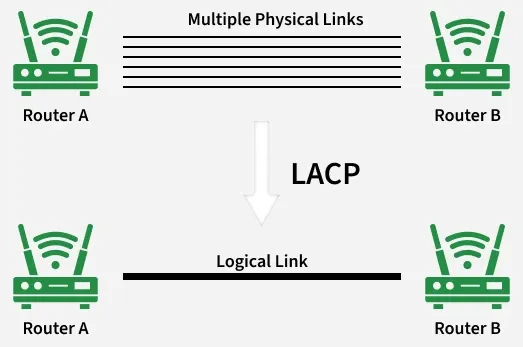
LACP
LACP Modes
LACP operates in two negotiation modes that determine how link aggregation is established between devices:
- **Active Mode: The port actively sends LACP Data Units (LACPDUs) to the connected device to initiate and maintain link aggregation.
- **Passive Mode: The port does not initiate communication but responds to received LACPDUs. Link aggregation is formed only if the connected device operates in active mode.
LACP Architecture and OSI Model Layers
LACP functions across multiple layers of the OSI model to efficiently manage link aggregation and traffic flow:
- **Layer 1 (Physical Layer): Combines multiple physical Ethernet links into a single logical communication channel.
- **Layer 2 (Data Link Layer): Groups switch ports into an aggregation set and manages MAC addressing and Ethernet frame transmission.
- **Layer 3 (Network Layer): Applies hashing algorithms based on parameters such as IP addresses, MAC addresses, or TCP/UDP port numbers to distribute traffic across active links for load balancing.
Features of LACP
- **Port Capacity: Supports up to 8 active links in a Link Aggregation Group (LAG); additional links can be configured as standby.
- **LACP Multicast Address: Uses the multicast MAC address 01:80:C2:00:00:02 to exchange LACP Data Units (LACPDUs) between devices.
- **Timers:
Fast Mode: LACP packets are transmitted every 1 second
Slow Mode (Default): LACP packets are transmitted every 30 seconds
- **Load Balancing: Traffic distribution can be performed using per-packet, per-flow, or per-socket hashing mechanisms based on MAC, IP, or transport-layer information.
- **Failover Support: Automatically redirects traffic to remaining operational links if any active link fails, ensuring continuous connectivity.
LACP Standards
**1. IEEE 802.3ad (Original Standard):
- Introduced Ethernet link aggregation
- Combines multiple full-duplex Ethernet links into one logical interface (LAG)
- Increases bandwidth using multiple lower-speed links instead of a single high-speed link
**2. IEEE 802.1AX (Enhanced Standard):
- Successor to IEEE 802.3ad
- Provides improved fault tolerance and redundancy
- Ensures higher link availability
- Widely used in modern switches and data centers for scalable performance
LACP Configuration (Cisco Example)
# Enable LACP on switch ports
Switch(config)# interface range fa0/0 - 3
Switch(config-if-range)# channel-group 1 mode active
Switch(config-if-range)# exit# Verify EtherChannel
Switch# show etherchannel summary
Below are screenshots for a better understanding of the process:

LACP Port Selection
Here, ports fa0/0–fa0/3 are aggregated into LAG 1 using LACP in active mode

LACP Commands
Real-World Applications
- **Enterprise LANs: Aggregating switch uplinks for higher bandwidth.
- **Data Centers: Enhancing throughput and redundancy for servers and storage systems.
- **Service Providers: Bundling multiple WAN links to deliver high-speed connectivity.
- **High-Availability Systems: Ensuring zero downtime with automatic failover.
LACP increases network capacity by aggregating multiple physical links into a single logical channel, providing higher bandwidth, efficient traffic distribution, automatic failover, and simplified, cost-effective link management.
LACP needs compatible devices and careful configuration, may cause packet reordering with improper load balancing, requires strict VLAN handling, and has limited port scalability.