MAC Media Access Control (original) (raw)
Last Updated : 24 Sep, 2025
Media Access Control (MAC) is a networking concept at the Data Link Layer (Layer 2) that governs how devices share a communication channel. It minimizes collisions, ensures efficient transmission, and uses unique MAC addresses (assigned to each device’s NIC) for accurate data delivery within a local network.
**Note: MAC addresses play a critical role in directing data packets to the correct destination within a local network. They function at the Data Link Layer (Layer 2) of the OSI model, ensuring collision-free and reliable communication among devices.
History of MAC
The concept of MAC addresses originated at Xerox PARC, where early networking technologies were developed. Over time, MAC addressing became standardized under IEEE 802 specifications.
MAC Control
MAC addresses are also referred to by several other names:
- Hardware Address
- Physical Address
- Ethernet Hardware Address
- Burned-In Address (BIA), especially in Cisco networking equipment
Characteristics of MAC
- **Uniqueness: Each MAC address is globally unique, allowing identification of devices across networks.
- **Length: A MAC address is 6 bytes (48 bits) long.
- **Representation Formats: According to IEEE 802 standards, MAC addresses can be written in multiple formats:
**Hyphen-separated: 45-67-89-AB-12-CD
**Colon-separated: 45:67:89:AB:DE:23
**Dot-separated: ABCD.4567.1238
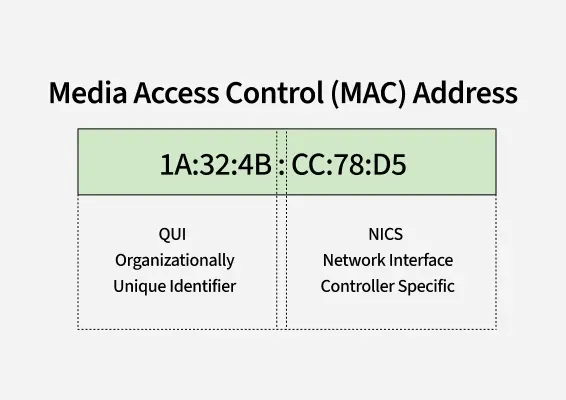
- **Structure: First 24 bits (Organizationally Unique Identifier) - Assigned by IANA, identifies the manufacturer & Last 24 bits (NIC Specific) - Unique number assigned by the manufacturer for the device’s NIC.
- **Example: NIC cards, bridges and switches, which operate at Layer 2 to provide reliable data transfer.
Functions of the MAC Layer
- Provides unique addressing to devices.
- Controls access to the physical medium.
- Prevents collisions in shared communication environments.
- Ensures error-free transmission over the Physical Layer.
- Supports both wired (Ethernet) and wireless (Wi-Fi) communication.
Pros of MAC
- **No additional cost: Devices connect seamlessly without extra attachment costs.
- **Reliable identification: Unlike dynamic IP addresses, MAC addresses remain constant, helping network administrators easily identify devices.
- **Simplified troubleshooting: Network issues related to IP addressing can be quickly diagnosed using MAC addresses.
- **Policy enforcement: Routers and switches can permit or deny devices based on MAC address filtering.
Cons of MAC
- **Address limitations: Each manufacturer is limited to 2^{24} unique addresses under a given OUI.
- **Spoofing vulnerabilities: MAC addresses can be easily spoofed, allowing attackers to impersonate authorized devices.
- **Security risks: Due to the broadcast nature of Ethernet, intruders can monitor network traffic and modify their MAC addresses to gain unauthorized access.