Multi Protocol Label Switching (MPLS) (original) (raw)
Last Updated : 10 Oct, 2025
Multi-Protocol Label Switching (MPLS) is an advanced packet-forwarding technique used in modern networks. Instead of making routers look into complex Layer 3 routing tables for every IP packet, MPLS uses labels for forwarding decisions. These labels create pre-defined, efficient paths across the network, which enhances speed, scalability and traffic management.
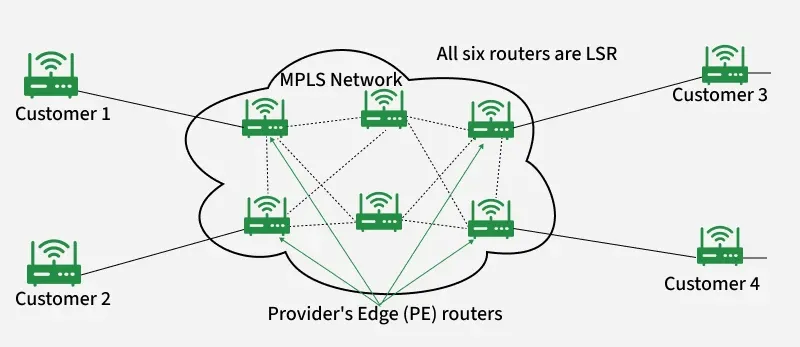
Multi Protocol Label Switching
**Note: MPLS lies between Layer 2 (Data Link) and Layer 3 (Network Layer) of the OSI model, which is why it is often referred to as a Layer 2.5 protocol.
Why MPLS
- Traditional IP routing involves a long lookup process in routing tables.
- MPLS simplifies forwarding by assigning a short fixed-length label to each packet.
- This ensures: Faster packet delivery, better support for Quality of Service (QoS) & easier traffic engineering and Virtual Private Networks (VPNs).
The MPLS header is 32 bits long and is inserted between the Layer 2 and Layer 3 headers. It contains the following fields:
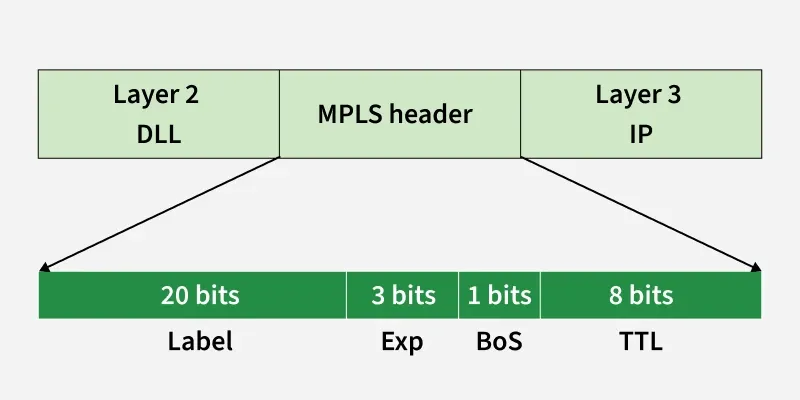
MPLS Header
| Field | Size | Description |
|---|---|---|
| Label | 20 bits | Identifier used to make forwarding decisions (range: 0 to 2²⁰ – 1). |
| Experimental (Exp) | 3 bits | Used for Quality of Service (QoS) and traffic prioritization. |
| Bottom of Stack (S) | 1 bit | Indicates whether this label is the last in the stack (1 = last label). |
| Time to Live (TTL) | 8 bits | Prevents loops; decrements by 1 at every hop. |
**Note: Multiple labels can be stacked to form a label stack, enabling hierarchical routing.
Key Terminologies in MPLS
- **Provider Edge (PE) Router: Router at the edge of the MPLS provider’s network; adds/removes labels from packets.
- **Customer Edge (CE) Router: Router at the customer’s network edge that communicates with PE routers.
- **Label Switch Router (LSR): Router inside the MPLS core that understands and processes labels.
- **Ingress LSR: First router that receives the packet from CE and pushes (adds) the MPLS header.
- **Intermediate LSR: Routers that swap labels as packets move across the MPLS path.
- **Egress LSR: The last router in the MPLS domain that pops (removes) the MPLS header before sending the packet to the CE.
- **Push, Pop, Swap: Push -> Add a label, Pop -> Remove a label. & Swap -> Replace an existing label with a new one.
Working of MPLS (Forwarding Process)
- **Ingress Stage (Push): CE sends an IP packet to the PE (Ingress LSR). Ingress PE assigns a label based on the destination and attaches an MPLS header.
- **Core Stage (Swap): Intermediate LSRs forward the packet based only on the label. They swap the label with a new one as defined in their Label Forwarding Information Base (LFIB).
- **Egress Stage (Pop): The Egress PE removes the MPLS header and forwards the original IP packet to the CE router.
Note: Labels are distributed using the Label Distribution Protocol (LDP).
MPLS and VPN
- MPLS can separate traffic of different customers similar to VPNs.
- Unlike regular VPNs, MPLS does not encrypt data.
- Instead, it ensures traffic isolation by keeping each customer’s traffic within its label-switched path (LSP).
Read more about Difference between VPN and MPLS
Advantages of MPLS
- Faster packet forwarding (label-based).
- Supports multiple protocols (hence “multi-protocol”).
- Enables Traffic Engineering (efficient use of resources).
- Facilitates Quality of Service (QoS).
- Provides scalable support for Layer 3 VPNs.
- Reliable with loop prevention (via TTL).
Disadvantages of MPLS
- Expensive to implement compared to IP routing.
- Complexity in configuration and management.
- Security is weaker than encrypted VPN solutions.
- Less suitable for small-scale networks.
- Multiprotocol Label Switching (MPLS) Routing.