Multicasting in Computer Network (original) (raw)
Last Updated : 13 Jun, 2026
Multicasting in computer networks is a method of data transmission in which a sender sends a single copy of data to a group of interested receivers. The network replicates the data only when necessary, reducing bandwidth consumption and improving communication efficiency.
- **One-to-Many Communication: Multicasting allows a sender to transmit data to multiple receivers simultaneously using a single transmission.
- **Targeted Data Delivery: Unlike broadcasting, data is delivered only to a specific group of intended receivers rather than all devices on the network.
- **Improved Network Performance: By minimising network traffic and reducing latency, multicasting enhances overall communication efficiency.
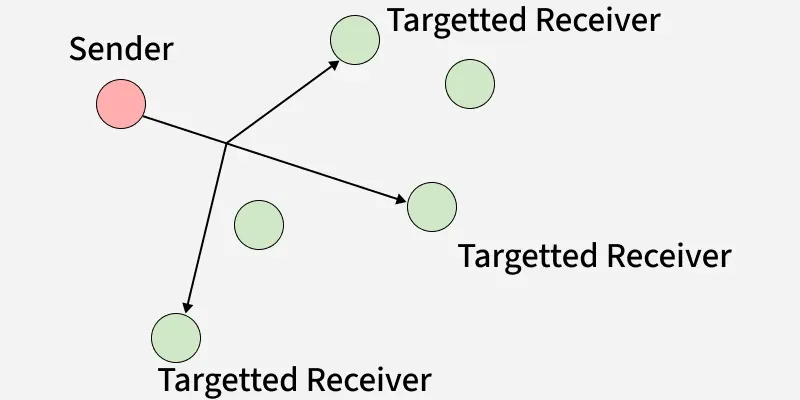
Multicasting in CN
**Note: Computer networks use multicasting to send data from one sender to a selected group of receivers simultaneously. For example, during a webinar or live video broadcast, a single transmission can be delivered to multiple participants, reducing bandwidth usage and network traffic.
Working of Multicasting
- A sender transmits a single copy of data.
- Receivers join a multicast group, and the network identifies the members of that group.
- The data is replicated only when necessary and delivered to the targeted receivers.
- Devices that are not members of the multicast group do not receive the transmission.
Types of Multicasting
**1. IP Multicasting
- Data is sent from one sender to a group of receivers identified by a multicast IP address.
- Routers replicate packets only when necessary.
- Commonly used for video streaming and online conferencing.
**2. Application-Level Multicasting
- Multicast functionality is implemented by the application rather than the network.
- End systems forward data to other participants.
- Useful when network infrastructure does not support IP multicasting.
**3. Source-Specific Multicasting (SSM)
- Receivers subscribe to data from a specific source and multicast group.
- Provides better security and efficiency.
- Commonly used for content distribution and IPTV.
**4. Any-Source Multicasting (ASM)
- Receivers can receive multicast data from any sender within the multicast group.
- Multiple sources may transmit data to the same group.
- Used in collaborative applications and group communications.
Importance of Multicasting in Networks
- **Efficient Bandwidth Utilization: A single data transmission is delivered to multiple receivers, reducing unnecessary duplicate traffic.
- **Scalability: Supports communication with a large number of receivers without significantly increasing bandwidth requirements.
- **Cost Efficiency: Reduces transmission and infrastructure costs by avoiding multiple unicast transmissions.
- **Support for Real-Time Applications: Enables efficient delivery of live audio, video, and conferencing data to multiple users simultaneously.
Protocols and Techniques Supporting Multicasting
- Internet Group Management Protocol (IGMP)
- Protocol Independent Multicast (PIM)
- Multicast Listener Discovery (MLD) for IPv6
Advantages
- **Reduced Network Traffic: Data is sent only to interested receivers, minimizing congestion.
- **Scalable Communication: Supports many receivers without a significant increase in network resources.
- **Lower Server Workload: The sender transmits a single data stream instead of multiple copies.
- **Suitable for Real-Time Applications: Ideal for live streaming, video conferencing, and IPTV services.
Applications
- IP multicasting
- Streaming media (audio/video)
- Video conferencing
- Webcasts and webinars
- IPTV services
- Online distance learning platforms
- Real-time data distribution (e.g., stock market updates)