Multipurpose Internet Mail Extension (MIME) Protocol (original) (raw)
Last Updated : 15 Oct, 2025
MIME (Multipurpose Internet Mail Extensions) is a standard designed to extend the format of email messages, allowing them to include more than just plain text. It enables the transmission of multimedia content such as images, audio, video and attachments, as well as other types of content, across email systems that traditionally only supported plain ASCII text.
- MIME allows email messages to carry diverse types of data by encoding them into a format that can safely travel over protocols like SMTP (Simple Mail Transfer Protocol) without data loss or corruption.
- It also provides metadata to help the receiving client identify and process the content correctly
**Note: In essence, MIME makes email messages more versatile and multimedia-friendly.
Characteristics of MIME
- **Text Encoding: Supports character sets beyond ASCII, such as UTF-8, enabling multilingual emails.
- **Attachments: Allows emails to include multimedia files like images, audio, video and documents.
- **Multipart Messages: Supports messages divided into multiple parts, such as plain text, HTML content and media attachments.
- **Header Fields: Introduces special headers like Content-Type, Content-Disposition and Content-Transfer-Encoding to manage content interpretation.
MIME Structure
A typical MIME email contains several key components:
- **MIME-Version: Specifies the MIME version used (commonly 1.0).
- **Content-Type: Indicates the type of content, such as
text/plain,text/html,image/jpegoraudio/mpeg. - **Content-Transfer-Encoding: Shows how content is encoded for safe transmission (e.g., base64, quoted-printable).
- **Content-Disposition: Determines whether content is inline or an attachment.
- **Content-ID: Provides a unique identifier for referencing embedded objects like inline images.
- **Content-Description: Offers a short description of the content (e.g., "PDF Document" or "Image File").
How MIME Works
When a user sends an email in a non-ASCII format:
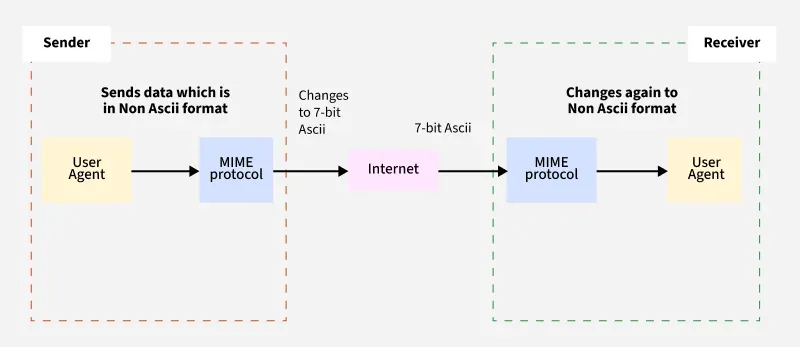
MIME working
- **Encoding: The message content is converted into a 7-bit ASCII format for safe transmission.
- **Transmission: The encoded message travels through the email system using SMTP.
- **Decoding: The receiving client decodes the message back into its original format.
- **Interpretation: The recipient’s email client reads the MIME headers to correctly display content and attachments.
**Note: MIME can also handle multipart messages, using boundary separators to distinguish between different parts of the email (e.g., text, images, attachments).
Pros of MIME
- **Supports Multiple Data Types: Text, audio, video, images and application files can all be sent via email.
- **Multilingual Compatibility: Allows emails in various languages like Hindi, French, Japanese or Chinese.
- **Rich Formatting with HTML/CSS: Enables customized emails with enhanced styling.
- **Handles Long Messages: Capable of transmitting large or lengthy content without corruption.
- **Unique Identification: Each MIME part can have a unique
Content-ID, helpful for managing embedded media.
Cons of MIME
- **Inconsistent Interpretation: The recipient’s system may not always correctly interpret MIME types.
- **Increased Overhead: Adds extra headers and encoding, increasing email size and transmission time.
- **Complexity for Users: Multiple media types and headers may be confusing for non-technical users.
- **Compatibility Issues: Older or limited email systems may not support MIME, potentially causing errors or data loss.