Network Devices (original) (raw)
Last Updated : 20 Apr, 2026
Network Devices are the physical appliances required for communication and interaction between computers on a computer network.
- Enable communication by transmitting and receiving data between devices.
- Allow devices to connect to networks efficiently and securely.
- Improve network performance by reducing congestion and managing traffic.
- Extend network coverage and solve signal loss or attenuation problems.
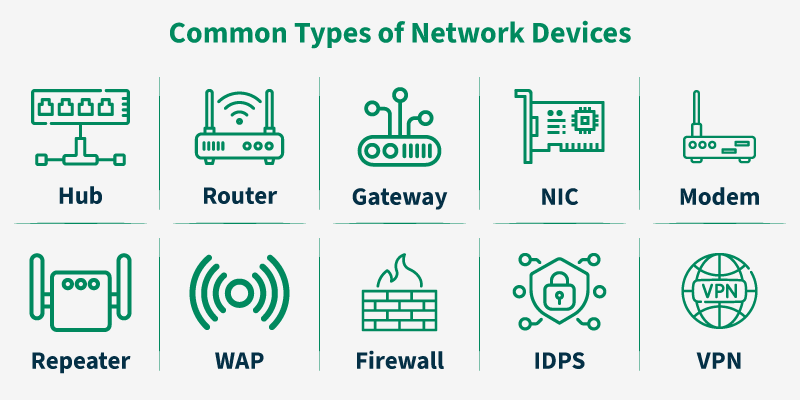
Types of Network Devices
Layer 1 Devices: Physical Layer
These devices deal with raw electrical or optical signals (bits). These devices donnot understand IP addresses or MAC addresses.
1. Hub
It is a central connection point for devices in a LAN.
- It takes an incoming signal on one port and blindly broadcasts it to all other ports without knowing the recipient.
- High network traffic collisions and security risks (everyone sees everyone's data).
- It is a obsolete device, replaced by Switches.
2. Repeater
It regenerates signals to extend the range of a network.
- It receives a weak signal (due to attenuation over long cables), amplifies it, and retransmits it.
- Extending WiFi range or Ethernet cables beyond 100 meters.
3. Modem (Modulator-Demodulator)
This bridges the gap between digital computer data and analog signals, allowing devices to connect to the internet via telephone, cable, or fiber lines.
- Connects your home network to the ISP (Internet Service Provider).
- Converts digital signals from your computer into analog signals for telephone/cable lines (Modulation) and vice-versa (Demodulation).
Layer 2 Devices: Data Link Layer
These devices work with MAC Addresses (Physical Addresses). They are smarter than hubs.
4. Switch
A switch is a high-speed networking device that connects devices (computers, printers, servers) within a Local Area Network (LAN),
- Unlike hub, switch learns the MAC address of every connected device.
- It sends data only to the specific port where the destination device is connected.
- Reduces collisions and improves security and speed.
5. Bridge
This connects two separate LAN segments to make them appear as one.
- Filters traffic based on MAC addresses to keep local traffic local, reducing congestion.
- Largely replaced by Switches (which are essentially multi-port bridges).
6. Access Point (AP)
It is a networking hardware device that allows Wi-Fi-enabled devices, such as laptops and smartphones, to connect to a wired network.
- Acts as a bridge between wired Ethernet and wireless Wi-Fi devices.
- An AP only provides Wi-Fi signal and it does not route traffic or assign IP addresses.
Layer 3 Devices: Network Layer
These devices work with IP Addresses (Logical Addresses) and connect different networks together.
7. Router
It is a networking device that connects multiple networks and directs data packets between them using IP addresses.
- It uses IP Addresses to determine the best path for data packets to travel.
- It maintains a Routing Table to make these decisions.
- Routers stop broadcast traffic, isolating networks from each other.
8. Brouter (Bridging Router)
It is a networking device combining bridge and router functions, operating at both the Data Link and Network layers of the OSI model.
- It can route known protocols (like TCP/IP).
- It bridge unknown protocols (like non-routable legacy traffic) at the same time and rarely used today.
Layer 4-7 Devices: Advanced Processing
9. Gateway
It is a hardware device or software node that acts as an entry/exit point between two distinct networks using different protocols, translating data to ensure compatibility.
- It can convert protocols, data formats, or architectures (e.g., connecting a TCP/IP network to a legacy Mainframe network).
- An Internet Gateway translates your private LAN requests into public internet requests.
10. Firewall
It is a network security system, comprising hardware, software, or both that monitors and controls incoming and outgoing network traffic based on predetermined security rules
- It is a physical appliance at the network edge.
- This is installed on a specific server or PC.
- It tracks active connections.
Hub vs. Switch vs. Router
| **Feature | **Hub | **Switch | **Router |
|---|---|---|---|
| **Layer | Layer 1 (Physical) | Layer 2 (Data Link) | Layer 3 (Network) |
| **Address Type | None (Bits) | MAC Address | IP Address |
| **Data Flow | Broadcast (to all) | Unicast (to destination) | Route (best path) |
| **Intelligence | Dumb | Smart | Smarter |
| **Used For | Obsolete | Connecting Devices (LAN) | Connecting Networks (WAN) |