Optical Communication in CCNA (original) (raw)
Last Updated : 4 Oct, 2025
Optical communication is the use of light to transmit information. This form of communication has many applications in many fields and is very useful for distance-transmitted data, which can be transmitted at a high speed by using light. It offers a cheaper way to transmit data over long distances without needing cables or radio waves. The ITU (International Telecommunications Union) often invites companies and organizations to express interest in forming an international standard regarding optical communication, but so far, there have been no official guidelines set forth. Optical communications are also used on cell phones; the technology was invented by Alexander Graham Bell in 1875. Optical communication works by sending a beam of light down a fiber optic line, which is a very thin glass thread (this is where the name “fiber optic” comes from).
Uses of Optical Communication:
Optical communications are used for broadband internet access, cable television, and telephone communication between countries. It is also used for local area networks (LANs). Optical transmission can be either uni-directional or bidirectional. Uni-directional transmission can be like fiber to the home (FTTH), fiber to the building (FTTB), fiber to the curb (FTTC), or fiber to the business office (FTTB). These transmit information from one point to another with no return signal. The bidirectional transmission uses the return signal to transmit information in reverse. For instance, Fiber to the Building (FTTB) is used to send traffic from a network to an individual building, whereas Fiber to the curb (FTTC) is used to send traffic from an individual building to a network.
Applications of Optical Communication:
- Optical communication deals with energy and light. Energy is defined as “the capacity of matter” to do work and includes both potential energy (heat), kinetic energy (movement), and electromagnetic radiation energy (light). The word “optical” referring to light comes from the Greek word “optikos”, meaning “pertaining or belonging to sight.” Light itself is one of the most important forms of electromagnetic radiation. Light is used for a variety of purposes, such as the illumination of books or elevators. Light also has uses that are less obvious; an example of this is the fact that light reveals the presence of something hidden (a “shadow” when light reaches its destination).
- Light is usually described in terms of its wavelength. Wavelength can be expressed with a unit of distance, such as meters or kilometers, or it can be expressed in absolute units. For most purposes, we will use a unit called nanometers to express wavelength, because it consists of billionths (10 -9)of a meter. The visible spectrum consists mostly of longer wavelengths as all human eyes can see. The visible spectrum ranges from 740 nm (red) to 380 nm (violet). Beyond the visible spectrum is ultraviolet light and then infrared. Infrared has a different function than ultraviolet and visible light because it is not visible to the human eye; it is used for night vision goggles and remote controls, among other uses.
- The amount of energy that a single photon contains depends on its wavelength. The shorter the wavelength, the more energy in each photon, so shorter wavelength photons are more energetic than longer ones. Energy, like all forms of radiation, travels in waves. When a wave encounters an obstacle, such as glass, it is absorbed or reflected. Different wavelengths of light have different amounts of energy absorbed. In the case of visible light, the amount of energy absorbed is very small because the wavelengths in the visible spectrum are relatively short compared to other wavelengths that exist.
- The study of optical communication involves more than looking at and manipulating optics; it also includes some other areas of science and technology. A device that helps determine the distance between two points can be considered part of an “instrument” for measurement, which is a physical object used to measure a property.
- A link is a path that is used to transfer data from one station to the next. If something happens to that path, it can cause the data you are trying to transmit to become corrupted and unusable. When a link becomes unavailable, your computer will have no other way to send the packets of data that it has for you. This causes them to be discarded by your computer's operating system.
Structure:
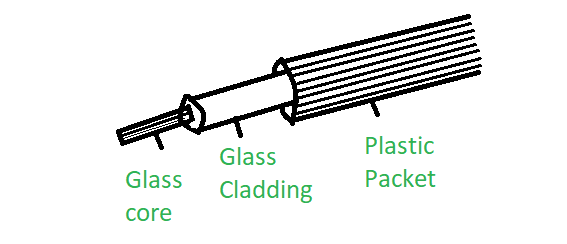
Optical fiber is made from a glass-like substance called “pure silica”, an amorphous solid which is essentially transparent on its own and which also does not transmit electricity well enough for use as an electrical wire. To make it useful for data communication, a transparent material is needed to be placed inside the “pure silica” core. That material turns out to be a gas called “argon”. And we know that optical fibers are used in data communication because they have the ability to carry pulses of light, or photons, over long distances. Optical fiber consists of inner and outer layers (core and cladding), both of which are made from pure silica. They differ in terms of density with the core being less dense than the cladding. The inner layer that is less dense allows light to pass through it easier than the secondary layer that is denser due to the fact that it reflects light.