OSI Model Full Form Open System Interconnection (original) (raw)
Last Updated : 31 Jul, 2025
OSI stands for Open Systems Interconnection. It is a conceptual framework developed by the International Organization for Standardization (ISO) that defines how computers communicate over a network.
It consists of seven layers, each with specific functions and protocols. The purpose of the OSI model is to show how communication between different systems can be facilitated without modifying the logic of the underlying hardware and software
Seven Layers of OSI Model
The OSI model can be considered a universal language for computer networking. It is based on the concept of divide and conquer, it splits up the communication system into 7 abstract layers, and the layer is stacked upon the previous layer.
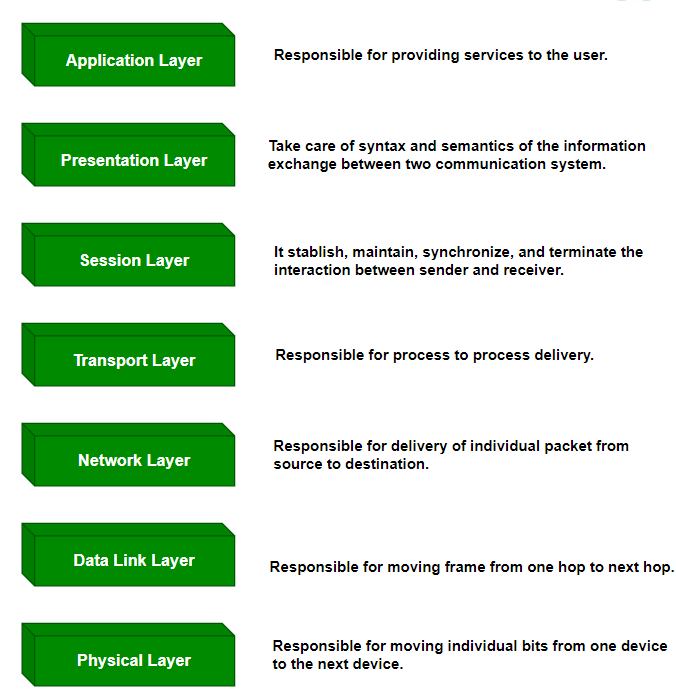
Seven Layers of OSI Model
Function of Seven Layers in OSI Model
- **Physical Layer: First layer is the physical layer, which deals with the physical aspects (such as cables, connectors, and signaling) of transmitting data between two devices. This layer define transmission mode also whether it is simplex, half duplex or full duplex. It define topology configuration.
- **Data Link Layer: The second layer is the data link layer, which is responsible for establishing and maintaining communication between two devices on the same network. Data link layer is responsible for moving frames from one hope to next hope.
- **Network Layer: The third layer is the network layer, which handles the routing of data between networks. Network layer is responsible for the delivery of individual packet from source to destination.
- **Transport Layer: The fourth layer is the transport layer, which ensures reliable transmission of data between two devices. Transport layer is responsible for process to process delivery. A process is an application program running on a host.
- **Session Layer: The fifth layer is the session layer it is also known as network dialog controller, which establishes and manages sessions between applications.
- **Presentation Layer: The sixth layer is the presentation layer, which deals with the syntax and semantics of the data being transmitted.
- **Application Layer: Seventh layer is the application layer, which provides services to applications for network communication.
**How Data Flows Through the OSI Model?
The OSI Model (Open Systems Interconnection) is like a roadmap for how data travels from one device to another over a network. Here each layer handling a specific job.
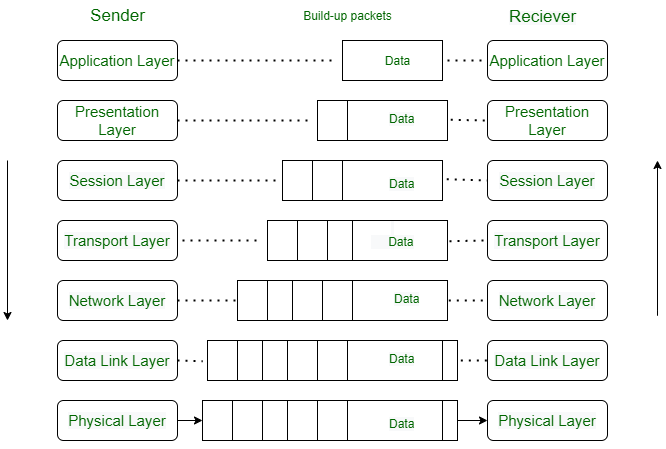
Data Flow in OSI Model
- **Physical Layer: Sends raw data (like bits, which are 1s and 0s) through cables or wireless signals.
- **Data Link Layer: Packages the raw data into chunks called frames and checks for any errors.
- **Network Layer: Finds the best route for the data to travel and adds addresses (like IP addresses) so it knows where to go.
- **Transport Layer: Breaks the data into smaller pieces (called segments) and ensures everything arrives correctly and in order.
- **Session Layer: Manages the conversation between two devices, making sure they stay connected during the data exchange.
- **Presentation Layer: Translates the data into a format that the receiving device can understand, like converting text or images.
- **Application Layer: This is where the user interacts with the data through apps like web browsers, email, or games.
Why Does The OSI Model Matter?
The OSI model is important because it helps network designers and administrators understand how different protocols and technologies work together to provide network communication. It also helps in troubleshooting network issues by isolating problems to specific layers. This makes sure that different devices and systems can easily talk to each other, no matter what kind of hardware or software they use.
**What is an OSI Model Used for?
Here are some of the key uses of the OSI model:
- **Facilitates Communication: The OSI model defines a clear and standardized set of protocols for communication between different devices on a network. This ensures that devices from different manufacturers can communicate with each other seamlessly.
- **Helps in Network Design: The OSI model helps network designers and administrators to understand how different protocols and technologies work together to provide network communication. This understanding is essential when designing new networks or upgrading existing ones.
- **Simplifies Troubleshooting: If there is a problem in the network, the OSI model helps isolate the problem to a specific layer. This makes it easier for network administrators to troubleshoot and fix the issue quickly.
- **Encourages Interoperability: The OSI model promotes interoperability between different devices and software from different vendors. This means that devices can work together regardless of their origin.
- **Provides a Common Language: The OSI model provides a common language and framework for network communication. This helps network administrators and engineers to communicate effectively about network issues and solutions.
**Key Issues of the OSI Model
Here are some of the key issues of the OSI model:
- **Too Complex: The OSI model has seven layers, which can make it difficult for some people to understand. This complexity can make it hard for network administrators to troubleshoot issues, as it can be challenging to determine which layer is causing the problem.
- **Not Always Practical: The OSI model is a theoretical model that is not always practical in real-world network communication. In practice, some layers may be combined or omitted altogether.
- **Not Widely Adopted: While the OSI model is widely used as a reference model, it is not always used in practice. Instead, many networks use a simplified model, such as the TCP/IP model.
- **Limited Scope: The OSI model is focused solely on network communication and does not cover other aspects of computer systems, such as storage or processing.
- **Limited Flexibility: The OSI model is a fixed model that does not allow for much flexibility in terms of adapting to new technologies or protocols.
History of the OSI Model
In the early days of computer networking (1960s-1970s), different companies made their own systems that couldn’t easily talk to each other. This made sharing information across networks very difficult. As the internet and networking grew, people needed a common set of rules so that devices from different companies (like IBM, Apple, or others) could communicate.
The International Organization for Standardization (ISO) saw this problem and wanted to create a universal way to connect systems worldwide. In 1984, the OSI Model was developed by ISO. It was designed to standardize the way data is transmitted between devices. The model broke the communication process into 7 layers, making it easier to understand and fix problems in networks.
Characteristics of the OSI Model
- It is the conceptual model that enables the diverse communication systems to communicate using the network.
- It was developed by the ISO (International Organization for Standardization) in 1984.
- It acts as an architecture for inter-computer communications.
- It is divided into 7 layers and each layer performs a particular task.
- Each layer is independent of the other and can perform its operations independently.
OSI Model vs TCP/IP Model
The **OSI (Open Systems Interconnection) Model and the **TCP/IP (Transmission Control Protocol/Internet Protocol) Model are both ways to explain how data travels across networks. They both help us understand how computers communicate, but they are built differently and serve different purposes. Knowing the differences between these models is important for anyone studying or working with computer networks.
The OSI model has 7 layers, providing a detailed and theoretical framework for how data moves through a network, while the TCP/IP model has 4 layers and is a practical model used on the internet. OSI separates functions more specifically into layers, while TCP/IP combines some layers for simplicity. OSI is mostly used for teaching, and TCP/IP is used in real-world networks, particularly for internet communication. While OSI is protocol-independent, TCP/IP is designed around specific protocols like TCP and IP, making it more practical for modern networks. For more detail reference article difference between OSI model and TCP/IP model.